Michigan will pay to put a ramp on your house, widen your doorways, or rebuild your bathroom through its Medicaid waiver — but only after you have tried to get someone else to pay for it first, and only if you can document that you tried.
That rule is written into the program, it is enforced on every single modification, and almost nobody mentions it. It is also the single most useful thing to know before you call, because doing it in the wrong order can cost you months. This page covers what MI Choice actually pays for, what it flatly refuses to pay for, the funding-of-last-resort rule and how to satisfy it, what happens if you rent, how the waiting list is prioritized, and where the door is.
The amount and the period: Michigan publishes neither
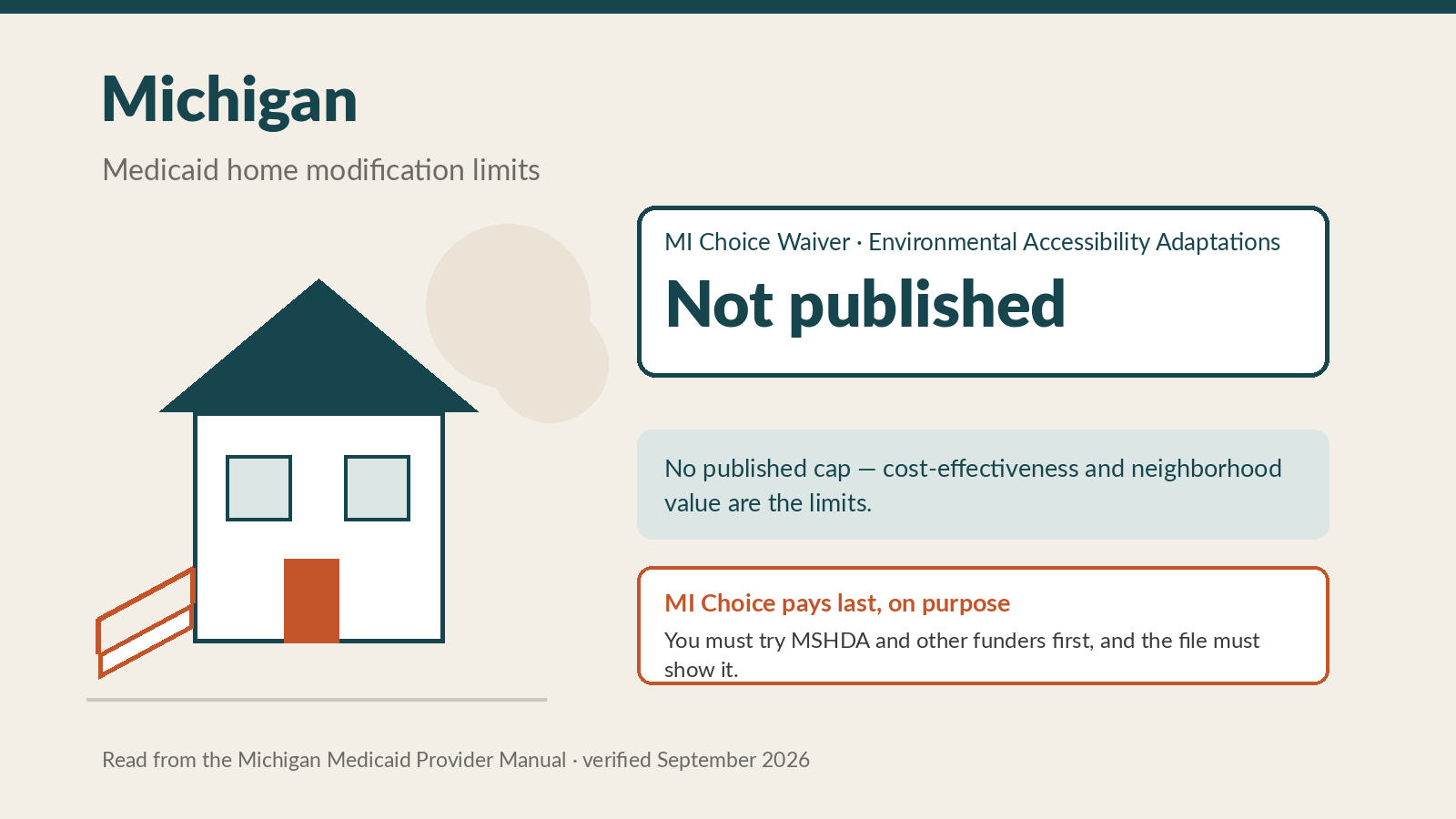
Michigan’s home modification benefit is called Environmental Accessibility Adaptations (EAA), and it lives inside the MI Choice Waiver. The MI Choice chapter of the Michigan Medicaid Provider Manual defines the service across several pages — what qualifies, what is excluded, who may perform the work, what the case record must contain — and at no point attaches a dollar cap, an annual limit, or a lifetime limit to it.
So the honest answer is Not published. Michigan is not being evasive; it has chosen a different kind of control than a number. Two limits do the work a cap would do elsewhere:
- The cost-effectiveness test. “The case record must contain documented evidence that the adaptation is the most cost-effective and reasonable alternative to meet the participant’s need(s).” The manual names its own examples of a reasonable alternative: “changing the purpose, use or function of a room within the home or finding alternative housing.” In other words, before the state buys you a stair lift, someone will ask whether the dining room could become a bedroom. You have to agree to the alternative before modifications start.
- The neighborhood-value test. “The adaptation cannot result in valuation of the structure significantly above comparable neighborhood real estate values.” A modest house in a modest area has a ceiling, and it is set by the block, not by a fee schedule.
That is a real constraint, but it is a different one from “you get $10,000.” If someone quotes you a Michigan EAA dollar limit, ask which document it came from.
The rule that changes the order you should do things in
This is the part that matters most, and it is unusual enough that it deserves its own heading.
“The participant, with the direct assistance of the waiver agency’s supports coordinator when necessary, must make a reasonable effort to access all available funding sources such as housing commission grants, Michigan State Housing Development Authority (MSHDA), and community development block grants. Before approving MI Choice payment for each modification or adaptation, each waiver agency must determine whether a participant is eligible to receive services through a program supported by other funding sources. The participant’s case record must include evidence of efforts to apply for alternative funding sources and the acceptances or denials of these funding sources.”
Read that carefully. Three separate obligations are stacked in one paragraph:
- You must make a reasonable effort to access other funding.
- The waiver agency must check your eligibility for other funding — before approving payment, for each modification, not once at intake.
- The file must contain evidence of the applications and their acceptances or denials.
Earlier versions of this chapter said it more bluntly: “The MI Choice program is a funding source of last resort.” The current text replaces the slogan with the machinery.
What this means practically. If you wait for your supports coordinator to tell you to apply to MSHDA or your local housing commission, you have already lost the time it takes those programs to answer. Start those applications early — even the denials are useful, because a denial letter in the file is exactly what the rule asks for. The three sources named by name in the manual are:
- Housing commission grants (your local public housing authority)
- The Michigan State Housing Development Authority (MSHDA)
- Community development block grants (administered locally)
Note that the manual says “such as” — it is a non-exhaustive list. A weatherization program, a veterans’ benefit, or a nonprofit ramp program can all belong in that file too.
What EAA covers
The service definition: EAA includes “physical adaptations to the home required by the participant’s person-centered service plan that are necessary to ensure the health and welfare of the participant or that enable the participant to function with greater independence in the home, without which the participant would require institutionalization.”
The manual then lists what adaptations may include:
- Installation of ramps and grab bars
- Widening of doorways
- Modification of bathroom facilities
- Modification of kitchen facilities
- Installation of specialized electrical and plumbing systems necessary to accommodate the medical equipment and supplies necessary for the participant’s welfare
- Environmental control devices that replace the need for paid staff and increase independence, such as automatic door openers
Two additional provisions are easy to miss and worth money:
Assessments and training are included in the cost of the service. If someone has to evaluate the house or teach you to use what gets installed, that is not a separate bill you have to fight for.
The agency may buy materials directly. “The waiver agency may purchase supplies for the modification or adaptation, such as grab bars, lumber, or plumbing supplies, and provide them to the direct service provider at their discretion.” Michigan also allows MI Choice funds to be used “to purchase materials and labor used to complete the modifications to prevent or remedy a sub-standard condition or safety hazard.”
What Michigan will not pay for
The exclusions are specific, and they are the source of most disappointment. Excluded are adaptations that are “of general utility,” that are “standard housing obligations of the participant or homeowner,” or that are “not of direct medical or remedial benefit.” The manual then names examples:
- Carpeting
- Roof repair
- Sidewalks and driveways
- Heating
- Central air conditioning (except under exceptions noted in the service definition)
- Garages and raised garage doors
- Storage and organizers
- Hot tubs, whirlpool tubs, and swimming pools
- Landscaping
- General home repairs
Three more limits sit alongside that list:
- Code violations are yours. Environmental adaptations “shall exclude costs for improvements exclusively required to meet applicable state or local building codes,” and electrical upgrades to support equipment “are not intended to correct existing code violations.” At the same time, the infrastructure involved in the funded work — electrical, plumbing, well or septic, foundation, heating and cooling, smoke detectors, roof — “must be in compliance with any applicable local codes.” If your panel is not to code, MI Choice will not fix the panel, but the ramp may stall until someone does.
- The structure has to be able to take it. “The existing structure must have the capability to accept and support the proposed changes.”
- New construction and new purchases are treated carefully. MI Choice does not cover general construction costs in a new home or additions to a home purchased after enrollment. If you build or buy while on the waiver, making the home meet basic needs is your responsibility. But MI Choice funds “may be authorized to assist with the adaptations noted above… for a home recently purchased,” and where a home under construction needs a special adaptation such as a roll-in shower, the program may fund “the difference between the standard fixture and the modification required to accommodate the participant’s need.” That difference-in-cost approach is worth asking about by name.
If you rent, Michigan is one of the states where this still works
Renters are shut out in several states. Michigan is not one of them:
“Adaptations may be made to rental properties when the lease or rental agreement does not indicate that the landowner is responsible for such adaptations and the landowner agrees to the adaptation in writing. A written agreement between the landowner, the participant, and the waiver agency must specify any requirements for restoration of the property to its original condition if the occupant moves.”
Two conditions, both manageable: the lease must not already put the obligation on the landlord, and the landlord must agree in writing, in a three-way agreement that spells out restoration. Contrast this with Georgia, whose manual says flatly that Medicaid does not reimburse for modification to rental property, with no landlord-consent mechanism at all. Same federal program, opposite answer, purely because of the state’s own policy text.
Who gets in: Michigan covers older adults, and that is not universal
MI Choice eligibility, verbatim: the program “is available to persons who are either elderly (age 65 or older) or adults with disabilities age 18 or older” who also meet these criteria:
- Establish financial eligibility for Medicaid;
- Be categorically eligible for Medicaid as aged or disabled;
- Meet functional eligibility through the online Michigan Medicaid Nursing Facility Level of Care Determination (LOCD) in CHAMPS;
- Require at least two waiver services, one of which must be Supports Coordination, with needs that cannot be fully met by State Plan or other services.
That first line is worth pausing on if you have been reading about other states. Georgia’s home modification benefit sits in a waiver that stops accepting applicants at 65; Illinois publishes a $25,000 cap that belongs to a program serving people under 60. Michigan names people 65 and older in the first sentence of its eligibility section, and the modification benefit is in that same waiver. For an older adult, Michigan’s “Not published” is a far more useful answer than some states’ published number.
On money: MI Choice uses “a special income level up to 300% of the Supplemental Security Income (SSI) Federal Benefit Rate” under 42 CFR §435.217 — a more generous standard than basic Medicaid. One trap is stated explicitly: “participants are not allowed to spend-down to the income limit to become financially eligible for MI Choice.” If you are over the limit, spending down is not the route in.
One more structural rule: you cannot be in MI Choice and a Medicaid Health Plan, PACE, MI Health Link, another §1915(c) waiver, a nursing facility, or Adult Home Help at the same time. Everyone gets a Freedom of Choice form at the end of the LOCD process precisely because it is an either/or decision.
The waiting list, honestly
Michigan does not publish a current statewide MI Choice waiting list count or an average wait, and we found none in a state source — on that question the answer is Not published. What the state does publish is unusually complete, and more actionable than a number.
Capacity is real and finite: “MI Choice capacity is limited to a maximum number of participants served at any point in the fiscal year as specified in the approved waiver application,” with each waiver agency allocated a specific number of slots per fiscal year. When an agency is at capacity, anyone screened must go on the list. The manual is emphatic that the door stays open: “The enrollment process for the MI Choice program is not ever actually or constructively closed.”
Your position is by priority category first, then date. The four categories, in the state’s order:
- State Plan Private Duty Nursing age expirations — people aging out of PDN coverage who still need it.
- Nursing facility transitions — residents who want to come home and would otherwise qualify. Priority is not given where State Plan services alone could meet the need.
- Adult Protective Services cases and diversions — an active APS case earns priority where MI Choice can address the critical need. “Diversion” priority goes to people in the community or leaving acute care who are at imminent risk of nursing facility admission, measured by the Imminent Risk Assessment (IRA). The IRA must be administered in person — “the design of the tool makes telephone contact insufficient” — the agency must request diversion status from MDHHS, and MDHHS gives final approval.
- Chronological order by service request date — everyone else.
Two things follow from this that are worth acting on. First, if your situation deteriorates, you can ask for a new IRA: “Applicants may request that a subsequent IRA be performed upon a change of condition or circumstance.” A fall, a hospital stay, a caregiver who can no longer cope — those are reasons to call, not just to worry. Second, the date that fixes your place in line is the date of the intake screening contact, so make that call early even if you are not sure you qualify.
Staying on the list. Agencies must call every applicant “at least once every 90 days,” more often for people in crisis or at risk. You can be removed for the obvious reasons — enrolled elsewhere, moved out of state, no longer interested — and for one that catches people out: being unreachable. Removal for non-contact requires all of the following first: at least three calls on varied days and times; if a message was left, no callback within 10 business days; and a letter giving 12 business days to respond that went unanswered or came back undelivered. An Adequate Action Notice must be sent no later than the date of removal.
The practical version: answer calls from your waiver agency, return voicemails within ten business days, open the mail, and keep your phone number current with them.
How to apply
MI Choice is not administered from Lansing. MDHHS contracts with regional waiver agencies — area agencies on aging and other organizations — and you apply to the one that serves your county. MDHHS publishes a Waiver Agency Region Map and a List of Waiver Agents by Region on its MI Choice page; find your region on the map, then use the list to get the agency, address and phone number. As an example of what you will find there, Region 1A (Detroit, Hamtramck, Highland Park, the Grosse Pointes, Harper Woods) is served by the Detroit Area Agency on Aging, 1333 Brewery Park Blvd., Suite 200, Detroit, MI 48207, phone 313-446-4444.
What happens when you call: if the agency is at capacity, you are screened by telephone or in person using the MI Choice Intake Guidelines, and the date of that contact fixes your chronological place on the list. Applicants who screen as Level C, D, D1 or E are considered potentially eligible and go on the agency’s list. If you are deaf, hard of hearing, or otherwise cannot do a phone interview, the agency must use your preferred means of communication, including an interpreter or assistive technology. Nursing facility residents are interviewed in the facility rather than by phone, and the date of that introductory visit serves the same purpose.
If the screening suggests you are ineligible, you can still request a face-to-face evaluation, and it must happen “within 10 business days of the date the MI Choice Intake Guidelines was administered.” Any apparent ineligibility triggers an adverse action notice with appeal rights. And if you look functionally eligible but not yet financially eligible, the agency must still place you on the list if you are expected to become financially eligible within 60 days.
Once enrolled, assessment is done in person by a team that includes at minimum a registered nurse and a social worker, both licensed in Michigan. Reassessment happens in person 90 days after the initial assessment, annually thereafter, and sooner on significant change.
Frequently asked questions
How much will Michigan Medicaid pay for a wheelchair ramp?
Michigan does not publish a dollar cap for Environmental Accessibility Adaptations. What limits the work is the requirement that the adaptation be the most cost-effective and reasonable alternative, and the rule that it cannot raise the home’s value significantly above comparable neighborhood real estate values.
Do I have to apply for other grants first?
Effectively, yes. You must make a reasonable effort to access other funding sources — the manual names housing commission grants, MSHDA, and community development block grants — and the waiver agency must determine, before approving payment for each modification, whether you are eligible for another program. Your case record has to contain evidence of the applications and their acceptances or denials. Starting those applications early is the single best thing you can do to speed this up.
I am 74. Does MI Choice cover me?
Age is not a barrier. MI Choice is available to people who are 65 or older, or adults with disabilities 18 or older, provided the financial, functional and service-need criteria are met. This is not true in every state.
Can Michigan Medicaid modify an apartment I rent?
Yes, under conditions. The lease must not make the landlord responsible for such adaptations, the landlord must agree in writing, and a three-way written agreement between landlord, participant and waiver agency must specify any restoration requirements if you move out.
Will it pay to fix my roof or replace my furnace?
No. Roof repair, heating, carpeting, sidewalks and driveways, garages, storage, landscaping and general home repairs are all listed as exclusions, as things of general utility or standard housing obligations rather than direct medical or remedial benefit.
How long is the MI Choice waiting list?
Michigan does not publish a current count or an average wait. It does publish how the list is ordered: four priority categories first — private duty nursing age expirations, nursing facility transitions, APS cases and imminent-risk diversions, then everyone else by request date.
Is there a way to move up the list?
Not by asking, but the priority categories are real. If you are at imminent risk of nursing facility admission, an in-person Imminent Risk Assessment can qualify you for diversion priority, and you may request a new IRA when your condition or circumstances change. If the person is currently in a nursing facility and wants to come home, that is its own priority category.
Primary sources and last verification date
Every rule and quotation on this page was read directly from a Michigan state source on 16 September 2026. Where Michigan publishes nothing, we say so rather than fill the gap.
- MDHHS Bulletin MSA 21-48, Revisions to the MI Choice Waiver Chapter of the Medicaid Provider Manual — issued 2 December 2021, effective 1 January 2022, with the revised chapter attached (chapter pages marked “Version MI Choice Waiver, Date: January 2022”). Sections cited: 2 (eligibility), 2.1 (financial eligibility), 3.3 (enrollment capacity), 3.4–3.4.B (waiting lists, priority categories, removal), 4.1.G (Environmental Accessibility Adaptations). michigan.gov
- MDHHS Bulletin MSA 19-17 — issued 1 November 2019, effective 1 December 2019, the previous revision of the same chapter, used here to confirm what changed. michigan.gov
- MDHHS, MI Choice Waiver Program — the covered service list, the Waiver Agency Region Map, and the List of Waiver Agents by Region with addresses and phone numbers. michigan.gov
A note on versions, because it matters here. The MI Choice chapter is revised by bulletin and then folded into the Medicaid Provider Manual, whose current edition is dated 1 July 2026. We were not able to pull the MI Choice chapter out of that consolidated manual in this review, so every quotation above is taken verbatim from the most recent standalone revision we could verify, MSA 21-48. Comparing it against MSA 19-17 shows the EAA section has been expanded rather than relaxed — the 2022 text added the documentation requirement for every approved adaptation, the materials-and-labor provision, the licensing requirement for EAA providers, and the per-modification check of other funding sources. If a decision turns on an exact sentence, ask your waiver agency to confirm it against the current manual.
How Michigan compares
- On transparency, Michigan is in the large group that covers the service without publishing an amount. See our 50-state table of Medicaid home modification limits for which states print a number and which do not.
- On age, Michigan is on the good side of the line: the same waiver that covers modifications explicitly covers people 65 and older.
- On rentals, Michigan permits them with a written landlord agreement — the opposite of Georgia.
- On sequencing, Michigan is stricter than most. Few states require the agency to check your eligibility for other funding before approving each individual modification.
For the national picture of what Medicaid will and will not pay for, start with does Medicaid pay for home modifications.
What to do this week
- Find your waiver agency on the Region Map and call for an intake screening. The date of that contact sets your place in line, so do it before you have every document ready.
- Start the other funding applications now — MSHDA, your local housing commission, community development block grants. Keep every acceptance and denial letter; the denials are the evidence the rule asks for.
- If the person is in a nursing facility, say so in the first sentence. Nursing facility transition is its own priority category.
- If they are in the community but a fall or a hospital stay has changed things, ask about the Imminent Risk Assessment by name. It has to be done in person, and it is the route to diversion priority.
- Answer the phone. Three unreturned calls, a voicemail unreturned for 10 business days, and an unanswered letter are enough to remove you from the waiting list.
Leave a Reply