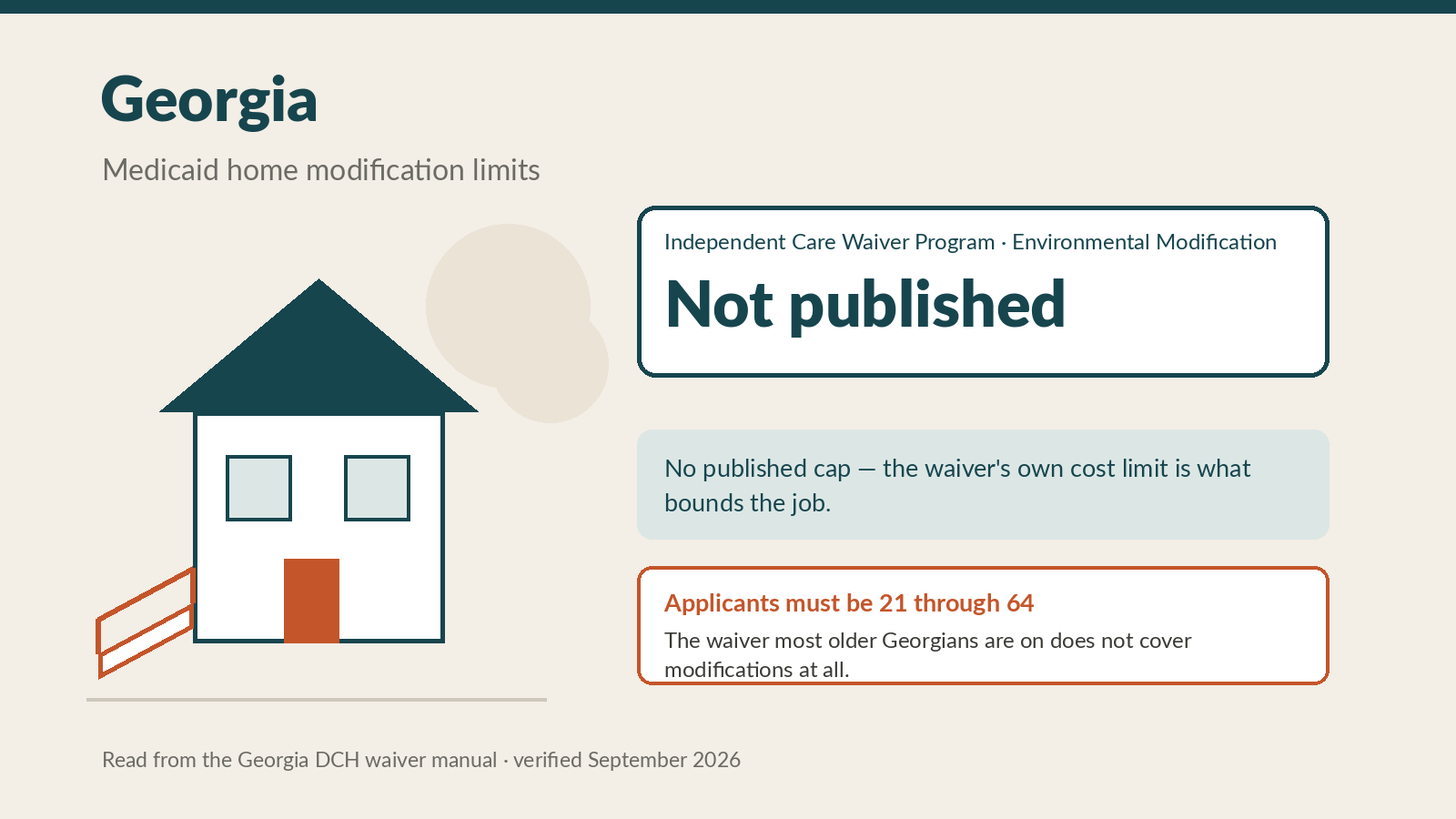
If you are looking for Medicaid money to widen a doorway, build a ramp, or put a roll-in shower into a Georgia home, there is one thing you need to know before anything else, because it decides whether the rest of this page applies to you at all: Georgia’s Medicaid program pays for home modifications through exactly one waiver, and that waiver only takes applicants between the ages of 21 and 64.
That is not a technicality. It is the single most consequential fact about home modification funding in Georgia, and it is the reason so many families call the state, get transferred three times, and hang up without an answer. This page walks through what the Independent Care Waiver Program (ICWP) actually covers, what Georgia publishes and what it deliberately does not, where the door is, what the wait really looks like, and — if you are 65 or older — which completely different program you should be calling instead.
The amount and the period: Georgia does not publish one
Many states print a hard number. Texas publishes $7,500. Illinois publishes $25,000 over five years. Georgia publishes neither an amount nor a period for Environmental Modification services.
We went through the current public version of the Georgia Department of Community Health’s Part II Policies and Procedures for Independent Care Waiver Services — 262 pages — looking specifically for a dollar cap, a lifetime limit, or a renewal period attached to Environmental Modification. There is none in the manual. The service is defined, the eligibility rules are spelled out in detail, the provider conditions run for pages, and the dollar figure simply is not there.
So the honest answer for Georgia is Not published. Anyone quoting you a specific Georgia Medicaid home modification cap is quoting something other than a Georgia state source, and you should ask them where it came from.
What Georgia does bound is the whole plan. Section 701.6 requires that an applicant “have a plan of care within the cost limit of the waiver,” and Section 703.5 refers to serving people “under the nursing home cost limit of the waiver.” In plain terms: your modification is not measured against a modification-specific cap, it is measured against what all of your waiver services cost together, tested against what a nursing facility would have cost. A large ramp competes for room in that budget with your personal support hours. That is a very different planning problem from a state with a standalone $10,000 modification line, and it is worth raising with your case manager early rather than late.
The 21-to-64 rule, and who this money is actually for
Section 701.2 of the ICWP manual is unambiguous. Eligible persons are those who, at the time of application:
“are 21 through 64 years of age when services begin. Any member admitted to the program prior to the 65th birthday may remain in the program until death or termination from the program”
The Department of Community Health says the same thing on its public Waiver Programs page: the ICWP “offers services to a limited number of adults who apply between the ages of 21 and 64,” and the services it lists include, explicitly, “home modifications.”
Read those two sentences together and the structure becomes clear:
- If you apply at 63 and get in, you keep the benefit for the rest of your life. Turning 65 does not push you out.
- If you apply at 65, this program is closed to you — no matter how severe the need, no matter how obviously a ramp would keep you out of a nursing home.
Section 701.3 adds a second filter that catches people by surprise. The applicant must have “severe physical impairment and/or traumatic brain injury that substantially limit one or more activities of daily living.” And then, in the same section: “Mental disorders, developmental delays, and intellectual delays cannot be used to meet the level of care for the ICWP waiver.” A person with both physical and cognitive impairment must qualify on the physical impairment or the TBI alone.
This matters enormously for the most common reason families go looking for grab bars in the first place — a parent with dementia who has started falling. Under ICWP rules, the dementia does not count toward the level of care. The physical limitation has to stand on its own.
If you are reading this for a parent in their seventies or eighties, skip ahead to the section on what 60-plus Georgians actually use. It is a different agency, a different funding stream, and a different phone number.
What Environmental Modification covers — and the one rule that stops most renters
Section 601.6.7 defines the service:
“Environmental Modification services provide physical adaptations to the home, specified in the Individual Plan of Care, which are necessary to ensure the health, welfare and safety of the members, or which enable the member to function with greater independence in the home and, without which, the member could require institutionalization. Medicaid does not reimburse for modification to rental property.”
Three things are doing real work in that paragraph.
First, “specified in the Individual Plan of Care.” A modification that is not written into your plan of care is not a covered service. Under Section 703.6 the case manager has thirty days from selection to develop that plan with you, and the plan is reviewed and updated quarterly and at least every twelve months. If the ramp is not in the plan, it does not exist as far as billing is concerned. Get it written in at the first plan meeting, not at the fourth.
Second, the institutional-diversion test. The wording is “without which, the member could require institutionalization.” That is the frame your justification should be written in. Not “it would be more comfortable.” Not “the bathroom is dated.” The case for a Georgia environmental modification is a case about what happens without it.
Third — and this one ends the conversation for a lot of families — “Medicaid does not reimburse for modification to rental property.” This is stricter than several neighboring states. Illinois, for example, allows modifications on property the member does not own if the landlord signs a written agreement acknowledging the work cannot be reversed. Georgia’s manual has no such consent mechanism attached to this sentence. If the member lives in a rented house or apartment, ICWP environmental modification is not the tool.
Section 601.6.10 covers a related but separate service, Specialized Medical Equipment and Supplies — “devices, controls, or appliances, specified in the Individual Plan of Care, which enable members to increase their abilities to perform activities of daily living.” That is the line item for equipment that is installed rather than built. The manual adds one specific exclusion worth knowing: “Ceiling track is not covered by Medicaid equipment.” If a ceiling lift is what you were counting on, plan around that sentence.
Georgia’s other Medicaid waiver — the one most seniors are actually on — does not cover this at all
This is the part that sends people in circles, so it is worth being blunt about.
Most older Georgians who receive Medicaid home and community-based services are in the Elderly and Disabled Waiver Program (EDWP), which runs under two names: CCSP (Community Care Services Program) and SOURCE. DCH’s own EDWP fact sheet lists every service in the program:
- Adult Day Health
- Alternative Living Services
- Emergency Response Services
- Home-Delivered Services
- Personal Support Services
- Consumer-Directed Personal Support Services
- Structured Family Caregiver
- Out-of-Home Respite Care
- Home Delivered Meals
- Case Management (Enhanced and Traditional)
Home modification is not on that list. It is not there under another name either — there is no environmental modification, no accessibility adaptation, no home safety line item. DCH’s Waiver Programs page describes CCSP and SOURCE the same way, listing case management, adult day care, alternative living services, personal care, home-delivered meals, and respite care for family caregivers, with no modification service.
So a Georgian on CCSP or SOURCE who asks their care coordinator about a ramp is asking for something their waiver does not contain. The coordinator is not being obstructive. The service genuinely is not in the package.
This is the same trap we documented in Illinois, where the published $25,000 cap belongs to a program that only serves people under 60. Two states, two different program architectures, the same outcome: the headline modification benefit sits in the disability-side waiver, and the aging-side waiver that most seniors are enrolled in does not include it.
If you are 60 or older in Georgia, here is the door that is actually open
Georgia does fund home modification for older adults — just not through Medicaid.
The Georgia Division of Aging Services (DAS) runs a non-Medicaid Home and Community Based Services program, mandated through the federal Older Americans Act. DAS describes it as serving “individuals age 60 and older and their caregivers,” administered by contract with 12 Area Agencies on Aging (AAAs) that regionally manage the program and consumer case management.
Under that program’s In-Home Services category, DAS lists, by name:
- Homemaker Services
- Personal Care Services
- Chore Services
- Assistive Technology
- Home Modification and Repair
- Telephone Reassurance
- Friendly Visiting
That is the realistic path for a 70-year-old Georgian who needs a ramp. Two honest caveats come with it. It is not an entitlement — Older Americans Act money is a fixed allocation, not a benefit you qualify for and then receive. And DAS publishes no statewide dollar amount for Home Modification and Repair, because the funding is allocated and administered regionally. What is available in the Atlanta Regional Commission’s territory is not necessarily what is available in Coastal Georgia. The only way to get a number is to ask your AAA.
If you want the Medicaid side as well — personal support, meals, adult day health — the same AAA is also the front door to EDWP. DCH’s fact sheet is explicit: “The AAA serves as the EDWP’s entry point, determines both consumer eligibility and the type of services needed.”
How to apply: the actual doors, by name
For ICWP (ages 21–64, the waiver that covers modifications): Section 702.2 of the manual says to contact Alliant Health Solutions for application information. You can call, write, or email to request a participant application by mail, or print it from the appendixes of the manual itself. A completed application can be mailed, emailed, or faxed back.
- Alliant Health Solutions, P.O. Box 105406, Atlanta, Georgia 30348
- Telephone: 1-888-669-7195
- Email: [email protected]
- Local fax: 678-527-3001 · Toll-free fax: 1-800-716-5358
DCH’s public Waiver Programs page lists a second number for ICWP applications — Alliant Georgia Medical Care Foundation at 800-982-0411 or 888-669-7195. Both trace back to the same contractor.
For EDWP (CCSP/SOURCE) and for non-Medicaid home modification help at 60+: contact your Area Agency on Aging, or the Division of Aging Services toll-free line at (866) 552-4464. DAS is at 47 Trinity Ave. S.W., Atlanta, GA 30334.
The timeline, in the state’s own deadlines
Georgia is unusually specific about how fast each step is supposed to move. From Sections 702.3.1 and 703:
- 2 workdays — after an inquiry by email or voicemail, Alliant contacts you for an initial telephone screening.
- 1 workday — if appropriate, an application is mailed or emailed to you.
- 10 days — after a completed application comes back, a review nurse runs a level-of-care screening using the DON-R tool.
- 45 days — from receipt of the completed application, and if a slot is available, Alliant schedules and performs the full assessment and makes a level-of-care determination.
- 5 working days — after you select a case manager, that case manager makes a face-to-face visit.
- 30 days — the Individual Plan of Care is developed with you. This is when your modification either does or does not get written in.
Note the conditional buried in the 45-day step. Every deadline on that list is contingent on there being a slot. That brings us to the part of the process that has no deadline at all.
The waiting list, honestly
Georgia does not publish a current ICWP waiting list count or an average wait time, and we did not find one in any state source. On that specific question the answer is Not published. But unlike most states, Georgia does publish the rules of the list, and they are more useful than a number would be.
From Section 702.4 and the procedure table in 702.4.1:
- Placement on the list happens after telephone screening, when budget constraints prevent new admissions. The screening is not the wait — the wait comes after you pass it.
- If there is no list, applicants are assessed first come, first served. If there is a list, the state completes assessments for “the applicants with the highest DON-R scores and the most days on the waiting list.” So the ordering is need first, then time — not time alone.
- Section 702.1 says the same thing from the other direction: application date governs if slots are available; if not, it is “application date and member need based on the Don-R score.”
- New slots open only “as member discharges occur or additional funding becomes available for the program.”
And then the rule that quietly removes more people from Georgia’s list than any other:
“Alliant Health Solutions reviews all waiting list individuals quarterly. AHS will send notification of the required review with a deadline to respond. Individuals or their representatives must respond to AHS and provide updated information to remain on the waiting list. Individuals who do not respond or no longer meet eligibility guidelines will be notified and removed from the waiting list.”
Four times a year, a letter arrives with a deadline. Miss it and you are off the list — not deprioritized, removed. If you are waiting on ICWP, treat mail from Alliant Health Solutions as time-sensitive, keep your address current with them, and tell whoever collects the mail what to watch for. There is one more deadline with teeth: once a slot is awarded, Section 702.4 requires that Alliant be notified of acceptance 30 days prior to the expiration of the slot approval notification.
One documented way around the list. The manual states that applicants transitioning from a nursing home to ICWP through Money Follows the Person (MFP) “may be placed into the program without going on the waiting list if all requirements and criteria are met.” If the person you are helping is currently in a nursing facility and wants to come home, MFP is the single most important phrase to say out loud, because it is the one path the state itself describes as bypassing the queue. An MFP coordinator handles transition needs before discharge and then hands off to an ICWP case manager.
What it takes to qualify financially
ICWP requires that applicants be “financially and resource eligible to participate,” with eligibility determined through the Division of Family and Children Services. The manual does not print the dollar thresholds.
DCH’s EDWP fact sheet does print thresholds for that program, and they give you a sense of the order of magnitude for Georgia waiver Medicaid: a waiver Medicaid/MAO income limit of $2,901 per month, a resource limit of $2,000 or less for an individual and $3,000 or less for a couple both in EDWP, a combined countable asset limit of $159,920 where the applicant has a community spouse, and up to $3,948 per month of income divertible to that spouse.
Two warnings on those figures. They are EDWP’s numbers, not ICWP’s — do not assume they transfer. And the fact sheet carrying them is marked Updated 2025; the SSI and spousal figures are adjusted annually, so confirm the current year’s amounts with your AAA or DFCS before relying on them. The fact sheet itself carries the same caution, noting that the limits “change when the Social Security Administration increases Social Security and SSI.”
How Georgia compares
Set against the other states we have documented, Georgia sits in a specific and fairly unhelpful corner of the map.
- On transparency, Georgia is in the group that covers the service but publishes no amount — alongside Mississippi, Montana, Nebraska, Rhode Island, South Dakota and Vermont. Compare Florida, which also withholds a figure, against Illinois and Texas, which print one.
- On age, Georgia is stricter than most. The modification benefit stops accepting new applicants at 65, and the aging-side waiver does not cover modifications at all.
- On rentals, Georgia is at the strict end. The flat sentence “Medicaid does not reimburse for modification to rental property” has no landlord-consent workaround in the manual.
- On process transparency, Georgia is unusually good. Few states publish their screening tool, their prioritization rule, and their step-by-step deadlines the way this manual does.
Our 50-state table of Medicaid home modification limits puts every state’s published figure, program name and primary source side by side. For the national picture of what Medicaid will and will not pay for, start with does Medicaid pay for home modifications.
Frequently asked questions
How much will Georgia Medicaid pay for a wheelchair ramp?
Georgia does not publish a dollar cap for Environmental Modification. The manual defines the service and its conditions but sets no amount or renewal period. What bounds the request is the waiver’s overall cost limit, tested against nursing facility cost, not a modification-specific ceiling. Anyone quoting you a specific Georgia number is not quoting a Georgia state source.
I am 68. Can I get Georgia Medicaid to pay for home modifications?
Not through ICWP. Applicants must be 21 through 64 when services begin. The waiver most seniors are enrolled in — EDWP, delivered as CCSP or SOURCE — does not include home modification among its services. The realistic route at 60-plus is the non-Medicaid Home and Community Based Services program run by the Division of Aging Services through the 12 Area Agencies on Aging, which lists Home Modification and Repair by name. Call (866) 552-4464 or your local AAA.
My mother has dementia and keeps falling. Does that qualify?
For ICWP specifically, the level of care must be met on physical impairment or traumatic brain injury alone. The manual states that mental disorders, developmental delays and intellectual delays cannot be used to meet the level of care. A dementia diagnosis by itself will not establish ICWP eligibility, though a separate physical impairment might. Note that EDWP treats it differently — DCH’s fact sheet says outright that Alzheimer’s and dementia are physical conditions for EDWP purposes — but EDWP does not pay for modifications.
Can Georgia Medicaid modify an apartment I rent?
No. Section 601.6.7 states that Medicaid does not reimburse for modification to rental property. Unlike some states, Georgia’s manual provides no landlord-consent process to get around this.
How long is the ICWP waiting list?
Georgia does not publish a current count or an average wait. What it does publish is how the list works: quarterly reviews you must respond to in order to stay on it, prioritization by DON-R score and days waited, and new slots opening only as members leave or funding increases.
Is there any way to skip the waiting list?
One documented route. The manual states that applicants transitioning out of a nursing home through Money Follows the Person may be placed into the program without going on the waiting list if all requirements and criteria are met. This only applies to people currently in a nursing facility.
Who actually decides whether my ramp gets approved?
Alliant Health Solutions determines eligibility and level of care and administers the slots. Your case manager writes the Individual Plan of Care that the modification must appear in. Alliant assesses applicants “utilizing the policies and procedures and budgetary limitations established by the Department of Community Health.”
Primary sources and last verification date
Every figure and rule on this page was read directly from a Georgia state source on 16 September 2026. Where Georgia publishes nothing, we say so rather than fill the gap.
- Georgia Department of Community Health, Part II Policies and Procedures for Independent Care Waiver Services — version date 1 October 2025. Sections cited: 601.6.7 (Environmental Modification), 601.6.10 (Specialized Medical Equipment), 701.2–701.6 (eligibility), 702.1–702.4.1 (selection, application, waiting list), 703 (case manager duties). mmis.georgia.gov
- Georgia Medicaid, Waiver Programs — ICWP entry marked Updated 08/04/25; CCSP and SOURCE entry marked Updated 3/10/20. medicaid.georgia.gov
- Georgia Department of Community Health, Elderly and Disabled Waiver Program (EDWP) fact sheet — marked Updated 2025. Full service list, eligibility criteria, financial thresholds, and the 12 Area Agencies on Aging with EDWP intake numbers. medicaid.georgia.gov
- Georgia Division of Aging Services, Home & Community Based Services — non-Medicaid program, age 60+, Older Americans Act, 12 AAAs, In-Home Services list including Home Modification and Repair. aging.georgia.gov
One caveat we are flagging rather than hiding. On the date of this review, the Georgia MMIS provider manuals index listed Independent Care Waiver Services with a policy date of 07/01/2026, while the manual file the portal serves publicly carries a version date of 1 October 2025. The sections quoted here are structural provisions — service definition, age range, application route, waiting list procedure — that rarely change between quarterly releases, and each is quoted verbatim above. Even so, if you are about to make a decision that turns on an exact sentence, ask Alliant Health Solutions to confirm the current text.
What to do this week
- Settle the age question first. Under 65 and applying: ICWP, via Alliant Health Solutions at 1-888-669-7195. Sixty or over: your Area Agency on Aging, via the Division of Aging Services at (866) 552-4464. Getting this one call right saves weeks.
- Check the ownership question before you call. If the home is rented, ICWP environmental modification is off the table, and the AAA route or non-Medicaid funding is where your time is better spent.
- If the person is in a nursing facility right now, say “Money Follows the Person” in your first sentence. It is the only documented path into ICWP that does not go through the waiting list.
- Write the modification into the plan of care at the first meeting. You have a thirty-day window with the case manager. A modification not named in the plan is not a covered service.
- Put the quarterly review letter on your calendar. If you end up on the waiting list, a missed response deadline removes you outright.
Leave a Reply