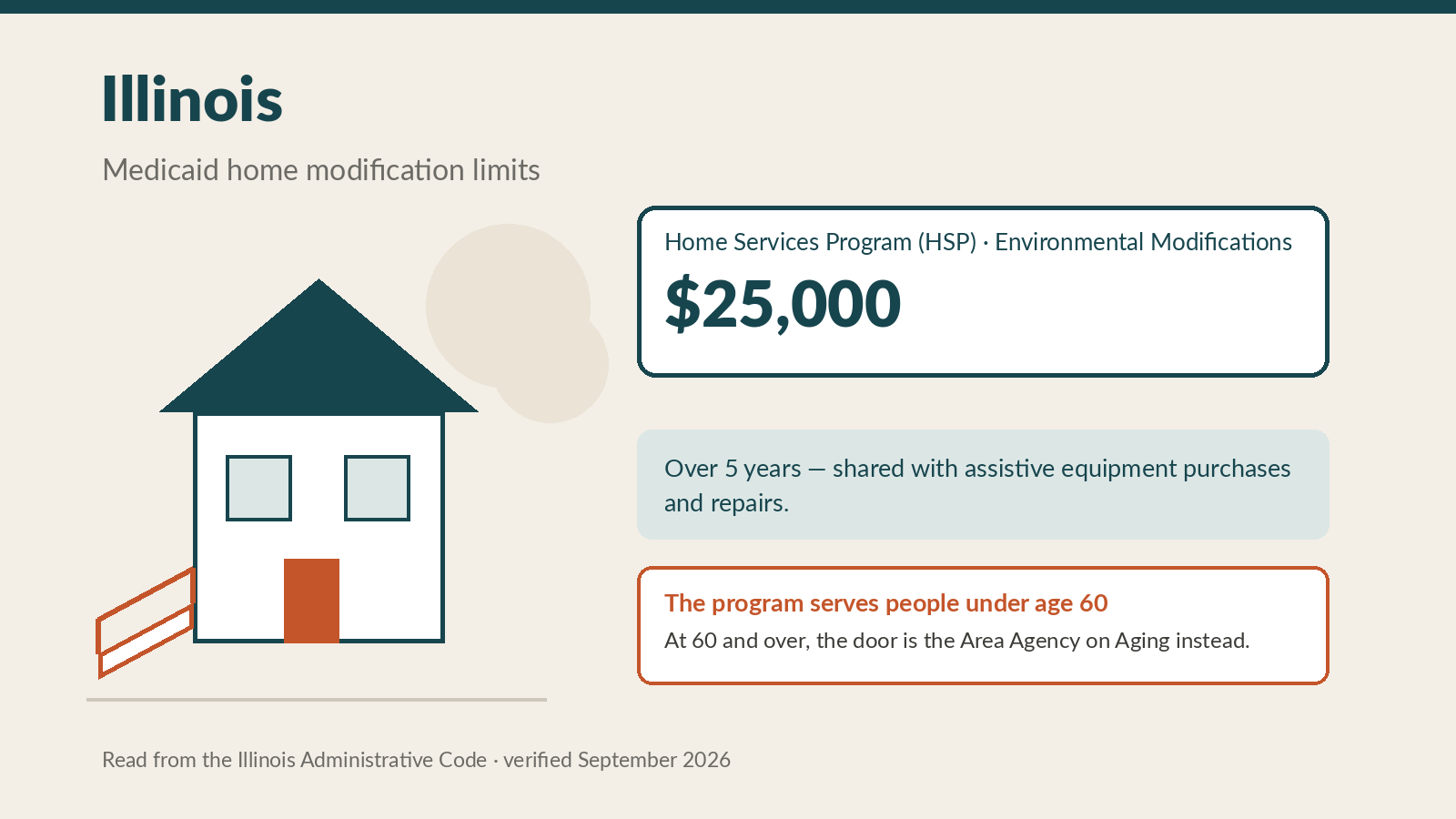
Illinois is one of the states that publishes an actual number: $25,000 over five years. That figure is real, it is in the administrative code, and you can look it up.
But two things about it are almost never explained, and both change whether it applies to you. The $25,000 is shared with assistive equipment, so the amount available for construction work is less than it looks. And it belongs to a program for people under age 60.
If you are looking this up for a parent in their seventies, that second point is the one that matters, and we will get to it before anything else.
The amount and the period
The rule is 89 Ill. Adm. Code 686.605(c), in the Illinois Administrative Code Part governing the Department of Human Services Home Services Program (HSP). It says environmental modifications may be provided if:
the HSP total cost for purchase of all environmental modifications and assistive equipment purchases, rentals, and repairs does not exceed $25,000 over 5 years.
The mirror-image rule at 89 Ill. Adm. Code 686.705(d) says the same thing from the assistive equipment side. It is one combined $25,000 ceiling, five years rolling, covering both.
So a power wheelchair, a hospital bed, a lift chair and a ramp all draw on the same pot. If $9,000 of equipment has already gone through, the money left for a bathroom conversion is $16,000, not $25,000. This is exactly the kind of shared-budget structure our 50-state Medicaid home modification limits table flags, because comparing Illinois’s $25,000 to a construction-only figure in another state is not comparing like with like.
One historical note that trips up people reading older sources. There used to be a separate rule, Section 686.610, “Cost of Environmental Modification.” It was repealed effective 27 September 2007, and the cost limit moved into 686.605(c) where it sits today. If a page cites 686.610 for the dollar figure, it is citing a repealed section.
The age 60 line — and who this money is actually for
This is the single most consequential fact on this page.
The Home Services Program is run by the DHS Division of Rehabilitation Services (DRS), and IDHS states its scope plainly: it serves people with severe disabilities under age 60. The same page says, for those 60 and over, contact the Illinois Department on Aging.
So the $25,000 environmental modification benefit sits inside a program that a 72-year-old cannot newly enter.
What does the Department on Aging offer instead? Its Community Care Program (CCP), which is the main 60+ home and community-based program, lists these services: Comprehensive Care Coordination, Adult Day Service, In-Home Service, Emergency Home Response Services, and Automated Medication Dispenser Service.
Environmental modification is not on that list. Neither is home modification under any other name.
That is not the end of the road, but you have to change doors:
- Area Agencies on Aging. Illinois has 13 AAAs, and the Department on Aging lists home modification explicitly among the AAA-funded “Supportive Services,” alongside case management, homemaker and chore services, in-home services, legal services and transportation. This is the realistic route for most people over 60 — but it is locally funded and locally administered, so there is no statewide dollar figure, and availability varies by region.
- Illinois Care Connections (ICC). Provides technology and assistive devices to adults 60 and over, administered with the Illinois Assistive Technology Program. You must be referred by an approved source — an AAA, an AAA-funded entity, a Care Coordination Unit, or an Adult Day Service provider. You do not have to already be receiving services from the referring agency.
- Supportive Living Program, run by HFS, for adults 65+ (and people with physical disabilities 22+) — an affordable assisted living model rather than a way to modify your own home.
The practical advice for a family with an older parent in Illinois: call the Senior HelpLine at 1-800-252-8966 and ask for your Area Agency on Aging’s home modification funding, not for the HSP $25,000. Asking for the wrong program by name is how these calls go nowhere.
What the modification has to do to qualify
Section 686.600 defines environmental modification as services to physically modify the customer’s home to accommodate loss of function in completing Activities of Daily Living.
Section 686.605(a) then requires the modification to do at least one of four things:
- Enable the customer to independently perform their ADLs
- Result in a decreased need for assistance from another person in completing ADLs
- Prevent an anticipated increase in service costs
- Improve the safety of the customer during completion of ADLs
The third one is worth pausing on. “Prevent an anticipated increase in service costs” is a cost-offset argument, and it is written into the rule as an independently sufficient reason. If a stair lift means the personal assistant’s hours do not have to increase next year, that is a qualifying justification on its own — you do not have to prove full independence.
Section 686.605(b) adds the condition that catches a lot of applications: there must be no other resources, public or private, that will provide the modification. For the assistive equipment side, 686.705(b) is stricter still — the file must contain official documentation of a Medicaid denial from the Department of Healthcare and Family Services (HFS) for the requested item. If you are asking for something that could be classed as equipment, expect to need that denial in writing before anything moves.
What gets it denied
Section 686.630 lists four grounds for denial, and they are unusually blunt:
- The cost does not comply with the $25,000 / five-year limit in 686.605(c)
- The customer has a poor history as a tenant, or is otherwise not expected to remain in the home to be modified for at least one year
- The past practices or reputation of the landlord is unfavorable
- The modifications are for “value added” or cosmetic purposes
Grounds 2 and 3 are the ones nobody warns renters about. Illinois will decline to spend $12,000 making a bathroom accessible if the state does not believe you will still be living there in a year — and it will also decline based on the landlord’s reputation, which is entirely outside your control. If you are renting and considering a move anyway, sort out the tenancy before you apply, not after.
Ground 4 is why “while you’re in there, could you redo the tile” is a request that can sink a whole file. Anything reading as cosmetic or value-adding is a denial reason in the rule itself.
The bidding rule, which sets your real timeline
Section 686.615 is short and it governs how long everything takes:
- Purchases costing $1,500 or less: no bids required.
- Purchases costing more than $1,500: three bids must be obtained, using Invitation to Bid form IL 488-0293.
- If the item is available from fewer than three sources, the maximum number possible is obtained.
- The lowest bid from an eligible provider will be accepted.
- All exceptions require supervisory approval.
Two consequences. First, small items — grab bars, a handheld shower, a threshold ramp — can move quickly because they fall under $1,500. Second, on anything larger, the state takes the cheapest compliant bid, not the contractor you liked. If you have a contractor you trust, the thing to do is make sure they are eligible and that they bid, rather than assuming you can choose them at the end.
Who is allowed to do the work
Section 686.608 sets provider requirements. An environmental modification provider must:
- Meet the approval of both the customer and the counselor
- Submit form 1413 A, the Waiver Program Provider Agreement for Participation in the Illinois Medical Assistance Program
- Submit a completed W-9
- Carry a minimum of $500,000 in liability insurance and provide DHS-DRS with the Certificate of Insurance
- Provide proof of current contractor licences as applicable
- Perform all work to the standards of the Environmental Barriers Act, the Illinois Accessibility Code [71 ILCS 400], and local zoning ordinances and codes
- Obtain proper building permits as required by local municipalities
The $500,000 insurance floor is the requirement most small contractors fail. It is worth asking a prospective contractor about that number specifically before anyone gets attached to a quote.
Ownership, renting, and permanency
Section 686.620 handles the awkward case of work that cannot be undone. For modifications that cannot be detached from the dwelling, the home must be owned by the customer, or the customer must hold the mortgage.
If the customer does not own the home, they must — with the counselor’s help — obtain the property owner’s written permission, and the owner must understand that the modifications are permanent and that DHS-DRS cannot return the building to its previous condition.
This is formalised: a Homeowner/Lessor Agreement, form IL 488-0040, must be completed and signed by the homeowner or lessor, the customer or lessee, and the counselor — before installation of any environmental modifications. Not after. Not during.
And after the work: under Section 686.640, the counselor must make a home visit within 30 days of completion to inspect the modifications and confirm the customer is satisfied.
How to apply: the actual door, by name
For someone under 60, applying to HSP:
- Use the online Rehabilitation Services Web Referral on the IDHS site — you can refer yourself or someone else.
- Or call the IDHS Help Line: 1-800-843-6154 (Voice, English or Español), TTY 1-866-324-5553.
- Or use the DRS Hotline: 1-877-581-3690, which routes you to the right regional contact if you do not know your local office.
- Or go through a local DRS office — IDHS lists these in local offices across the state, and there is an office locator. (A small inconsistency worth knowing: one IDHS page says 47 local offices and another says 48. Use the locator rather than the count.)
A DRS rehabilitation counselor is the person who assesses you and who jointly develops your service plan. That counselor is also the person who has to approve the modification provider, sign the Homeowner/Lessor Agreement, and do the 30-day inspection. In Illinois, more than in most states, one named individual controls the whole file. Getting that relationship right is the single highest-leverage thing you can do.
For someone 60 or over: Illinois Department on Aging Senior HelpLine, 1-800-252-8966 (711 TRS), and ask to be connected to your Area Agency on Aging about home modification supportive services.
The waiting list, honestly
Not published. We could not find an Illinois state document publishing a waiting list or a wait time for HSP environmental modifications, and we are not going to invent one.
What is published, and what actually governs your timeline, is the sequence: counselor assessment, then Medicaid eligibility, then — for anything over $1,500 — three bids on form IL 488-0293, then the work, then a counselor inspection within 30 days. The bidding step is the one with no deadline attached to it and the one families most often find themselves waiting on.
On the Department on Aging side, the CCP page states the program “is available to any person who requests services and meets all current eligibility requirements,” which reads as an entitlement rather than a queue — but note that CCP does not include home modification, so this does not tell you anything about how long AAA home modification funding takes.
A change coming in 2027 you should know about
DRS is consolidating the three Medicaid HCBS waivers that support HSP — the Persons with Disabilities, Brain Injury, and HIV/AIDS waivers — into a single new Disabled Persons Waiver.
The targeted implementation date was 1 July 2026 and has been moved to 1 July 2027. IDHS attributes the change to delays in required statewide steps and federal review and approval.
IDHS is explicit that current HSP services continue without interruption and people currently receiving services do not need to take any action. Questions go to the DRS Home Services Program at [email protected] or 1-877-581-3690, and DRS says the new waiver will be posted for public comment once complete.
Practical read: the $25,000 / five-year limit lives in the administrative code Part, not in the individual waivers, so a waiver merger does not automatically change it. But a consolidation is exactly the kind of event at which service definitions get rewritten. If you are reading this in 2027, re-check 686.605(c) before relying on the figure.
How Illinois compares
Against the states that publish nothing, Illinois looks good: you can find out the ceiling before you call anyone, and the rules on bidding, provider qualification, denial grounds and inspection are all written down. Compare that with Florida, where the coverage policy contains no dollar amount at all and your ceiling is whatever your managed care plan authorizes.
But two caveats keep Illinois from being the best-in-class case it first appears to be. The $25,000 is shared with equipment, so headline-to-headline comparisons overstate it. And the benefit is structurally unavailable to people entering the system at 60 or older — which, for a page about aging in place, is close to being the whole audience.
For the federal baseline underneath all of this, see does Medicaid pay for home modifications.
Frequently asked questions
Is the Illinois $25,000 per project or lifetime?
Neither exactly. It is a rolling five-year total across all environmental modifications and assistive equipment purchases, rentals and repairs combined, under 89 Ill. Adm. Code 686.605(c) and 686.705(d).
My mother is 74. Can she get the $25,000?
Not through the Home Services Program, which IDHS states serves people with severe disabilities under age 60 and directs those 60 and over to the Illinois Department on Aging. The realistic route at 74 is Area Agency on Aging home modification supportive services, via the Senior HelpLine at 1-800-252-8966.
Does the Community Care Program pay for a ramp?
The Department on Aging’s published CCP service list is care coordination, adult day service, in-home service, emergency home response, and automated medication dispenser. Home modification is not on it. Home modification appears instead under AAA-funded supportive services.
Do I need three quotes?
Only if the purchase costs more than $1,500. At $1,500 or less, no bids are required. Above it, three bids on form IL 488-0293, and the lowest eligible bid is accepted.
I rent. Can I still get modifications?
For anything that can be detached, yes. For permanent modifications you must either own the home or hold the mortgage, or complete a Homeowner/Lessor Agreement (IL 488-0040) signed by owner, tenant and counselor before installation. Be aware that Section 686.630 also permits denial based on a poor tenancy history, an expectation you will not stay a year, or an unfavourable landlord reputation.
Why was my equipment request denied when the modification was approved?
Assistive equipment has an extra hurdle: 686.705(b) requires official documentation of a Medicaid denial from HFS for that specific item before HSP will fund it. Environmental modifications under 686.605 do not carry that particular requirement, though they do require that no other public or private resource will provide it.
Does the counselor really have to come back out?
Yes. Section 686.640 requires a home visit within 30 days of completion to inspect the work and confirm satisfaction. If it has been longer than that, you have a rule to point at.
Primary sources and last verification date
- 89 Ill. Adm. Code Part 686, Illinois General Assembly / JCAR. Source for the $25,000 over five years shared limit (686.605(c) and 686.705(d)), the qualifying criteria (686.605(a)), the no-other-resources condition (686.605(b)), the HFS Medicaid denial documentation requirement (686.705(b)), provider requirements including the $500,000 liability insurance minimum (686.608), the bidding thresholds and form IL 488-0293 (686.615), permanency and form IL 488-0040 (686.620), the four denial grounds (686.630), and the 30-day inspection (686.640). Sections 686.600–686.640 as read carry the source note “Added/Amended at 31 Ill. Reg. 14238, effective September 27, 2007”; Section 686.610 is marked Repealed at the same citation.
- IDHS: Home Services Program (HSP), Illinois Department of Human Services. Source for the under-60 scope and the referral to the Department on Aging for those 60 and over, the service list including Environmental Modification, the application routes, the DRS Hotline 1-877-581-3690, and the Disabled Persons Waiver consolidation with the implementation date moving from 1 July 2026 to 1 July 2027.
- IDHS: Home Services Program. Corroborates the under-60 scope, the Rehabilitation Services Web Referral route and the IDHS Help Line 1-800-843-6154 / TTY 1-866-324-5553.
- Home & Community-Based Services, Illinois Department on Aging. Source for the CCP service list, for home modification appearing among AAA-funded supportive services, for Illinois Care Connections and its referral requirement, and for the Senior HelpLine 1-800-252-8966.
Last verified: 8 September 2026. All four sources were retrieved and read on that date and all four remain live. The administrative code sections carry an effective date of 27 September 2007 and we found no later amendment in the Part as published. The waiver consolidation date of 1 July 2027 was current on the IDHS page as of this check and is the one thing here most likely to move again.
Where a figure was not published we have written Not published rather than estimating. That applies to waiting times, and to any statewide dollar amount for AAA home modification funding.
What to do this week
- Check the age first. Under 60, HSP is your program. Sixty or over, it is not, and calling DRS will cost you a week.
- Under 60: submit the Rehabilitation Services Web Referral online, or call 1-877-581-3690 to be routed to your regional DRS contact.
- Sixty or over: call the Senior HelpLine 1-800-252-8966 and ask specifically for your Area Agency on Aging’s home modification supportive services, and ask separately whether you can be referred to Illinois Care Connections for assistive devices.
- Ask your counselor how much of the $25,000 five-year total has already been used on equipment. Do this before pricing any construction.
- If the job will exceed $1,500, line up three eligible bidders early — and confirm each carries at least $500,000 in liability insurance and can pull local permits.
- If you rent, get the Homeowner/Lessor Agreement (IL 488-0040) in motion now. Nothing permanent can be installed before it is signed by all three parties.
- Frame the request around preventing an increase in service costs where you can. It is a qualifying reason written into 686.605(a), and it is the easiest one to evidence.
Illinois gives you a number. Just make sure it is your number before you plan around it.
Leave a Reply