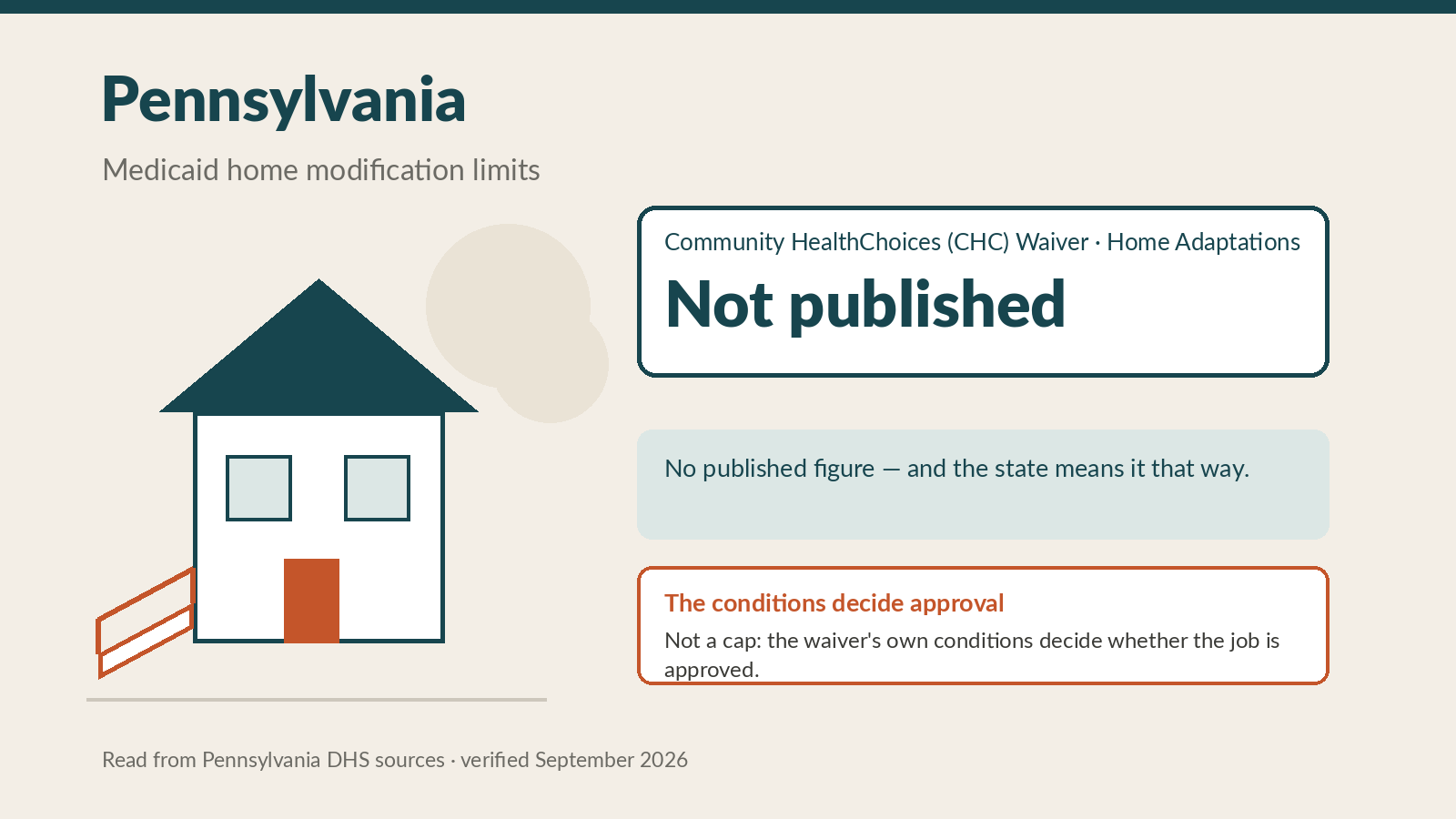
Pennsylvania does not publish a dollar limit on Medicaid home modifications. What it publishes instead is something more useful and almost nobody writes about: a long, specific, itemised list of exactly what counts as a home adaptation, plus about a dozen conditions that decide whether yours gets approved.
Those conditions are where Pennsylvania applications actually fail. Not on money. On an unpaid property tax bill, a missing landlord letter, or an evaluation done by the wrong kind of professional.
The amount and the period: no published figure, on purpose
Home modifications in Pennsylvania Medicaid sit inside Community HealthChoices (CHC), the state’s mandatory managed long-term services and supports program. The benefit is called Home Adaptations, and it is defined in Appendix C-3 of Pennsylvania’s 1915(c) waiver — CMS waiver number 0386.R05.00, effective 1 January 2025 and running through 31 December 2029.
That waiver document has a section headed “Specify applicable (if any) limits on the amount, frequency, or duration of this service.” We read it in full. It contains rules. It contains no dollar figure.
The reason is structural. Pennsylvania delivers CHC through capitated managed care organisations — the CHC-MCOs. The state pays a plan a fixed amount per member; the plan authorizes services against an individual person-centered service plan. There is no per-service pot to cap. Arizona and Florida are in the same position for the same reason.
So the honest answer to “what is Pennsylvania’s home modification limit” is Not published. Your ceiling is what your CHC-MCO authorizes, filtered through the conditions below. Our 50-state Medicaid home modification limits table shows which states do publish a number and which, like Pennsylvania, do not.
What Pennsylvania covers — the full published list
This is the part that makes Pennsylvania unusually easy to plan around. The waiver enumerates the adaptations, and the list is long:
- Ramps from street, sidewalk or house
- Specialized electric and plumbing systems needed to accommodate medical equipment and supplies
- Vertical lifts
- Track lift systems — a ceiling-mounted track for moving a person from one location to another
- Handrails and grab bars in and around the home
- Accessible alerting systems for smoke, fire and carbon monoxide for people with sensory impairments
- Outside railing to safely access the home
- Widened doorways, landings and hallways
- Swing-clear and expandable offset door hinges
- Flush entries and leveled thresholds
- Slip-resistant flooring
- Kitchen counter, sink and cabinet modifications, including brackets for appliances
- Bathroom adaptations for bathing, showering, toileting and personal care
- Stair gliders and stair lifts
- Raised electrical switches and sockets
- Other adaptations, subject to CHC-MCO approval, to address specific assessed needs in the service plan
Two details in that list are worth pulling out because they cost people money.
Kitchen modifications have a condition attached. The waiver says they will be considered only when the participant will be preparing their own meals, or when the adaptation reduces the participant’s dependence on another person. If a family member does all the cooking, a lowered counter is a hard sell.
Alerting systems have a step before them. The waiver instructs Service Coordinators to first seek smoke, fire and carbon monoxide alert systems from local municipalities and/or fire departments. Many PA fire departments hand these out free. Expect to be asked whether you tried.
The benefit also covers more than the hardware itself: installation, repair, maintenance, permits, necessary inspections, and extended warranties are all inside the service definition. Permits and inspections being explicitly covered matters — in older Pennsylvania housing stock those are real line items.
What it will not pay for
The exclusions are specific, and one of them has an exception that is worth real money.
Square footage. Building a new room that adds to the total square footage of the home is excluded — except when necessary for the addition of an accessible bathroom, when the cost of adding the bathroom is less than retrofitting an existing bathroom.
That exception is unusual. Florida’s rule excludes square-footage additions with no exception at all. Pennsylvania will fund building a new accessible bathroom if the numbers favour it over gutting the old one — which, in a narrow 1920s row house where the only bathroom is upstairs and 30 inches wide, they often do. If you are in that situation, the thing to ask for is a cost comparison, not a bathroom.
Also excluded:
- General maintenance and upkeep that is not of direct medical or remedial benefit — including bringing items up to code
- Specialized Medical Equipment and Supplies, which is a separate waiver service
- Portable lift systems — these are covered by the MA State Plan or by Specialized Medical Equipment and Supplies, not by Home Adaptations
- The service is not available to participants receiving Residential Habilitation, or residing in Assisted Living Residences, Domiciliary Care Homes, or other provider-owned and operated settings
And a timing rule that catches people discharging from a nursing facility: adaptations included in the service plan and begun while the person was institutionalized are not considered complete and may not be billed until the date the participant leaves the institution and enters the waiver. The work can start early. The payment cannot land early.
The conditions that actually decide approval
Here is where Pennsylvania differs most from other states, and where most of the avoidable failures happen.
1. Your house has to qualify, not just you
The waiver states plainly that adaptations will not be approved if any of the following is true:
- The home is in foreclosure
- The home is in delinquent tax status
- The home is not structurally sound
- The adaptation presents a safety concern under applicable state and local building codes
Delinquent property taxes are the one that blindsides families. An older homeowner living on a fixed income who fell behind on school taxes two years ago is not eligible for a ramp until that is resolved. If this might apply to you, deal with it before the assessment rather than after a denial.
Separately, the contractor is responsible for confirming the dwelling is structurally sound and can accommodate the proposed modification before starting any work.
2. Medicaid pays last
Home Adaptations may only be funded through the waiver when the services are not covered by a responsible third party — the waiver names Medicare and private insurance — and when all other payors and community resources have been exhausted.
The Service Coordinator must confirm that third-party coverage continues until plan limits are reached or a non-coverage determination has been established, before the service goes into the plan. In practice: expect to produce a denial letter from Medicare or your insurer for anything that could plausibly be durable medical equipment.
Which leads to a split that confuses almost everyone.
3. Some of it is not waiver at all — it is the State Plan
Pennsylvania’s MA State Plan covers home accessibility durable medical equipment — the waiver names wheelchair lifts, stair glides, ceiling lifts and metal accessibility ramps — where medically necessary to enter and exit the home or support activities of daily living, meeting the definition at 42 CFR §440.70(b)(3)(i–ii), along with installation.
Other home adaptations in the waiver service specification are not covered in the State Plan.
The practical consequence: a metal ramp and a stair glide may come to you through the State Plan DME route, while a widened doorway and slip-resistant flooring come through the waiver. Same house, same goal, two different approval paths. If your Service Coordinator sends everything down one path, some of it will bounce.
4. An independent evaluation by an OT or PT is mandatory
This is not optional and it is not part of the service. The waiver says the service “does not include, but requires, an independent evaluation,” conducted — depending on the type of adaptation and their scopes of practice — by an occupational therapist or a physical therapist meeting Department standards.
For complex adaptations, that evaluation may be supplemented by an assessor holding one of three named credentials:
- Certified Environmental Access Consultant (C.E.A.C.)
- Certified Living in Place Professional (CLIPP)
- Executive Certificate in Home Modifications
These supplemental assessors must have at least two years of experience assessing home adaptations for older adults or people with disabilities. Naming the credentials you are entitled to ask for is one of the few pieces of real leverage a family has in this process.
5. Renting? Three conditions, in writing
Adaptations at rental properties are allowed, but all three of these must hold:
- There is a reasonable expectation the participant will continue to live in the home
- Written permission is secured from the property owner, including acknowledgement that no waiver funds will be used to return the home to its original state
- The landlord will not increase the rent because of the adaptation
Get that letter early. It is the single most common reason a renter’s file sits idle.
6. Cheapest workable option, and rent-to-own is allowed
Home adaptations “must be obtained in the least expensive, most cost-effective manner.” But the waiver also permits something families rarely know about: rent-to-purchase vertical lifts and stair glides may be rented, provided the rental cost does not exceed the purchase price. Where long-term use is expected, or rental would exceed purchase cost, the equipment is purchased outright or a permanent adaptation is considered.
If someone’s prognosis is uncertain, renting a stair glide is an option that exists in the rules.
How to apply: the actual door, by name
Pennsylvania has three published entry points and they are not interchangeable.
- The Independent Enrollment Broker (IEB) — 1-877-550-4227, TTY 1-877-824-9346. This is the front door for long-term services and supports. The IEB is a statewide contracted entity, not a county office.
- The Consumer Service Center — 1-866-550-4355. Since 16 June 2025 this line accepts long-term care and HCBS applications by phone.
- COMPASS — Pennsylvania’s online benefits system, at compass.dhs.pa.gov.
What happens next, per DHS:
- The IEB schedules an in-person assessment, done wherever you are — your home, a hospital, or a nursing facility — to determine what services you need.
- The IEB also helps you complete the Medicaid application, which goes to your County Assistance Office (CAO).
- A CAO caseworker may contact you with questions about your financial information.
- You are notified whether you qualify.
Only after CHC enrollment does a Service Coordinator build the person-centered service plan — and Home Adaptations must be in that plan, “determined necessary in accordance with the participant’s assessment,” before anything is authorized.
The agencies by name: DHS Office of Long-Term Living (OLTL) writes the policy; the IEB is who you call; the CAO decides financial eligibility; your CHC-MCO authorizes the work; your Service Coordinator is the person who has to put it in the plan.
The waiting list, honestly
Not published. We looked, and Pennsylvania’s published application path does not describe a wait list or a queue position the way Florida’s does. CHC is mandatory statewide managed care rather than a capped-slot program, and the process DHS documents is an assessment plus a financial determination, not a prioritisation score.
What that does not mean is “fast.” The published sequence has three sequential gates — IEB assessment, CAO financial determination, then MCO service authorization — and the third one cannot start until the first two finish. For a home adaptation specifically, add the OT or PT independent evaluation and the third-party denial letters. None of those steps has a published deadline attached.
If someone tells you Pennsylvania has a specific waiting time for home modifications, ask which state document it comes from. We could not find one. We would rather say so than invent a number.
How Pennsylvania compares
Set against a state that publishes a figure, the trade is clear. Illinois names $25,000 over five years, though it is shared with assistive technology, equipment and vehicle modifications. Ohio and North Carolina both publish numbers you can look up before you call anyone. That number is a planning anchor even when it is small.
Pennsylvania gives no anchor but gives an unusually complete rulebook. You cannot find out in advance what they will spend. You can find out in advance, item by item, whether the thing you want is on the list, whether your house disqualifies you, who has to evaluate you, and what your landlord has to sign.
Compared with the other two no-figure states, Pennsylvania is also the most generous on paper: Florida’s covered-adaptations list names five categories, Pennsylvania’s names sixteen and includes track lifts and stair lifts explicitly. For the federal baseline underneath all of it, see does Medicaid pay for home modifications. For a state that also runs managed care but handles the queue very differently, see our Florida page.
Frequently asked questions
Does Pennsylvania Medicaid pay for a stair lift?
Stair gliders and stair lifts are named in the Home Adaptations service definition, so yes, within CHC. But stair glides are also named as home accessibility DME under the MA State Plan, so the request may be routed there instead. Ask your Service Coordinator which path they are using.
Is there a dollar limit on home modifications in Pennsylvania?
None is published. The waiver’s limits section sets conditions, not amounts. Your CHC-MCO decides the amount against your service plan.
Can Medicaid build an accessible bathroom addition in Pennsylvania?
Yes, in one specific circumstance. Square-footage additions are excluded except when necessary to add an accessible bathroom and the cost of adding it is less than retrofitting the existing one. Ask for that cost comparison to be documented.
I rent. Can I still get a ramp?
Yes, if there is a reasonable expectation you will stay, your landlord gives written permission acknowledging that waiver funds will not restore the property, and the landlord will not raise the rent because of the adaptation.
Why was my request denied when I have unpaid property taxes?
Because the waiver says adaptations will not be approved where the home is in delinquent tax status or in foreclosure. This is a condition of the benefit, not a discretionary judgement by your plan.
Who is allowed to assess my home?
An occupational therapist or physical therapist meeting Department standards must perform the required independent evaluation. For complex adaptations it may be supplemented by an assessor holding a C.E.A.C., CLIPP, or Executive Certificate in Home Modifications, with at least two years of relevant experience.
Can I get a home adaptation while my relative is still in a nursing home?
The work can be planned and started, but it may not be billed until the day the participant leaves the institution and enters the waiver.
Primary sources and last verification date
- Community HealthChoices 1915(c) Waiver, Appendix C-3 Waiver Services Specifications — Home Adaptations, PA Department of Human Services, Office of Long-Term Living. Source for the service definition, the full covered list, exclusions and the accessible-bathroom exception, foreclosure and delinquent-tax conditions, the State Plan DME split, the independent evaluation and assessor credentials, rent-to-purchase, rental property conditions, the institutional billing rule, and the setting exclusions. Contains no dollar amounts.
- PA Community HealthChoices Waiver (0386.R05.00), medicaid.gov. Source for waiver authority 1915(c), status Approved, original approval 04/01/2002, effective 01/01/2025, expiration 12/31/2029.
- Access Long-Term Care Services, Commonwealth of Pennsylvania. Source for the IEB number 1-877-550-4227 and TTY 1-877-824-9346, the Consumer Service Center number 1-866-550-4355 and its 16 June 2025 start date, COMPASS as the online route, and the assessment then CAO sequence.
Last verified: 8 September 2026. All three documents were retrieved and read on that date and all three remain live. The waiver’s stated effective period runs to 31 December 2029, so the service definition above should be stable; the waiver specification we read is Appendix C-3 as published by OLTL and does not itself carry a printed revision date, which is why we cite the medicaid.gov record for the effective dates.
Where a fact was not published, we have written Not published rather than estimating. That applies to the dollar limit and to waiting times.
What to do this week
- Call the IEB at 1-877-550-4227 and ask to start a long-term services and supports application. If you would rather apply online, use COMPASS.
- Before the assessment, check two things about the property: is it current on taxes, and is it out of foreclosure. These are disqualifiers, and they are fixable in a way that a denial is not.
- If you rent, ask your landlord now for a letter granting permission, acknowledging no waiver funds will restore the property, and confirming no rent increase.
- Ask your Service Coordinator, by name, for the independent OT or PT evaluation, and for a supplemental assessor with C.E.A.C., CLIPP or Executive Certificate in Home Modifications if the work is complex.
- If your only bathroom is unusable, ask for a written cost comparison between adding an accessible bathroom and retrofitting the existing one. That comparison is the key to the square-footage exception.
- Gather any Medicare or private insurance denial letters. Medicaid pays last here, and the file will stall without them.
Pennsylvania will not tell you what it will spend. It will tell you, in unusual detail, what it will spend it on — and that is more actionable than most states manage.
Leave a Reply