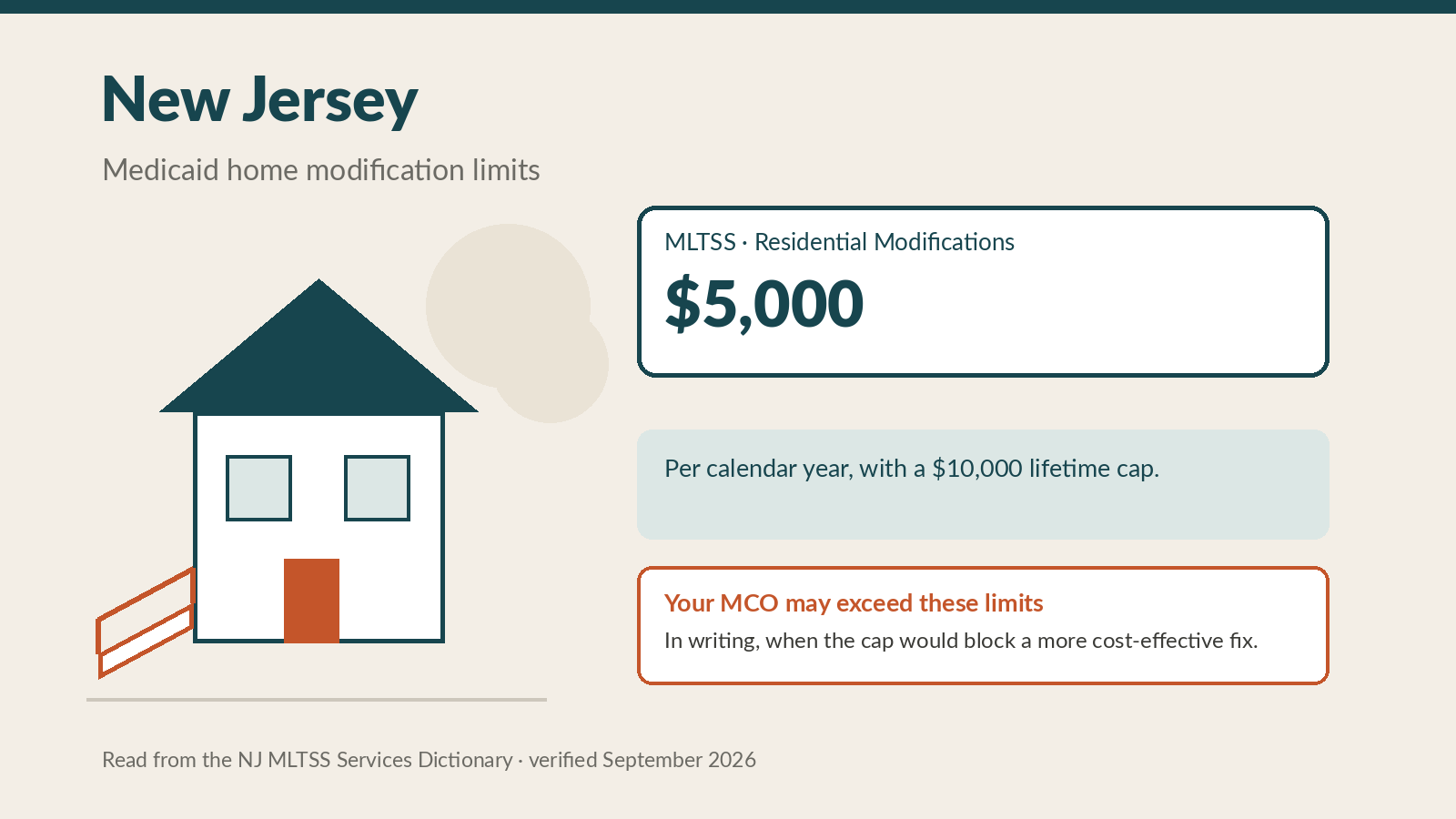
New Jersey is one of the minority of states that publishes an actual number for Medicaid home modifications. The number is $5,000 per calendar year, with a $10,000 lifetime cap.
That is the headline, and most pages stop there. But the same document that sets those limits also contains a sentence that can raise them, and a set of conditions that quietly disqualify a lot of people before the money is ever discussed. This page covers both — what the benefit is, who can and cannot use it, the exception clause worth quoting to your care manager, what happens if you rent, and what the 2026 financial thresholds actually are.
The amount and the period
New Jersey’s home modification benefit is called Residential Modifications, and it sits inside Managed Long Term Services and Supports (MLTSS) — the way New Jersey Medicaid (NJ FamilyCare) delivers long-term care. The MLTSS Services Dictionary states it plainly:
“Residential Modifications are limited to $5,000 per calendar year, $10,000 lifetime.”
Two limits, working together. The annual figure resets on 1 January, so a project split across a December and a January can draw on two years’ allowance. The lifetime figure does not reset, ever — it is the real ceiling, and it means you effectively get two full annual allotments across your entire time on the program.
The service itself is defined as “those physical modifications/adaptations to a participant’s private primary residence required by his/her plan of care which are necessary to ensure the health, welfare and safety of the individual, or which enable him/her to function with greater independence in the home or community and without which the individual would require institutionalization.” The named examples: installation of ramps and grab bars, widening of doorways, modifications of bathrooms, and installation of specialized electrical or plumbing systems needed to accommodate medical equipment.
The exception clause — the most useful sentence on this page
Immediately after the limitations, the Services Dictionary says this:
“If it is determined that one of the above limitations would prevent the MCO from implementing a more appropriate or cost effective method of support or ensuring the health, safety and well-being of an individual, the MCO may exceed these limitations in those specific circumstances. The need to exceed the limitation must be documented in the plan of care.”
Read that carefully. The $5,000 and $10,000 figures are not absolute. Your managed care organization has written authority to go past them in specific circumstances, and the state has told it in advance how to justify doing so: the limitation would otherwise block a more appropriate or more cost-effective support, or would prevent the MCO from ensuring your health, safety and well-being. The only procedural requirement is documentation in the plan of care.
Very few states put an escape hatch like this in writing. If a $9,000 bathroom conversion is the thing standing between someone and a nursing facility — and a nursing facility costs the state far more per month — that is precisely the argument the clause was written for. Ask your care manager to document the cost-effectiveness comparison in the plan of care, in those words.
Two honest caveats. This is discretionary, not an entitlement: “may exceed,” not “shall exceed.” And it is your MCO that decides, not the state directly. But a written clause you can point to is a far stronger position than asking for a favor.
Who is disqualified before the money is discussed
Three exclusions decide eligibility for this benefit independently of your medical need, and they catch people by surprise.
1. Where you live. The benefit applies to a “private primary residence.” The dictionary is explicit about who is out: “Participants living in licensed residences (ALR, CPCH, ALP, and Class B & C Boarding Homes) are not eligible to receive Residential Modifications.” If you are in an assisted living residence, a comprehensive personal care home, an assisted living program, or a Class B or C boarding home, this benefit is not available to you — the setting’s licensing already puts accessibility obligations on the operator.
2. Who owns the space. “Modifications to public areas of apartment buildings, communities governed by a homeowner association or community trust and/or rental properties are the responsibility of the owner/landlord, association or trust and excluded from this benefit.” A ramp at the shared entrance of your condo building is the association’s problem, not MLTSS’s. The line runs between your unit and everything held in common.
3. Whether a provider owns the home. “Residential Modifications may not be furnished to adapt living arrangements that are owned or leased by providers of waiver services, except for approved Adult Family Care (AFC) Caregivers’ homes.” The AFC exception is worth knowing if you are in that arrangement.
If you rent: yes, with three conditions
New Jersey permits modifications to rented housing, and states the conditions precisely:
- Prior written approval of the landlord. “Adaptations to rented housing units must have the prior written approval of the landlord.” Prior — not after the contractor has been scheduled.
- A year of tenancy assured. “Continued tenancy of at least one year is to be assured prior to approval of the request.” If your lease has four months left, expect to be asked to extend it before the work is approved.
- A letter that also releases the State. “A letter from the owner of the property approving the modification to the property and acknowledging that the State/MCO is not responsible for the removal of the modification from the property is required.” One document, doing two jobs. Get both elements in it the first time.
That last point differs from how several other states handle rentals. Michigan requires a three-way agreement that specifies restoration if the tenant moves. New Jersey instead requires the owner to acknowledge that nobody will be restoring anything. Practically, that can make a New Jersey landlord easier to persuade — you are asking them to accept a permanent ramp, not to negotiate its removal — and it is worth saying so when you ask.
What is excluded
Two categories of exclusion, plus one that is genuinely unusual.
General utility items. “Excluded from this service are those modifications to the home that are of general utility and are not of direct medical or remedial benefit to the individual, such as carpeting, roof repair, central air conditioning, etc.” Standard across states, and the reason “while we’re at it” requests get denied.
Square footage. “Adaptations that add to the total square footage of the home are excluded from this benefit except when necessary to complete an adaptation (e.g., in order to improve entrance/egress to a residence or to configure a bathroom to accommodate a wheelchair).” This is the one worth reading twice. A general addition is out. But if enlarging a bathroom is the only way to make it wheelchair-usable, or if a landing has to be built to make an entrance work, the state’s own examples say that is inside the benefit. Frame the request as completing the adaptation, not as adding a room.
Codes. “All services shall be provided in accordance with applicable State/local building codes.”
And one baseline that governs everything: “All residential modifications are limited based on the participant’s assessed need. The adaptation will represent the most cost effective means to meet the needs of the participant.” The assessment drives the scope, and among ways of meeting the assessed need, the cheapest adequate one wins.
Who does the work
New Jersey is specific about contractors, and this trips up families who already have someone in mind:
- The provider “must be licensed in NJ per the NJ Division of Consumer Affairs, NJSA 56:8-136 et seq. as a home repair contractor,” and must appear in the Division of Consumer Affairs database.
- The provider “must apply and become approved through the MCO.”
- “The Contractor must provide his/her license number.”
So a licensed contractor is necessary but not sufficient — they also have to go through your MCO’s approval. If you have a trusted local builder, start that approval process early, or ask the MCO for its already-approved list. Choosing from the existing list is usually the faster path.
The separate pot of money for coming home from a nursing facility
If the person you are helping is moving out of a nursing facility and back into the community, there is a second, independent benefit that does not touch the Residential Modifications cap.
Community Transition Services carries its own “Limit of up to $5,000” and covers the costs of setting up a household: security deposits and application fees required to obtain a lease; essential furnishings and moving expenses including furniture, window coverings, food preparation items and bed and bath linens; set-up fees or deposits for telephone, electricity, heating and water; pest eradication and a one-time cleaning before occupancy; and “necessary accessibility adaptations to promote safety and independence.”
The dictionary is explicit that the two do not overlap: “Community Transition Services do not include residential or vehicle modifications.” They also exclude recreational items such as televisions and cable access, monthly rent or mortgage, and recurring expenses like food and regular utilities — though a security deposit is specifically not counted as rent. The MCO is to arrange delivery and set-up of essential household items “no later than day of discharge.”
For a transition, then, the realistic budget is up to $5,000 of Residential Modifications plus up to $5,000 of Community Transition Services, doing different jobs.
There is also a Vehicle Modifications benefit — lifts, electronic monitoring systems — with no published dollar cap. The conditions: the vehicle must be owned by the participant or their authorized representative and registered in New Jersey; general-utility adaptations, routine vehicle maintenance, and the purchase of a vehicle are all excluded.
Qualifying for MLTSS in 2026
None of the above is available until you are enrolled in MLTSS, which requires two separate determinations — clinical and financial.
Clinical. You must need a “nursing home level of care.” For adults 21 and older this means, in the state’s words, that the individual “requires hands on assistance with three or more activities of daily living such as bathing, dressing, toileting, locomotion, transfers, eating, and bed mobility or has cognitive deficits and requires supervision and cueing with three or more activities of daily living.” The cognitive route matters: someone physically capable but needing supervision and cueing through three ADLs can qualify.
Age or disability. You must be 65 or older, or under 65 and determined blind or disabled by the Social Security Administration or the State of New Jersey.
Financial (2026 figures, from the state’s April 2026 application guidance).
- Resources: $2,000 or less. The house you live in and the vehicle you use do not count. If you are married and your spouse is not applying, some marital assets are set aside for the spouse.
- Resources are counted as of the first day of the month. The guidance is blunt: over $2,000 on the first of the month — “even if the amount goes lower the very next day” — means no MLTSS for any part of that month.
- Income over $2,982 per month in 2026 requires a Qualified Income Trust (QIT) to be income-eligible. Income placed in a QIT may only be used toward cost of care and may be subject to recovery by the State after death.
- Income of $1,330 or less per month in 2026 may allow a Self-Attestation Form and fewer documents — though the agency still runs a computer check of resources.
- Five-year look-back. A caseworker reviews resources and income going back five years from your first MLTSS application, checking for transfers for less than fair market value. Undocumented transfers are treated as gifts and produce a transfer penalty — a period of Medicaid ineligibility.
- Life insurance with a total face value over $1,500 has its cash value counted as a resource. You are not required to cash out the policy; assigning it to a funeral home is named as an option.
A denial is not the end: “If your application is denied for any of these reasons, you do not have to wait to reapply.” The agency will pull documents from your previous application rather than making you resubmit everything.
How to apply
Two tracks run in parallel, and starting both early is the single best thing you can do.
The clinical screening. If you are living in the community and not already in a Medicaid program, contact your Area Agency on Aging at 1-877-222-3737 to schedule an MLTSS screening exam. If you are already enrolled in a Medicaid program, call the member services number on the back of your health plan card and ask for a clinical eligibility exam for the purpose of enrolling in MLTSS. If you live in an assisted living facility or nursing home, ask the social worker to schedule it. Clinical eligibility is determined through the Division of Aging Services; if you are not found eligible you receive notice from the Office of Community Choice Options.
The financial application. Applications are processed by the County Social Service Agency (CSSA) in the county where you live. Applying online is the fastest route and lets you upload documents at the end. Paper applications can be obtained from the AAA or CSSA, or printed from the DMAHS website.
One question decides how your application is routed. The guidance says: “When you apply, answer ‘Yes’ to the question on the application that asks if you need ‘nursing home like’ services and need assistance with daily activities, such as dressing, bathing, and mobility. This will make sure that your application is processed for MLTSS.” And: “You do not need to live in a nursing home to apply for MLTSS.”
For children from birth through 20, contact the Division of Disability Services at 1-888-285-3036. For free legal help with an application, the Health Care Access Project at Legal Services of New Jersey is 1-888-576-5529.
Is there a waiting list?
We found no published MLTSS waiting list, slot allocation, or enrollment cap in any New Jersey state source reviewed for this page. The state’s own materials describe MLTSS as a determination process — clinical eligibility, then financial eligibility, then enrollment with a managed care organization — rather than a queue for a limited number of places.
That is a structural difference from the waiver states. Michigan publishes explicit enrollment capacity and a four-tier priority waiting list; Georgia’s ICWP describes slots opening only as members leave. New Jersey’s published process has no equivalent mechanism. We are stating what we did and did not find rather than asserting that no queue exists anywhere in practice — if you are told there is a wait, ask what it is a wait for: the screening exam, the financial determination, or the contractor.
Frequently asked questions
How much will New Jersey Medicaid pay for a wheelchair ramp?
Residential Modifications are limited to $5,000 per calendar year with a $10,000 lifetime cap. The annual amount resets each 1 January; the lifetime amount does not. The MCO may exceed these limits in specific circumstances where the limit would prevent a more appropriate or cost-effective support or would prevent ensuring your health, safety and well-being, with the need documented in the plan of care.
Can the $5,000 limit be raised?
Yes, at the MCO’s discretion. The MLTSS Services Dictionary authorizes the MCO to exceed the limitations in specific circumstances, and requires the reason be documented in the plan of care. Ask for the cost-effectiveness comparison against institutional care to be written into the plan.
I live in an assisted living residence. Can I get a bathroom modification?
No. Participants living in licensed residences — ALR, CPCH, ALP, and Class B and C boarding homes — are not eligible for Residential Modifications. Accessibility in those settings is the operator’s responsibility.
Can New Jersey Medicaid modify an apartment I rent?
Yes, with three conditions: prior written approval from the landlord; assurance of at least one more year of tenancy before the request is approved; and a letter from the owner approving the modification and acknowledging that the State and MCO are not responsible for removing it. Modifications to shared or public areas of the building are the owner’s or association’s responsibility and are excluded.
Will it pay to add a room?
Adaptations that add to the home’s total square footage are excluded — except where necessary to complete an adaptation, and the state’s own examples are improving entrance and egress, or configuring a bathroom to accommodate a wheelchair. Frame it as completing an adaptation, not as an addition.
Can I use my own contractor?
Only if they are licensed in New Jersey as a home repair contractor under NJSA 56:8-136 et seq., appear in the Division of Consumer Affairs database, provide their license number, and are approved through your MCO. Ask the MCO for its approved list if time matters.
I am moving home from a nursing facility. Is there extra help?
Yes. Community Transition Services carries its own limit of up to $5,000 for deposits, essential furnishings, moving expenses, utility set-up, pest eradication and a pre-occupancy cleaning. It explicitly does not include residential or vehicle modifications, so it does not consume your Residential Modifications allowance.
Primary sources and last verification date
Every figure and quotation on this page was read directly from a New Jersey state source on 16 September 2026.
- NJ Department of Human Services, Division of Medical Assistance and Health Services — MLTSS Services Dictionary (Article B.9.0). Sections cited: Residential Modifications, Community Transition Services, Vehicle Modifications. This is the source of the $5,000 / $10,000 limits, the exception clause, the rental conditions, the exclusions and the contractor requirements. nj.gov
- NJ FamilyCare ABD — MLTSS Application Guidance, April 2026. Source of all 2026 financial figures: the $2,000 resource limit, first-of-month counting, the $2,982 QIT threshold, the $1,330 self-attestation threshold, the five-year look-back, the $1,500 life insurance rule, and the AAA screening number. nj.gov
- NJ DMAHS — What is MLTSS? Source of the clinical eligibility standard, the age and disability requirement, the covered services list, and the application routes including the DDS number for children. nj.gov
A note on the version of the Services Dictionary. The Services Dictionary is an article of New Jersey’s managed care contract and is published by DMAHS without a date on its face, so we cannot quote an effective date for it the way we can for a dated bulletin. The $5,000 annual and $10,000 lifetime figures are independently corroborated in the State’s own Final Report of the New Jersey Task Force on Long-Term Care Quality and Safety, which describes MLTSS members not living in a licensed facility as entitled to up to $5,000 of home modifications per year, not to exceed $10,000 over their lifetime. Two separate state sources, the same numbers. The 2026 financial thresholds come from a document dated April 2026 and are current for this year; they are adjusted annually, so confirm them with your CSSA if you are applying near a year boundary.
How New Jersey compares
- On transparency, New Jersey is in the minority that publishes a number at all. Our 50-state table of Medicaid home modification limits shows how few states do.
- On flexibility, New Jersey may be the most useful of the published-number states, because the number comes with a written exception clause. A published cap that can be exceeded on record beats an unpublished one you cannot argue with.
- On settings, New Jersey is stricter than most: licensed residential settings are excluded outright.
- On rentals, New Jersey allows them with landlord consent, unlike Georgia, which excludes rental property entirely.
For the national picture, start with does Medicaid pay for home modifications.
What to do this week
- Call your Area Agency on Aging at 1-877-222-3737 to schedule the clinical screening, and start the CSSA financial application at the same time. They are separate determinations and both have to finish.
- Check your resources on the first of the month. Being over $2,000 on day one disqualifies you for the entire month, regardless of the balance on day two.
- If you rent, get the landlord letter early — approving the modification, acknowledging the State and MCO will not remove it, and confirming at least another year of tenancy.
- If the project will run past $5,000, raise the exception clause by name before the plan of care is finalized, and ask for the cost-effectiveness reasoning to be written in.
- If someone is coming home from a nursing facility, ask about Community Transition Services separately. It is a different $5,000 and it does not touch the modification cap.
Leave a Reply