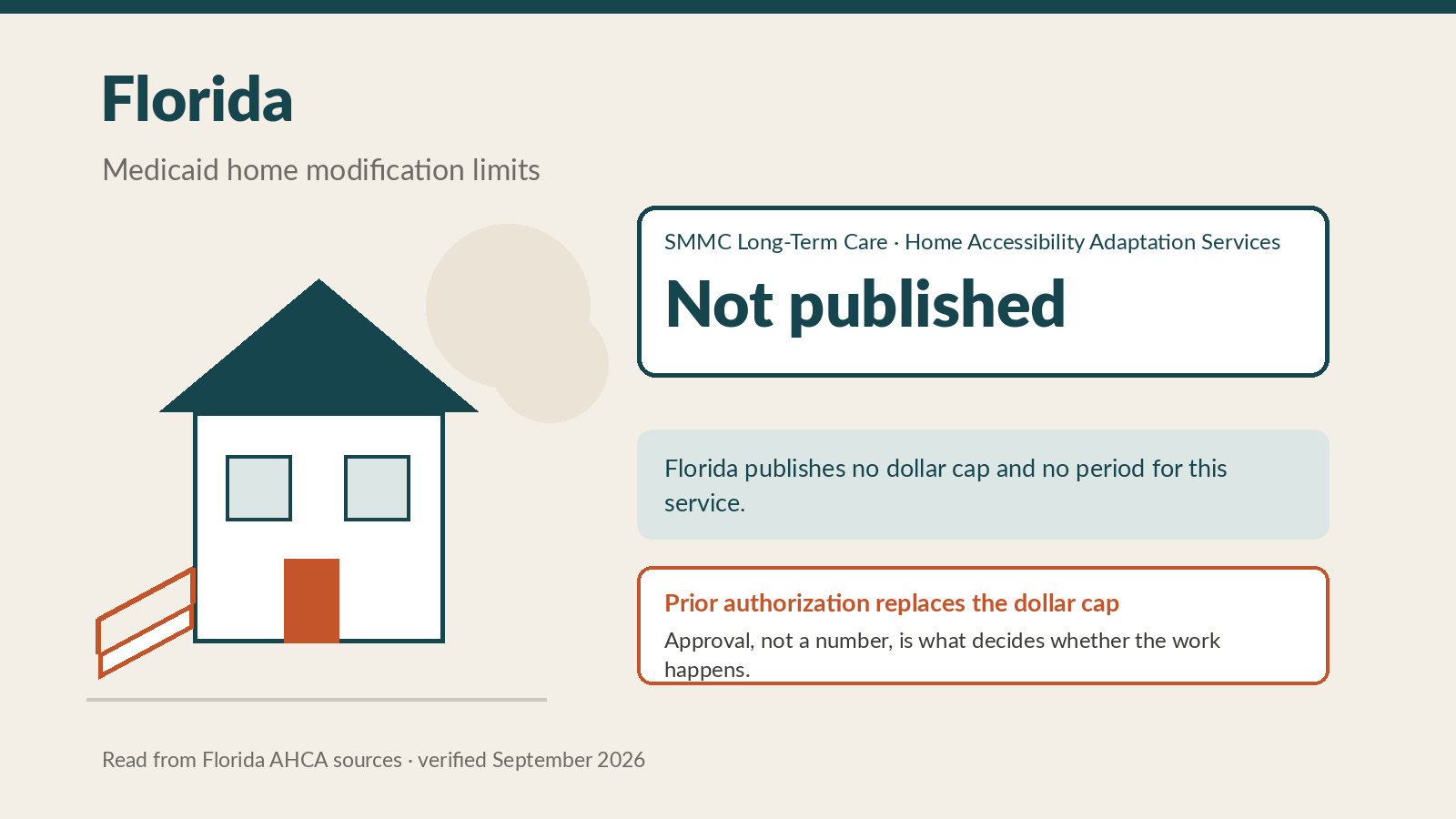
If you are trying to find out how much Florida Medicaid will pay to put a ramp on your mother’s front step or a roll-in shower in her bathroom, you are going to run into something frustrating: there is no number. Not a low number, not a hidden number. Florida’s governing coverage policy for this benefit contains no dollar amount at all.
That is not an oversight, and it is not us failing to find the figure. It is a direct consequence of how Florida delivers long-term care. Understanding why changes what you should actually do next, so it is worth five minutes.
The amount and the period: Florida does not publish one
Home modifications in Florida Medicaid live inside the Statewide Medicaid Managed Care Long-term Care program — usually written SMMC LTC. The benefit is called Home Accessibility Adaptation, and it is billed under procedure code S5165.
The rule that governs it is Rule 59G-4.192, Florida Administrative Code, incorporated as the Statewide Medicaid Managed Care Long-term Care Program Coverage Policy, dated March 2017. We read that policy front to back for this page. It defines the service, lists who may provide it, lists what is excluded, and states that services must be authorized before they are delivered.
What it does not do — anywhere — is state a maximum dollar amount, a lifetime cap, or a per-year allowance.
Compare that with states that do publish one. Ohio, Illinois, Maryland and Kansas all put a figure in their waiver documents. Florida does not, and neither do Arizona or Pennsylvania, for the same structural reason: all three deliver long-term care through capitated managed care plans. The state pays a plan a fixed monthly amount per enrollee. The plan then authorizes services case by case against an individual plan of care. There is no line item to cap, because the money is not allocated per service in the first place.
So the honest answer to “what is Florida’s home modification limit” is: Not published. Your effective limit is whatever your LTC plan authorizes for you, and that is a clinical and contractual decision, not a published schedule. We have listed exactly which documents we checked at the bottom of this page.
If you want to see how Florida sits next to the states that do publish a figure, our 50-state Medicaid home modification limits table puts all of them side by side with the source document for each.
What Florida’s LTC program actually covers
Rule 59G-4.192 defines Home Accessibility Adaptation as physical adaptations to the home that ensure the enrollee’s health, safety and welfare, or that let the enrollee function with greater independence at home — where without them, the enrollee would require institutionalization.
The policy names these examples directly:
- Installation of ramps
- Installation of grab bars
- Widening of doorways
- Modification of bathroom facilities
- Installation of specialized electrical and plumbing systems to accommodate medical equipment and supplies necessary for the enrollee’s welfare
All adaptations must comply with applicable state and local building codes. That is written into the rule, and it matters more in Florida than in most states — a contractor who cannot pull a permit for a ramp in a coastal county is not going to be paid.
Two adjacent benefits are worth knowing about, because families often want them and do not realise they are separate line items in the same program:
- Medical Equipment and Supplies — governed by Rule 59G-4.070, F.A.C. The LTC policy specifically says this includes devices, controls or appliances that increase the enrollee’s ability to perform activities of daily living, along with items not otherwise available under the State Plan, and repair or replacement parts. A shower chair or a transfer bench usually sits here, not under home modification.
- Personal Emergency Response Systems — installation and monthly monitoring of a call button for an enrollee at high risk of institutionalization. Codes S5160 and S5161.
Grouping matters because the plan authorizes against a single person-centered plan of care. Asking your case manager for “the home modification benefit” when what you need is a $90 shower chair can send the request down a slower path than it needs to go.
What it will not pay for
The exclusions section of Rule 59G-4.192 is short and specific. For home modification purposes, the one that catches the most families is the first:
Adaptations which add to the total square footage of the home.
That single sentence rules out a very common plan: building a small addition so a parent can have a ground-floor bedroom and bath. Converting an existing garage or den is a different conversation — you are not adding square footage — but a bump-out is out of scope, full stop.
The exclusions list also rules out room and board payments to assisted living facilities or adult family care homes, and services delivered to enrollees while they are in a hospital, a licensed group home, a state mental health hospital, or an intermediate care facility.
One more constraint is not in the exclusions list but does real work: the policy’s medical necessity definition requires that the service be at a level that can be safely furnished and for which no equally effective and more conservative or less costly treatment is available statewide. In practice that clause is why a plan may authorize a modular aluminium ramp instead of a poured concrete one. It is not the plan being difficult; it is the rule they are applying.
Prior authorization is what replaces the dollar cap
Because there is no published ceiling, the whole question of “how much will they pay” collapses into one process: prior authorization by your LTC plan. Rule 59G-4.192 says LTC services must be authorized by the enrollee’s plan before the service is delivered. Work done first and invoiced later is work you may end up paying for yourself.
Three things drive whether the authorization comes through:
1. It has to be on the plan of care. The policy requires services to be consistent with the type, amount, duration, frequency and scope specified in the authorized plan of care, and tied to a goal in that plan. If “remain safely at home, independent with bathing” is not written as a goal, a walk-in shower has nothing to attach to. Ask your case manager to write the goal before you ask for the modification.
2. The plan of care gets reviewed at least every 90 days. That is a required field in the plan-of-care template under the rule. A 90-day review is the natural moment to add a modification request, and it is a deadline you can plan around rather than waiting for a callback.
3. The contractor has to be qualified under the rule. The appendix to 59G-4.192 lists who may perform Home Accessibility Adaptation: an independent provider licensed under state and local building codes and Chapter 205, F.S., licensed by the local city or county for the type of work being performed and able to furnish proof of current insurance; a Center for Independent Living as defined under s. 413.371, F.S.; or a general contractor. Your neighbour’s handyman does not qualify, however good he is.
You also have appeal rights and the rule makes the plan tell you so. The plan-of-care template must carry a verbatim statement above your signature: that you have read the plan, and that you have the right to file an appeal or fair hearing if services are denied, reduced, terminated or suspended. If a modification is denied, that sentence is the one to point at.
How to apply: the actual door, by name
Florida’s entry point is not the Medicaid agency. It is the aging network.
- Call your local Aging and Disability Resource Center (ADRC), or the statewide toll-free Elder Helpline at 1-800-96-ELDER (1-800-963-5337). The ADRC administers a telephone screening. Expect it to take roughly 45 minutes to an hour, and expect questions about daily functioning, caregivers and living situation.
- The screening produces a priority score and rank. This is automated, based on the Department of Elder Affairs screening under Rule 58A-1.010, F.A.C.
- If your rank is high enough, you go on the wait list. If it is not, you get written notice of that plus information on community resources.
- When you are released from the wait list, the Department of Elder Affairs sends written notice with a Medical Certification for Medicaid Long-term Care Services and Patient Transfer Form (AHCA MedServ Form 5000-3008). You must return it within 30 calendar days.
- Two eligibility tracks run in parallel. The Department of Children and Families determines financial eligibility. The Department of Elder Affairs CARES program determines whether you meet nursing facility level of care. Both have to land before AHCA enrolls you in an LTC plan.
- Only after enrollment does a plan case manager build your plan of care — and only then can a home modification be authorized.
The agencies, by name and role, so you can ask for the right one: Department of Elder Affairs (DOEA) — screening, wait list, CARES clinical eligibility. Aging and Disability Resource Centers (ADRCs) — the phone number you actually call. Department of Children and Families (DCF) — financial eligibility. Agency for Health Care Administration (AHCA) — the Medicaid agency; it sets how many enrollments are available and it does the enrolling.
The wait list, honestly
This is the part that most pages skip, and it is the part that determines your timeline.
Florida’s LTC program has a wait list, and release from it is not based on how long your name has been on it. AHCA states this plainly. Each month DOEA releases individuals based on priority score and frailty-based rank, against however many enrollments AHCA has made available that month.
The ranks, from Rule 59G-4.193, F.A.C.:
| Band | Rank | Priority score |
|---|---|---|
| Low priority | Rank 1 | 0–15 |
| Low priority | Rank 2 | 16–29 |
| High priority | Rank 3 | 30–39 |
| High priority | Rank 4 | 40–45 |
| High priority | Rank 5 | 46 or above |
| High priority | Rank 6 | Aging Out referral |
| High priority | Rank 7 | Imminent Risk |
| High priority | Rank 8 | Adult Protective Services high risk referral |
Only high priority ranks — 3 and above — get wait list placement at all. Rank 1 and Rank 2 do not.
“Imminent Risk” is defined, not discretionary. Under 59G-4.193 it means all three of the following are true: the person cannot perform self-care because of deteriorating mental or physical health; there is no capable caregiver; and nursing facility placement is likely within a month, or very likely within three months. If that describes your situation, say so explicitly during screening.
Two practical levers most families never use:
- Rescreening after a significant change. For a low priority rank, ADRCs may rescreen on request annually, or will rescreen when notified of a significant change. For a high priority rank, they rescreen annually or on a significant change. A fall, a hospitalisation, or a caregiver who has stopped being available are all reasons to call and ask.
- You can request a copy of your completed screening tool, including the priority score. The written notice you receive after screening is required to tell you how. If you think the score is wrong, that document is where you find out why.
You also have the right to request an administrative fair hearing over the screening result. The notice must include instructions for doing so.
One last trap: if DOEA cannot reach you to schedule a screening or rescreening, or you miss an appointment, they send a letter giving you 30 calendar days to make contact — and you can be removed from the process or the wait list if you do not. Keep your address and phone number current with the ADRC.
How Florida compares with states that publish a number
It is tempting to read “no published limit” as generous. It is more accurate to read it as unpredictable.
In Illinois, the Home Services Program environmental modifications benefit carries a stated figure of $25,000 over five years — though that budget is shared with assistive technology, equipment and vehicle modifications, so the amount actually available for construction is less. In Ohio and North Carolina you can look up a number before you call anyone. That number gives a family something to plan against, even when it is small.
Florida gives you no such anchor. What you get instead is a plan-of-care process with a 90-day review cycle and an appeal right. That can produce a better outcome than a small hard cap — a plan authorizing a bathroom conversion is not constrained by a $6,000 ceiling — or a worse one, if the request never makes it onto the plan of care in the first place.
The practical implication: in a capped state your job is to make the money stretch. In Florida your job is to document need. Occupational therapist assessments, fall history, and a clearly written plan-of-care goal do more here than they do almost anywhere else.
For the federal baseline underneath all of this, see does Medicaid pay for home modifications. For a capped state to contrast against, our Texas page covers a state that also runs managed care but handles its waiver waiting list very differently.
Frequently asked questions
Does Florida Medicaid pay for a walk-in shower?
Modification of bathroom facilities is named in Rule 59G-4.192 as a covered adaptation, so it is within scope. Whether your plan authorizes it depends on medical necessity and on it appearing in your authorized plan of care. The rule’s “no equally effective and less costly treatment” clause means a plan may propose a lower-cost alternative first.
Is there a lifetime cap on home modifications in Florida?
Not one that Florida publishes. The SMMC LTC coverage policy contains no dollar amounts. Your ceiling is set by what your LTC plan authorizes against your plan of care.
Can Florida Medicaid pay to add a bedroom or bathroom onto the house?
No. Adaptations that add to the total square footage of the home are explicitly excluded. Converting existing space is a different question and is not excluded by that clause.
How long is the Florida Medicaid long-term care wait list?
Florida does not publish a wait time, and a wait time would be misleading if it did: release is by priority score and rank, not by how long you have waited. Someone screened at Rank 7 can be released ahead of someone who has been on the list for two years at Rank 3.
Do I have to be on Medicaid already to be screened?
No. You can be screened and placed on the wait list first. AHCA’s guidance is explicit that people not on Medicaid when released from the wait list must then complete financial eligibility with DCF and medical eligibility with DOEA before enrollment can happen.
Who actually pays the contractor?
Your LTC plan, through its contracted or authorized provider network, after prior authorization. The contractor must meet the qualifications in the appendix to 59G-4.192 — licensed for the type of work, licensed under Chapter 205 F.S. where applicable, and able to show current insurance.
Primary sources and last verification date
Every factual claim above comes from one of these documents. We read each of them directly rather than relying on summaries.
- Rule 59G-4.192, F.A.C. — Florida Medicaid Statewide Medicaid Managed Care Long-term Care Program Coverage Policy (March 2017), Agency for Health Care Administration. Source for the service definition, covered adaptations, exclusions, medical necessity language, plan-of-care requirements, provider qualifications and procedure code S5165. Contains no dollar amounts.
- Rule 59G-4.193, F.A.C. — SMMC Long-term Care Waiver Program Prioritization and Enrollment, AHCA. History: new 12-8-16, amended 7-20-21. Source for priority ranks, the Imminent Risk definition, rescreening rules, the 30-day notice deadlines and AHCA MedServ Form 5000-3008.
- SMMC LTC Program Waitlist Release, AHCA. Source for monthly release by score and rank, and for the statement that release is not based on time on the list.
Last verified: 8 September 2026. Both rules were retrieved and read in full on that date and both remain live at the URLs above. Rule 59G-4.193 carries an amendment date of 20 July 2021 and states it is effective for five years after its effective date — worth re-checking before you rely on the rank bands in 2027.
What to do this week
- Call the Elder Helpline at 1-800-96-ELDER and ask to be screened by your ADRC. Set aside an hour.
- Before the call, write down falls in the last twelve months, hospitalisations, and exactly which daily tasks now need help. The priority score is built from this.
- If there is no capable caregiver and a nursing home looks likely within three months, say those words during screening — that is the Imminent Risk definition, and Rank 7 sits near the top of the release order.
- If you are already enrolled in an LTC plan, ask your case manager for the date of your next 90-day plan-of-care review, and ask for the safety goal to be written in before that review.
- If you have been denied, ask in writing for a copy of your completed screening tool and the instructions for an administrative fair hearing. Both are things the state is required to give you.
Florida is a state where the process, not the price list, decides what you get. That is worse for planning and better for anyone willing to be persistent.
Leave a Reply