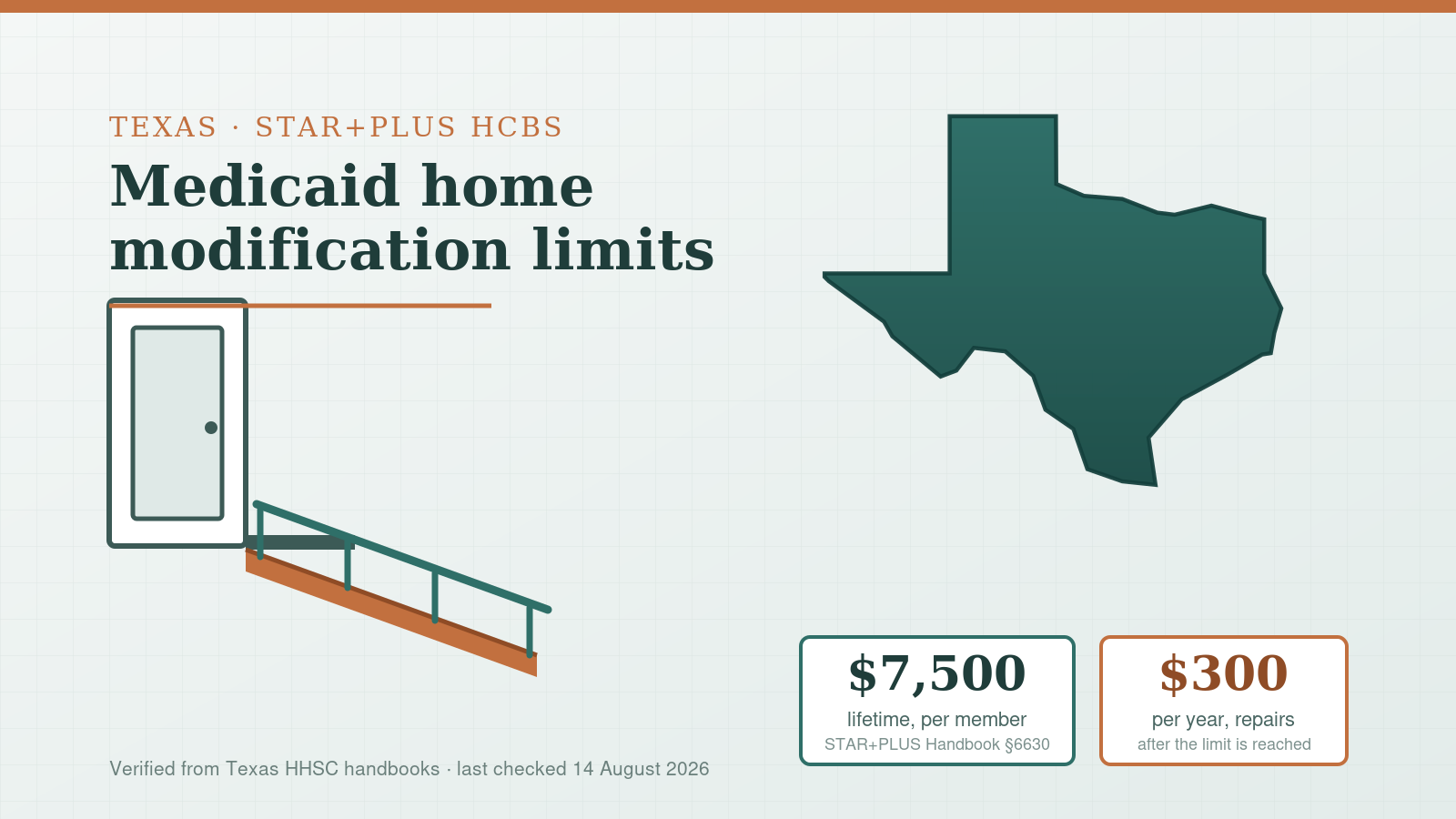
Short answer: Texas Medicaid pays for home modifications through the STAR+PLUS Home and Community Based Services (HCBS) program, and the published ceiling is $7,500 per member for life, plus $300 per year for repairs after that ceiling is reached. Those two numbers come straight out of the STAR+PLUS Handbook, Section 6630. They are not estimates, and they are not per-year figures — the $7,500 is a lifetime number that follows you even if you switch health plans.
This page collects every dollar figure Texas actually publishes for home modification funding, names the agency you contact, quotes the exclusion list verbatim, and is honest about the one number the state does not publish: how long the wait is. Every figure below was read directly from a Texas Health and Human Services Commission handbook, a Texas Administrative Code citation, or a Texas Department of Housing and Community Affairs program page. Last verified August 14, 2026.
The dollar limits, and the period each one covers
Texas does not run one home modification benefit. It runs several, attached to different waivers and different age groups, and the limits are genuinely different. Mixing them up is the single most common error in the commercial pages that rank for this question.
| Program | Who it covers | Home modification limit | Period |
|---|---|---|---|
| STAR+PLUS HCBS | Adults 21+ on Medicaid who meet nursing facility level of care | $7,500, then $300 for repairs | Lifetime, then per year |
| STAR Kids / MDCP | Members under 21 in the Medically Dependent Children Program | $7,500, plus $300 for maintenance and repair | Lifetime, plus per ISP period |
| CLASS waiver | People with a related condition other than intellectual disability | $10,000, then $300 for repair and maintenance | Lifetime, then per IPC period |
| Amy Young Barrier Removal | Households at or under 80% of area median family income, disability | $22,500 | One-time grant |
STAR+PLUS HCBS: $7,500 lifetime, $300 a year afterward
Section 6630 of the STAR+PLUS Handbook (Revision 20-2, effective October 1, 2020) reads: “There is a lifetime limit of $7,500 per member for this service and $300 yearly for repairs. Once the $7,500 cost limit is reached, only $300 per year per member, excluding associated fees, will be allowed for repairs, replacement or additional modifications.”
Three details in that section matter more than the headline number:
- Your managed care organization is allowed to go over the limit. The handbook states that if your individual service plan identifies a need for modifications that exceed the lifetime benefit limit, “the MCO is permitted to exceed the cost limit without prior approval from” HHSC. The MCO simply cannot bill the overage back to the state. This is a real, written escape hatch — it is worth asking your service coordinator about directly, by name, citing 6630.
- The limit follows you between health plans. If you change MCOs, “the losing MCO must provide documentation to the gaining MCO related to any MHM expenditures.” Switching plans does not reset your $7,500.
- The $300 is for repairs, not a fresh allowance. It covers “repairs, replacement or additional modifications” only after the $7,500 is exhausted, and it excludes associated fees.
Under 21: STAR Kids and MDCP
The STAR Kids Handbook, Section 4821 (Revision 22-2, effective September 1, 2022), sets the same headline figure but structures the repair money differently: “The minor home modification lifetime limit is $7,500. The service coordinator may authorize up to $300 per the individual service plan (ISP) period for maintenance or repairs of minor home modifications previously approved and reimbursed with waiver funds. The service coordinator does not include $300 maintenance and repair limit as part of the $7,500 lifetime limit.”
Two other MDCP numbers are worth knowing, because families routinely confuse them with home modification money. Adaptive aids — which in Texas include stair lifts, barrier-free lifts, van lifts and environmental control units — carry a separate limit of $4,000 per annual ISP period (Section 4811). Transition Assistance Services, used to set up a household when leaving a nursing facility, carry a $2,500 lifetime limit (Section 4834). A stair lift for a child on MDCP therefore comes out of the $4,000 adaptive aid pot, not the $7,500 modification pot. If you are trying to work out which bucket a lift falls into, our page on whether Medicare covers stair lifts explains why the equipment-versus-modification distinction changes the answer so often.
The STAR Kids handbook also contains a provision families should read carefully: if a requested modification exceeds the limit, the MCO may approve it “only if the member agrees to pay any costs that are in excess of the service limit,” documented and signed. That is a different mechanism from the STAR+PLUS one, where the MCO may absorb the overage itself.
CLASS waiver: $10,000 lifetime
Appendix II of the CLASS Provider Manual (Revision 22-1, effective August 23, 2022) is the highest published Medicaid ceiling in Texas: “The maximum amount HHSC authorizes as payment to the DSA for all MHMs purchased for a person receiving CLASS program services is $10,000. This is a lifetime limit… After reaching the lifetime maximum cost of $10,000, the person may receive, during an IPC period, a maximum of $300 for repair and maintenance of an MHM purchased through the CLASS program, needed after one year has elapsed from the date the MHM is complete.”
CLASS also imposes a bidding rule that slows projects down and is worth budgeting time for: for any modification costing $1,000 or more, the direct services agency “must obtain comparable bids for the requested MHM from three vendors,” and the assessment behind the request must be a face-to-face evaluation conducted no more than one year before the purchase date.
Outside Medicaid: the Amy Young Barrier Removal Program
Texas runs one accessibility grant that is not Medicaid at all and does not require a waiver slot. The Texas Department of Housing and Community Affairs describes it plainly: “The Amy Young Barrier Removal (AYBR) Program provides one-time grants of up to $22,500 for qualified households with Persons with Disabilities who need modifications to increase accessibility and eliminate hazardous conditions in their home.”
Household income must not exceed 80% of Area Median Family Income, and — importantly — applicants “may be tenants or homeowners.” The catch, stated on TDHCA’s own page: “The AYBR program is not available in all areas of Texas.” TDHCA contracts the program out to nonprofits and local governments, so availability depends on whether a subrecipient covers your county. At $22,500 it is three times the STAR+PLUS ceiling, which makes it the first thing to check for anyone who is either not Medicaid-eligible or stuck on an interest list.
What STAR+PLUS covers — and the exclusion list nobody quotes
Section 6620 of the STAR+PLUS Handbook (Revision 19-1, effective June 3, 2019) lists what may be purchased. The covered list is long and more generous than most people expect. It includes wheelchair ramps and protective awnings over ramps; roll-in and wheelchair-accessible showers; sink, bathtub, toilet and faucet modifications; turnaround space modifications; accessible kitchen work surfaces and cabinet adjustments; door widening and door replacement for accessibility; electrical wiring; grab bars and handrails; automatic door openers, doorbells, door scopes and adaptive wall switches; fire safety adaptations and alarms; light alarms and doorbells for people who are deaf or blind; floor leveling where a ramp is not possible; vinyl flooring or industrial-grade carpet where the existing surface is unsafe; widening a garage or carport to allow safe wheelchair transfers; sidewalk installation from a detached garage or driveway; porch and patio leveling; security fencing for a person with cognitive impairment who may wander; protective wall padding and corner guards; motion sensory lighting; intercom systems; and lever door handles.
One line in 6620 is genuinely useful and almost never mentioned: “There is no limit to the number of wheelchair ramps that can be authorized, provided the total cost does not exceed the cost limit.” Multiple ramps at multiple entrances are allowed if the documentation supports the need.
The exclusions, verbatim
Section 6620 also names items the service coordinator cannot approve. Quoted as written:
- carpeting (other than industrial grade)
- newly constructed carports, porches, patios, garages, porticos or decks
- electric fences
- landscaping and yard work or supplies
- roof repair or replacement
- gutters
- leaky faucet repair
- elevators
- house painting
- electrical upgrades and/or electrical outlets, unless needed to power adapted equipment or a safety hazard exists
- air duct cleaning and maintenance
- pest exterminations
Three further exclusions sit elsewhere in the same section. Adaptations that add square footage are excluded from the benefit — a bathroom can be reconfigured, but it cannot be built as an addition. Carbon monoxide detectors “cannot be purchased under STAR+PLUS Home and Community Based Services (HCBS) program as a ‘fire safety adaptation and alarm.’” And requests for “routine home maintenance and upkeep” cannot be approved at all, which is the category most denied requests actually fall into.
Note also the heating and cooling rule, which trips people up constantly: HVAC equipment itself may be approved as an adaptive aid, not a home modification, but “the modification of the home must be authorized as an MHM.” A window unit is an aid; widening the window to fit it is a modification. They come from different budgets.
If you rent
Section 6640 is short and absolute: “When the member has a landlord or when the owner of the home is not the member, written approval prior to the initiation of any requested modification must be obtained.” Get the landlord’s signature before anything is ordered, not after. Separately, modifications are not made to homes “leased, owned or controlled by providers contracted with the managed care organization” — a rule aimed at assisted living arrangements.
How long the work should take
Section 6650 (Revision 21-1, effective May 1, 2021) gives you a deadline you can hold the plan to: once a modification is on your individual service plan, the MCO “must ensure completion of the MHM within 90 business days” after the ISP start date or the date of the revision that added it. If the MCO misses that date, it is required to document the delay, tell you the reason, and give you a new proposed completion date — in writing, and again for every subsequent slip.
Who qualifies, and where to apply
The STAR+PLUS Program Support Unit Operational Procedures Handbook, Section 1200 (Revision 25-2, effective June 6, 2025), lists the eligibility criteria for the HCBS program. An applicant or member must:
- be 21 years or older
- have full Medicaid financial eligibility
- be a U.S. citizen
- be a resident of Texas
- have an approved medical necessity for a nursing facility level of care
- have an individual service plan with services under the established cost limit
- have an unmet need for at least one STAR+PLUS HCBS program service
- be living in an appropriate living situation
That sixth condition has a number attached to it. Section 1260 (Revision Notice 25-5, effective December 17, 2025) states the cost of HCBS services on your ISP “should not exceed 202 percent of the cost of care” HHSC would pay for you in a nursing facility, per 1 TAC §353.1153(c)(1)(H). If your plan exceeds it, the Office of the Medical Director and Utilization Review staff review whether you qualify through the Medically Fragile group or general revenue funds process.
The agencies and the phone numbers
- Texas Health and Human Services Commission (HHSC) — administers STAR+PLUS, STAR Kids and CLASS. Program page: hhs.texas.gov/services/health/medicaid-chip/medicaid-chip-members/starplus
- HHSC Interest List Management (ILM) — the unit that puts your name on the STAR+PLUS HCBS list. HHSC’s own interest list page directs people to call 1-877-438-5658 for waiver programs other than HCS and TxHmL.
- Your Texas Benefits — where you apply for Medicaid itself, which must happen first. HHSC’s STAR+PLUS page: “To enroll in Medicaid, visit Your Texas benefits or call 2-1-1.”
- Texas Department of Housing and Community Affairs (TDHCA) — administers Amy Young. Program page: tdhca.texas.gov/programs/amy-young-barrier-removal-program-aybr. To find a local provider, TDHCA directs households to its Help for Texans search, filtered to “Home Repair/Accessibility Modifications.”
If you are already enrolled in STAR+PLUS, Section 1200 says you can be placed on the interest list “by contacting… their managed care organization” instead of ILM — that is, your existing health plan can do it for you.
The interest list: what Texas publishes, and what it does not
Texas does not call it a waiting list. It calls it an interest list, and the mechanics are stated openly on HHSC’s Interest List Reduction page: “Because the demand for community-based services and supports often outweighs available resources, applicant’s names may be placed on an interest list until services are available… Applicants are placed on interest lists on a first-come, first-served basis. Allocations are based on available funding. People who have been on the interest lists the longest are enrolled first.”
The scale of the funding constraint is visible in the one allocation table HHSC publishes on that page. For the 2022–23 biennium, the Legislature funded 1,549 new waiver slots across all programs, of which 107 were for STAR+PLUS HCBS. That is the entire statewide expansion for the program in a two-year budget cycle.
Not published here: the current list count and the average wait
We are not going to give you a number of people currently on the STAR+PLUS HCBS interest list, or an average wait in years, because we could not read one from a state source. Rider 19 of Senate Bill 1 (87th Legislature) does require HHSC to post monthly interest list counts, counts by years on list, and the percentage found ineligible or declining services — and HHSC does publish them. But it publishes them as spreadsheet downloads (for example, interest-list-data-july-2025.xlsx under hhs.texas.gov/sites/default/files/documents/), which we could not open and read verbatim during this verification pass.
Pages that quote you a precise current headcount are almost always copying an old news article or another commercial site. If you want the real figure, go to the source: HHSC’s Interest List Reduction page and open the most recent monthly data file listed there.
Three documented ways around the list
Section 1200 describes three routes that do not require waiting your turn, and they are the most actionable thing on this page:
- The upgrade process. “For individuals currently receiving Medicaid and who are already enrolled with an MCO, they may be able to bypass the interest list through the upgrade process.” If you already have Medicaid and a STAR+PLUS plan, ask your service coordinator about an upgrade assessment by name.
- Money Follows the Person. “An individual living in a nursing facility (NF) may become eligible for the STAR+PLUS HCBS program by pursuing the Money Follows the Person (MFP) process.” MFP exists precisely to move people out of facilities and into modified homes.
- Other services while you wait. HHSC states that “People can receive Medicaid or other community services while they are on the interest list, if they are eligible,” and that “Receiving other services does not impact a person’s place on an interest list.” Taking help now does not cost you your position.
Route 3 is where Amy Young matters most: at $22,500 it is a larger grant than the Medicaid benefit, it is administered by a different agency entirely, and using it does not affect where you sit on the HHSC list.
How Texas compares
$7,500 lifetime places Texas in the middle of the national range, which is far wider than most people assume. Across the states that publish a figure at all, the ceilings run from West Virginia’s $1,000 per service year to Alaska’s $40,000 every three years — a fortyfold spread for what is nominally the same federal benefit. Roughly two in five states publish no dollar figure whatsoever.
We maintain the full side-by-side in our Medicaid home modification funding limits by state table, which lists all 50 states and DC with the program name, the published limit, the period it covers, and a link to the primary source for each — including the states where the honest answer is “not published,” with the pages we checked. For the underlying question of what Medicaid will and will not pay for anywhere, start with does Medicaid pay for home modifications. If Medicaid is not your route, our overview of home modification grants covers the non-Medicaid programs, and California readers can compare directly against home modification grants in California, where the CalAIM ceiling is the same $7,500.
Primary sources and last verified date
Every figure on this page was read from one of the documents below on August 14, 2026. We do not cite commercial senior-care directories, law firm marketing pages, or blogs for dollar amounts.
- Texas HHSC, STAR+PLUS Handbook §6600–6650, Minor Home Modifications — fhb.hhs.texas.gov/handbooks/starplus-handbook/6600-minor-home-modifications (§6630 Revision 20-2, effective October 1, 2020)
- Texas HHSC, STAR+PLUS Program Support Unit Operational Procedures Handbook §1200, STAR+PLUS HCBS Program Eligibility — fhb.hhs.texas.gov/handbooks/starplus-program-support-unit-operational-procedures-handbook/1200-starplus-hcbs-program-eligibility (Revision 25-2, effective June 6, 2025; §1260 Revision Notice 25-5, effective December 17, 2025)
- Texas HHSC, STAR Kids Handbook §4800, Adaptive Aids, Minor Home Modifications, and Transition Assistance Services — fhb.hhs.texas.gov/handbooks/star-kids-handbook/4800-… (§4821 Revision 22-2, effective September 1, 2022)
- Texas HHSC, CLASS Provider Manual, Appendix II, Minor Home Modification Services — fhb.hhs.texas.gov/handbooks/community-living-assistance-support-services-class-provider-manual/appendix-ii-minor-home-modification-services (Revision 22-1, effective August 23, 2022)
- Texas HHSC, Interest List Reduction — hhs.texas.gov/about/records-statistics/interest-list-reduction
- Texas HHSC, STAR+PLUS program page (enrollment, service areas, health plans) — hhs.texas.gov/services/health/medicaid-chip/medicaid-chip-members/starplus
- Texas Department of Housing and Community Affairs, Amy Young Barrier Removal Program — tdhca.texas.gov/programs/amy-young-barrier-removal-program-aybr
- 1 Texas Administrative Code §353.1153, STAR+PLUS Home and Community Based Services (HCBS) Program — cited in the handbooks above for the eligibility criteria and the 202% ISP cost limit
Our sourcing rules are set out in how we source our data. If a figure on this page has changed, or a link has gone dead, tell us through the contact page and we will correct it and update the verification date.
Frequently asked questions
Does Texas Medicaid pay for a stair lift?
Not as a minor home modification. Stair lifts appear on the STAR Kids adaptive aid list, which carries a separate $4,000 annual limit. The STAR+PLUS minor home modification list in §6620 does not include stair lifts, and it explicitly excludes elevators. Ask your service coordinator to price the lift as an adaptive aid, not a modification.
Can I get more than $7,500 if my ramp and bathroom together cost more?
Possibly. STAR+PLUS Handbook §6630 states the MCO “is permitted to exceed the cost limit without prior approval from” HHSC when the ISP identifies a need above the lifetime limit. It is a discretionary decision by your health plan, not an entitlement, but it is written into policy and worth citing directly.
Does Texas Medicaid pay for a roof or a new bathroom addition?
No to both. §6620 lists “roof repair or replacement” among items the service coordinator cannot approve, and §6600 excludes “adaptations that add to the total square footage of the home.” An existing bathroom can be reconfigured; a new one cannot be built.
I rent. Can I still get modifications?
Yes, with written landlord approval obtained before work begins (§6640). Amy Young is also open to tenants, not just homeowners.
How long is the STAR+PLUS HCBS interest list?
HHSC publishes monthly counts, but only as downloadable spreadsheets, and we do not republish a figure we have not read verbatim. Check the most recent data file on HHSC’s Interest List Reduction page. What HHSC does state plainly is that the list is first-come, first-served and that allocations depend on legislative funding — 107 STAR+PLUS HCBS slots in the 2022–23 biennium.
State detail pages: we are building out a full page for each state, with the application route, the exclusion list quoted verbatim and an honest account of the waiting list. Published so far: Texas and New York.
Other state pages: Ohio Medicaid home modification limits and New York.
Not sure how your state compares? Our 51-state funding checker shows what any state actually publishes — the ceiling, the period it covers, and an honest note where the state publishes nothing at all.
Also in this series: North Carolina CAP/DA, the 28,000 dollar limit and the statewide waitlist.
Also in this series: Washington COPES, the 700 dollar limit and why Community First Choice will not pay for modifications.
Leave a Reply