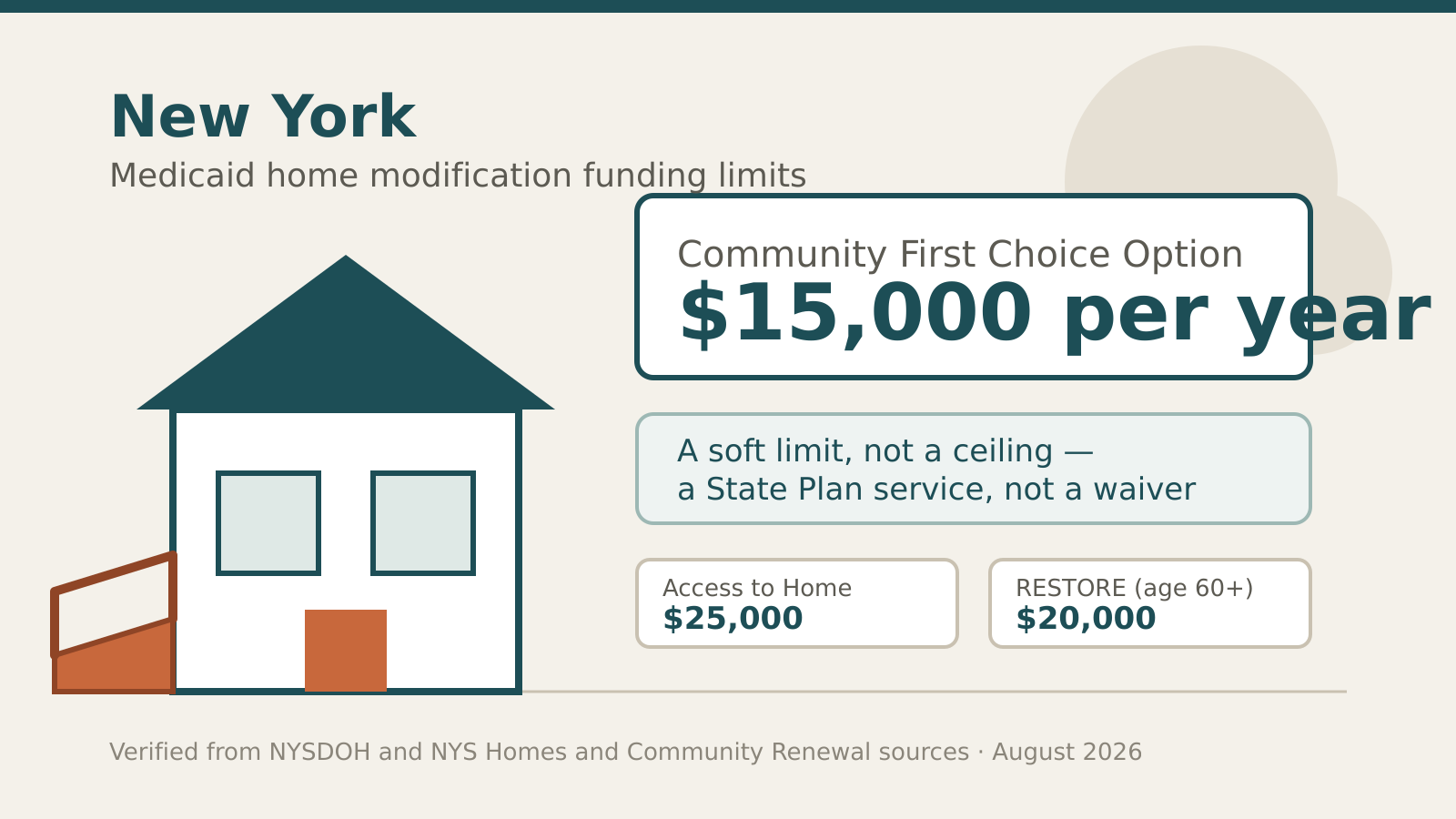
Short answer: New York pays for home modifications through the Community First Choice Option (CFCO), and it does something almost no other state does — it makes them a Medicaid State Plan service rather than a waiver benefit. The published figure is $15,000 per year, and the state’s own guidance calls it a soft limit that may be exceeded. Above that number your local district or health plan has to get approval from the New York State Department of Health first.
That one structural fact — State Plan service, not waiver service — is the most important thing on this page, and it is the thing commercial pages get wrong most often. It changes who you apply to, it changes whether there is a waiting list, and it changes what happens when the estimate comes in over budget. Every figure below was read directly from a New York State Department of Health guidance document, a Homes and Community Renewal program manual, or a state agency program page. Last verified August 19, 2026.
The dollar limits, and the period each one covers
New York runs accessibility money out of two entirely separate agencies. The Department of Health pays for Medicaid environmental modifications. Homes and Community Renewal runs two grant programs that have nothing to do with Medicaid and are worth checking in parallel, because their ceilings are higher.
| Program | Who it covers | Published limit | Period |
|---|---|---|---|
| CFCO Environmental Modifications (E-Mods) | Medicaid recipients with an institutional level of care, living at home | $15,000 (soft limit) | Per year |
| Access to Home (HCR) | Households at or below 80% of area median income with a documented disability | $25,000 | Per property, per 3-year regulatory period |
| RESTORE (HCR) | Homeowners 60+, income at or below 100% of area median income | $20,000 | Per project |
| NHTD and TBI waivers | Waiver participants transitioning from or diverting from nursing home care | Not published here — see below | — |
CFCO: $15,000 a year, and why “limit” is the wrong word
The Department of Health’s Guidelines for Authorizing Environmental Modifications (revised June 2019) is the controlling document. It opens by stating that the guidelines “outline the process for authorizing environmental modifications (E–Mods) under Community First Choice Option (CFCO) as a covered State Plan service.”
The money sentence reads: “Agreements for E–Mods may not exceed $15,000 per year without prior approval from the New York State Department of Health. The Department of Health may delegate this responsibility to Medicaid managed care plans for their enrollees. The Local Departments of Social Services (LDSS) or the Developmental Disability Regional Office (DDRO) must contact the Department of Health to obtain this approval. In all cases, service limits are soft limits that may be exceeded due to medical necessity.“
Read that last sentence twice. Most states that publish a number treat it as a ceiling and make you argue your way past it. New York wrote the escape hatch into the guidance itself. The $15,000 is not a cap on what you can receive — it is the threshold at which the approval moves up a level, from your local district or managed care plan to the state. If your ramp and bathroom conversion price out at $22,000, the correct response is not to cut the scope. It is to ask your care manager to document medical necessity and route the request for state approval.
Two smaller details in the same sentence matter in practice. First, if you are enrolled in a Medicaid managed care or MLTC plan, DOH may have delegated the over-$15,000 approval to your plan, which means the decision can be made without ever leaving the plan. Second, if you receive services through the developmental disability system, the request goes through a Developmental Disabilities Regional Office rather than your county social services district.
Who qualifies
DOH lists three criteria, and you must meet all of them. State Plan services under CFCO are available to individuals who are:
- “Eligible for medical assistance under the New York State Medicaid”
- “Have an institutional level of care as determined by the functional assessment used by that population (UAS)”
- “Are living in their own home or a family member’s home (not a congregate setting)”
The second criterion is the one that surprises people: you have to be assessed as needing nursing-home-level care to qualify for the modification that keeps you out of a nursing home. The assessment is the UAS-NY, and it is the same assessment used to authorize personal care hours, so if you already receive home care you have almost certainly been through it.
The third criterion quietly rules out assisted living and adult care facilities. The E-Mod guidelines reinforce it from the provider side: “Provider–owned or leased homes are not eligible for E–Mods.”
What CFCO covers, and what it will not
DOH gives an explicitly non-exhaustive list of examples: ramps; “lifts that require modifications to the home: hydraulic, manual or electric”; widened doorways; roll-in showers and accessible tubs; cabinet and shelving adaptations; handrails and grab bars; automatic or manual door openers and doorbells; water faucet controls; and “electrical and plumbing accommodations for new equipment.”
The lift language is worth pausing on, because it settles a question that comes up constantly. A lift is covered when it requires modification to the home. That is a different test from most states, which sort lifts into an equipment bucket with its own smaller budget. If you are trying to work out which side of the line a particular device falls on, our page on whether Medicare covers stair lifts explains why the equipment-versus-modification distinction changes the answer so often.
The exclusions are short and quoted here as written. CFCO will not fund:
- “Adaptations or improvements to the home that are of general utility, and are not of direct medical or remedial benefit to the individual”
- “Adaptations that exceed the necessity of the service (e.g. roll–in showers or accessible tubs will not be provided if a shower chair will do)”
- “Adaptations that add to the total square footage of the home”
The middle one is unusual and it is where New York denials actually happen. Most states exclude categories of work; New York also excludes over-specification. A roll-in shower is covered — unless a shower chair would have solved the same problem. The practical consequence is that the clinical justification has to explain why the cheaper option fails for you specifically, not merely that the expensive option would help.
Separately, the guidance states that E-Mods “cannot cover home improvements such as central air conditioning, new carpet, roof repair, etc. that are unrelated to the individual’s POC,” that “all materials must be construction grade,” and that “E–Mods may only be provided where the individual lives.”
The bidding rule that depends entirely on your enrollment
This is the single biggest practical difference between two New Yorkers with identical needs, and it is stated plainly in the authorization procedure.
If you are not in a managed care plan, the local district reviews your package, tells your care manager to start seeking bids, and you must obtain “one for E–Mods less than $1,000, three for E–Mods of $1,000 or more.” The LDSS then selects “the lowest responsible bid that meets the assessed need.” If three bids cannot be obtained without jeopardizing your care, health or safety, the district may proceed with fewer, with the justification documented in the case file. Then, for LDSS-approved projects, the whole package goes to DOH for review and approval before work starts.
If you are in a managed care plan, the guidance says something much shorter: “Please note that MCOs are NOT required to obtain bids.”
Most New Yorkers receiving long-term care are in an MLTC or mainstream managed care plan, which means the bidding cycle and the DOH package review that dominate the fee-for-service path simply do not apply to them. If you are on the fee-for-service side, expect the bid collection to be the slowest part of the project and start it the moment your district gives you the go-ahead.
If you rent
Renting is not a barrier in New York, but the paperwork is front-loaded. The authorization procedure requires that “the individual’s residence must be identified, and residential information must also include the name of the home owner or landlord and their written permission for the modifications/adaptations.” That permission is part of the initial package, not something you produce later — a request without it does not start moving.
One thing to check before you ask: if the property owner is already obligated by law to provide the improvement as a reasonable accommodation, that is a different route with a different payer. HCR applies this test to its own grant programs, requiring that applicants assisting rental units “ensure that the property owner is not otherwise obligated by federal, State, or local law to provide such improvements.”
Where to apply, and the form you will be asked for
There is no application form for an E-Mod that you fill in yourself. The request is generated through the person-centered planning process by your care manager or case manager, which means the first move is always a conversation with whoever manages your plan of care.
- If you are in a managed care or MLTC plan — start with your plan’s care manager. Under the delegation language above, your plan may also hold the authority to approve amounts over $15,000.
- If you are fee-for-service Medicaid — start with your county’s Local Department of Social Services. New York’s Office of Temporary and Disability Assistance maintains the full county-by-county directory at otda.ny.gov/workingfamilies/dss.asp. In New York City the district is the Human Resources Administration, 718-557-1399.
- If you receive developmental disability services — the request routes through your Developmental Disabilities Regional Office rather than the county district.
- To find an approved contractor — DOH publishes a statewide list of Environmental Modification providers at health.ny.gov. All E-Mod providers must be Medicaid-enrolled, an approved 1915(c) waiver provider or OPWDD-approved, or hold a provider agreement with the district, regional office or plan.
You will also need a physician’s order stating the need for assistance. DOH names the acceptable forms: “this may be an approved form requesting home care such as the M11Q used by NYC’s Human Resources Administration or the Form 4539 used by the rest of the State or a letter on physician’s letterhead stating the need for assistance.” A letter on letterhead is explicitly acceptable, which is often the fastest route.
One step catches people out. Before CFCO will pay, the guidance requires that “the care/case manager and the individual will explore potential payment sources for the identified E–Mod including private insurance, community resources, and other Local/State/Federal programs.” Medicaid is the payer of last resort here, and the Access to Home and RESTORE programs described below are exactly the “other State programs” this clause has in mind.
The waiting list question, answered honestly
For CFCO, there is no waiting list mechanism — and the reason is structural rather than a matter of state generosity. DOH describes CFCO as allowing “long term services and supports that were previously only available through a waiver to be Medicaid State Plan Services.” A 1915(c) waiver has a fixed number of funded slots, and a slot cap is what produces a waiting list. A State Plan service has no slot cap. New York moved environmental modifications out of the waiver structure through State Plan Amendment 13-35, and the queue mechanism went with it.
That is not the same as saying the service is fast or that everyone gets it. The rationing in New York happens through the clinical gate — the institutional level of care determination, the clinical justification, and the “exceeds the necessity of the service” test — not through a queue. Being denied and being told to wait are different problems, and in New York you are far more likely to face the first.
Not published here: the NHTD and TBI waiver ceilings
New York also runs two 1915(c) waivers that include environmental modifications: Nursing Home Transition and Diversion (NHTD) and Traumatic Brain Injury (TBI), both administered through Regional Resource Development Centers. These have their own rules, their own approval thresholds and their own slot structure, and they are not governed by the $15,000 CFCO figure.
We are not publishing a dollar ceiling for either one. Figures circulate online, but during this verification pass we could not read one verbatim from a current DOH source. The pages we checked were the NHTD program manual index at health.ny.gov/facilities/long_term_care/nhtd/manual.htm, the manual PDF at nhtd/docs/manual.pdf, and the waiver manual sections at long_term_care/waiver/nhtd_manual/section_05/ and section_06/ — all of which returned the provider qualification and application chapters rather than the service definition chapter that carries the limits. If you are applying under NHTD or TBI, ask your Regional Resource Development Center for the current service definition in writing, and do not assume the CFCO number applies to you.
Outside Medicaid: two state grants with higher ceilings
New York State Homes and Community Renewal runs two programs that pay for the same kind of work without any Medicaid involvement. Both are larger than the CFCO threshold, and both have a catch that is easy to miss.
Access to Home — $25,000
The program “provides financial assistance to make residential units accessible for low- and moderate-income persons with disabilities.” The Local Program Administrator manual, updated March 2026, sets the ceiling: “Eligible activities include accessibility modification and habitability work up to $25,000 in any single building or property, which include hard costs of construction and project delivery funds only. Administrative funds are not included in the $25,000 per-project cap.” The manual also confirms the money can be split across visits — the cap runs to “a total of $25,000 for one or more repairs to a given property within the three-year regulatory period.”
Eligibility is a documented substantial limitation caused by a disability, plus household income at or below 80% of area median income. Veterans certified by the VA or the Department of Defense as entitled to disability payments for a wartime disability qualify at up to 120% of area median income. The unit must be the primary permanent residence, and it “may be owner-occupied or a rental unit.”
RESTORE — $20,000
RESTORE — Residential Emergency Services to Offer (Home) Repairs to the Elderly — covers “the cost of addressing emergencies and code violations that pose a threat to their health and safety or affect the livability of their home.” Eligibility is narrower: you must own and occupy the home as your primary residence, be sixty or older, and have household income at or below 100% of area median income.
The ceiling changed recently and older pages still quote the old figure. HCR records that on August 8, 2022 legislation “increased the individual project cap from $10,000 to $20,000.” The same law requires that “all repairs must be completed within sixty business days of the start of the repairs provided.” Note the scope: RESTORE is an emergency repair and code violation program, not an accessibility program. A furnace failure or a dangerous staircase fits; a roll-in shower generally does not.
The catch for both
HCR states it identically on both program pages: “Municipalities and not-for-profit organizations are eligible to apply for RESTORE program resources, homeowners and individuals are not eligible to apply directly to HCR for assistance.” You cannot apply to the state. You apply to a Local Program Administrator — a municipality or nonprofit that won a grant round — and whether one covers your county in the current round is the whole question. HCR maintains the current list of Local Program Administrators at hcr.ny.gov/grants-available-through-local-partners. Check that list before you spend time on anything else; if no administrator serves your area this round, the $25,000 is not available to you no matter how well you qualify.
How New York compares
$15,000 a year is one of the more generous published figures in the country, and the annual reset makes it more generous still. Most states that publish a number attach it to a lifetime — Texas caps STAR+PLUS at $7,500 for life, and California’s CalAIM ceiling is the same $7,500 lifetime. A New Yorker who needs a ramp this year and a bathroom conversion in three years is working with two separate $15,000 authorizations. A Texan in the same situation has one $7,500 pot for both.
Across the states that publish a figure at all, the ceilings run from West Virginia’s $1,000 per service year to Alaska’s $40,000 every three years, and roughly two in five states publish no dollar figure whatsoever. We maintain the full side-by-side in our Medicaid home modification funding limits by state table, which lists all 50 states and DC with the program name, the published limit, the period it covers, and a link to the primary source for each — including the states where the honest answer is “not published,” with the pages we checked.
For the underlying question of what Medicaid will and will not pay for anywhere, start with does Medicaid pay for home modifications. If Medicaid is not your route, our overview of home modification grants covers the non-Medicaid programs. Readers comparing states directly can look at Texas STAR+PLUS, where the same benefit is structured as a lifetime cap, or home modification grants in California.
Primary sources and last verified date
Every figure on this page was read from one of the documents below on August 19, 2026. We do not cite commercial senior-care directories, law firm marketing pages, or blogs for dollar amounts.
- New York State Department of Health, Guidelines for Authorizing Environmental Modifications (CFCO) — health.ny.gov/health_care/medicaid/redesign/cfco/emod_guidelines.htm (revised June 2019)
- New York State Department of Health, Community First Choice Option (CFCO) program page, including eligibility criteria and State Plan Amendment 13-35 — health.ny.gov/health_care/medicaid/redesign/community_first_choice_option.htm (revised November 2022)
- New York State Department of Health, Environmental Modification provider directory — health.ny.gov/health_care/medicaid/redesign/directories/em_providers.htm
- NYS Homes and Community Renewal, Access to Home program page — hcr.ny.gov/access-home
- NYS Homes and Community Renewal, Access to Home Local Program Administrator Manual, updated March 2026 — hcr.ny.gov/access-home-lpa-manual
- NYS Homes and Community Renewal, RESTORE Program page, including the August 8, 2022 statutory changes — hcr.ny.gov/restore-program
- NYS Office of Temporary and Disability Assistance, Local Departments of Social Services directory — otda.ny.gov/workingfamilies/dss.asp
Our sourcing rules are set out in how we source our data. If a figure on this page has changed, or a link has gone dead, tell us through the contact page and we will correct it and update the verification date.
Frequently asked questions
Is the $15,000 a hard cap?
No. DOH’s E-Mod guidelines state that “in all cases, service limits are soft limits that may be exceeded due to medical necessity.” Above $15,000 the request needs prior approval from the Department of Health, and DOH may have delegated that approval to your managed care plan. Ask your care manager to document medical necessity rather than reducing the scope of the work.
Does New York Medicaid pay for a stair lift?
The E-Mod examples list includes “lifts that require modifications to the home: hydraulic, manual or electric.” The test is whether the installation modifies the home. A device that simply sits in place is more likely to be assessed as assistive technology, which has its own authorization guidelines under CFCO.
I rent my apartment. Can I still get modifications?
Yes. The landlord’s written permission must be part of the initial request package, along with the owner or landlord’s name. Provider-owned or leased homes are not eligible, and if the landlord is already legally obligated to make the change as a reasonable accommodation, that obligation comes first.
Is there a waiting list for E-Mods in New York?
Not for CFCO. Because New York made environmental modifications a State Plan service rather than a waiver service, there are no funded slots to queue for. The NHTD and TBI waivers are structured differently and are administered by Regional Resource Development Centers; ask yours directly about current availability.
Can I use Access to Home and Medicaid together?
They are separate programs with separate applications, and CFCO explicitly requires that other payment sources be explored first — so checking Access to Home is a step in the Medicaid process, not an alternative to it. The practical obstacle is availability: you apply to a Local Program Administrator, not to the state, and coverage depends on whether one serves your county in the current funding round.
Other state pages: Ohio Medicaid home modification limits and Texas.
Not sure how your state compares? Our 51-state funding checker shows what any state actually publishes — the ceiling, the period it covers, and an honest note where the state publishes nothing at all.
Also in this series: North Carolina CAP/DA, the 28,000 dollar limit and the statewide waitlist.
Also in this series: Washington COPES, the 700 dollar limit and why Community First Choice will not pay for modifications.
Leave a Reply