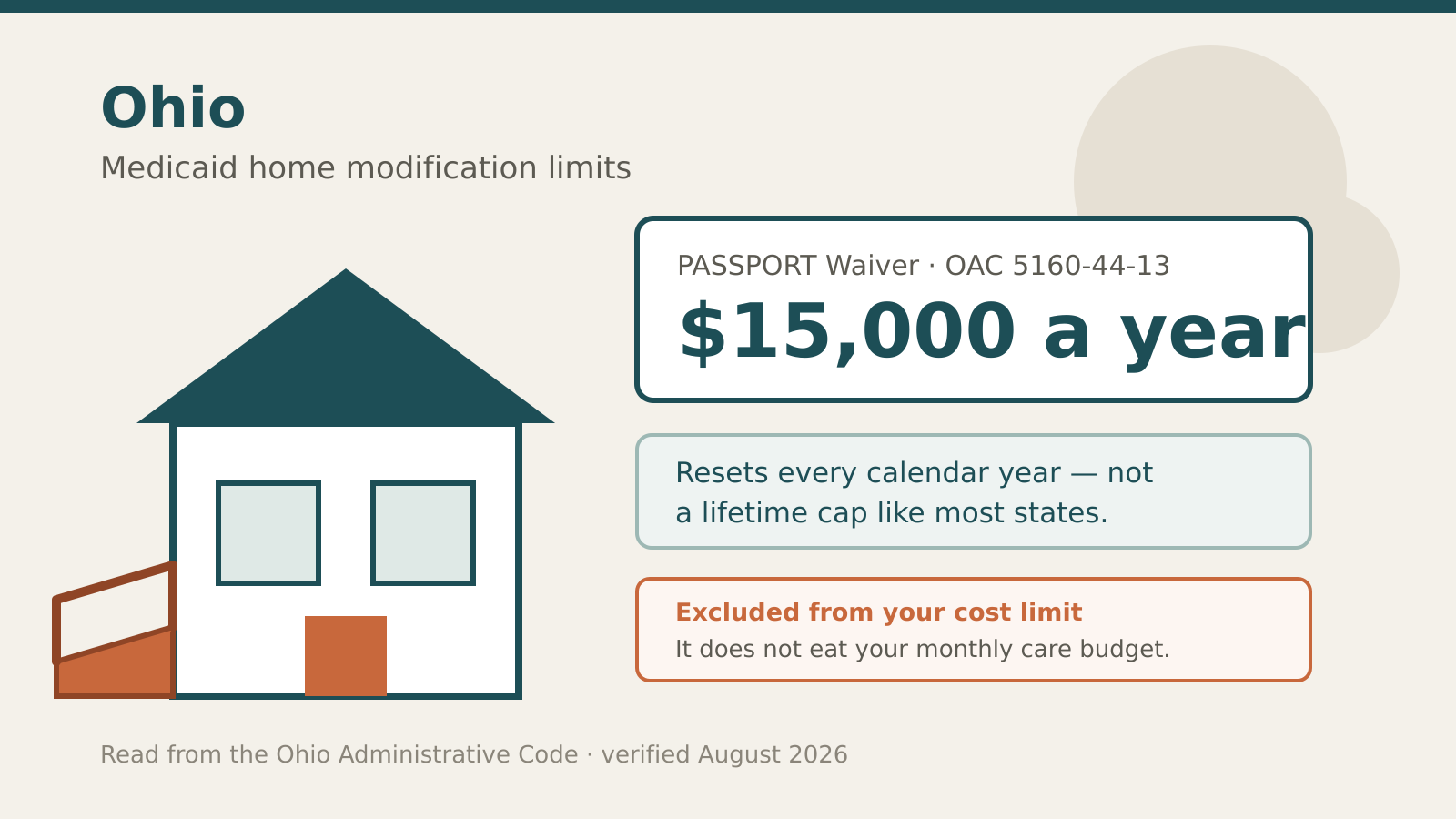
Ohio funds home modifications through Medicaid waivers at up to $15,000 — but the two halves of the system count that $15,000 differently, and one of them changed on July 1, 2026. On the aging and physical-disability side the cap is $15,000 per calendar year per individual. On the developmental disabilities side it is $15,000 per project, with a documented exception process above that. Same number, very different meaning.
This page gives you the rule text, the dollar limits, the exclusion list, the door you actually walk through, and an honest account of the waiting list — all read directly from the Ohio Administrative Code and verified on August 26, 2026.
The amounts and the period they apply to
| Which side of the system | Rule | Limit | Counted per | Rule effective |
|---|---|---|---|---|
| Nursing-facility level-of-care HCBS programs (aging and physical disability) | OAC 5160-44-13 | $15,000 | Calendar year, per individual | April 17, 2026 |
| Developmental disabilities waivers — Individual Options, Level One, SELF | OAC 5123-9-23 | $15,000 | Per project (exception process above) | July 1, 2026 |
Why the difference matters more than the number. A calendar-year cap resets on January 1 and covers everything you do in those twelve months combined. A per-project cap has no annual ceiling stated in the rule — two separate projects in one year are each measured against $15,000 on their own. If your situation involves a ramp now and a bathroom later, which side of the system you are on changes the answer completely.
What changed on the DD side in 2026
The developmental disabilities cap used to be lower. As of the version of OAC 5123-9-23 effective July 1, 2026, payment for environmental accessibility adaptations will not exceed fifteen thousand dollars per project unless the county board documents the need for an exception.
And the exception is real, not decorative. The rule states that when the cost of needed adaptations exceeds $15,000 per project, the Ohio Department of Developmental Disabilities and the county board will collaborate with the individual and the individual’s team to ensure the individual’s health and welfare needs are met either through waiver funding or non-Medicaid funds. When waiver funding is necessary, the county board submits documentation to the department establishing how the project will ensure health and welfare.
Practically: on the DD side, $15,000 is not a hard ceiling. It is the point at which a county board has to write something down. On the aging side, $15,000 per calendar year is stated flatly with no exception clause in the rule.
The one-year-early rule that most families miss
Both rules let modifications be authorized before the person comes home from an institution. Both use 180 days. They differ on what happens if the move falls through, and the difference is worth money:
- Aging / physical disability side (5160-44-13): modifications may be authorized up to 180 consecutive days prior to transition. The date of service for reimbursement is the date the individual leaves the institutional setting. “If an individual fails to transition into the community, the modification is still reimbursable.”
- DD side (5123-9-23): adaptations may be authorized up to 180 calendar days before waiver enrollment, but work begun while the person is still institutionalized is not considered complete and may not be billed until the date the individual leaves the institution and enrolls in the waiver.
If you are planning a discharge from a nursing facility or an ICF, start the modification conversation six months out, not at discharge. On the aging side the risk of the move falling through is explicitly carried by the program, not by the contractor or the family.
What Ohio covers, and what it will not pay for
Covered
OAC 5160-44-13 defines home modifications as environmental adaptations to the private home authorized by the person-centered services plan that are necessary to ensure health, welfare and safety, or that enable the individual to function with greater independence at home. The rule names, as examples and not as a closed list:
- Installation of ramps and grab bars
- Widening of doorways
- Modification of bathroom or kitchen facilities
- Installation of specialized electric and plumbing systems necessary to accommodate medical equipment and supplies
- Replacement of previous home modifications when it is determined the modification cannot be repaired through another resource
The DD rule uses nearly identical examples and adds that repair of previously approved adaptations is covered when repair is more cost effective than replacement and the repair is not needed because of apparent misuse, abuse, or negligence.
Not covered — the exclusion list, in the rules’ own terms
This is where most applications die, so read it before you get a quote.
| Excluded | 5160-44-13 (aging/PD) | 5123-9-23 (DD) |
|---|---|---|
| General-utility improvements — the rules name carpeting, roof repair, central air conditioning | Excluded | Excluded |
| Anything adding to the total square footage of the home | Excluded, except when necessary to complete an adaptation (improving entrance/egress, configuring a bathroom for a wheelchair) | Excluded; also excludes construction of a new home or an addition, i.e. building walls where no walls exist |
| Repair or replacement of approved work damaged by apparent misuse, abuse, or negligence | Excluded | Excluded |
| Removing modifications and returning the property to its prior condition when the person moves out | Excluded | Excluded |
| Work that is a typical homeowner’s responsibility, such as complying with a local building code | — | Excluded |
| Modifications to a residential facility | — | Excluded |
The landlord question, answered plainly. On the aging side the provider record must include the written consent of the property owner to modify the property, including acknowledgment that the owner understands the waiver is not responsible for returning the property to its prior condition. Renters can use this benefit. The landlord has to sign, and the landlord has to accept that nobody is coming back to undo the ramp.
The bid rules that protect you — and the one that constrains you
Ohio does not simply hand over a budget. Both rules require competitive, documented pricing:
- Aging side: providers submit a fixed cost proposal good for the term of the work agreement. It must include a drawing or diagram, a breakdown of needed materials, material costs, labor costs, a list of all required building permits, a completion time estimate, a written statement of all warranties including a warranty lasting at least one year from the date of final acceptance of work against defective workmanship, and a written guarantee that all materials, products and installed appliances perform their advertised function. A fixed cost proposal may be adjusted for good cause only if job specifications are modified in writing and the adjustment is approved.
- DD side: whenever possible the service and support administrator secures at least two bids from department-certified providers. Each bid must include an itemized quote naming specific materials by brand name and item number, plus demolition, permit fees, cleanup and debris removal; a detailed scale drawing; a timeline; proof the provider is bonded, licensed and/or insured; and a description of any warranties.
The constraint: both rules require selection of the lowest cost alternative that meets the individual’s assessed need. Not the best option. Not the one you prefer. The cheapest one that meets the assessed need. If you want a specific solution, the leverage is in the assessment, not in the bid.
Two more limits worth knowing. On the aging side, the provider may not be the owner of the home being modified, and the program must have safeguards against conflicts of interest between whoever performs the evaluation and the modification provider. And bundling home modification with other waiver services is allowed — but the individual service limits still apply.
How to apply: the actual door, by name
There are two separate front doors in Ohio, and walking through the wrong one costs months.
If the person is older or has a physical disability
The agencies named in the rule are the Ohio Department of Medicaid and the Ohio Department of Aging, or their designee. The practical entry point is the long-term care consultation, run by a program administrator — in most of Ohio that means your Area Agency on Aging, an entity designated under ORC 173.011 to administer programs on behalf of the Department of Aging.
Here is the sentence to know, from OAC 173-43-02: “The program administrator shall offer a consultation to any individual who contacts the program administrator to seek information about options available to meet long-term care needs.”
Read that again. No application. No eligibility test. No diagnosis requirement. You contact them, they must offer you a consultation. It can be in person, by telephone, or by video conference. The consultation must cover the availability of long-term care options, sources and methods of both private and public payment, factors to consider when choosing, and opportunities for maximizing independence. If the person is a veteran — or the spouse, surviving spouse, or representative of a veteran — the consultation must additionally cover VA health care and financial benefits and point you to a congressionally-chartered veterans service organization or the county veterans service office. At the end you get a written or electronic summary of the options discussed, and the information is not binding: you choose.
One more provision worth carrying into a hospital discharge meeting: a nursing facility with an Ohio Medicaid provider agreement may admit an individual as a resident only if it has evidence that the program administrator provided a consultation, unless the individual is exempt under OAC 173-43-03. And the facility may not deny or limit access to any person who is attempting to provide a consultation.
Agency websites: Ohio Department of Aging at aging.ohio.gov; Ohio Department of Medicaid at medicaid.ohio.gov.
If the person has a developmental disability
The door is your county board of developmental disabilities, not the state. The state agency is the Ohio Department of Developmental Disabilities at dodd.ohio.gov, which administers three waivers — Individual Options, Level One, and Self-Empowered Life Funding (SELF) — but county boards run enrollment, assign the service and support administrator, gather the bids, verify the completed project, and release payment.
What happens between the request and the ramp
Both sides require a professional assessment before anyone prices anything:
- Aging side: ODM, the Department of Aging, or their designee may require an in-home evaluation by an occupational therapist or physical therapist licensed under Chapter 4755 of the Revised Code, or another appropriately qualified professional. That professional determines the individual’s capacity to use the requested modification, the suitability of the immediate environment, and the viability of the modification improving independence — then, in consultation with the individual and caregivers, develops a written referral.
- DD side: the need is identified through an assessment conducted in person at the individual’s home by a qualified professional such as an OT or PT acting within scope of practice.
After the work: on the DD side, the claim goes in only after the individual confirms the authorized work was completed, the county board verifies the project meets the individual service plan and that required inspections were completed, and the service and support administrator releases payment. On the aging side, the provider must obtain final written approval from the individual and from ODM or the Department of Aging, and must have permits and post-inspection reports in hand before billing.
The waiting list, honestly
Ohio’s developmental disabilities waiting list is not a queue. This is the single most misunderstood thing about the program, and the rule — OAC 5123-9-04, effective July 1, 2025 — is unusually explicit about it.
It is assessment-based, not first-come-first-served
A county board places a name on the waiting list only when a waiting list assessment tool shows the person has a “current need” — defined as an unmet need for home and community-based services within twelve months — that cannot be met by community-based alternative services in the county where they live. The person must also have a severe, chronic disability manifested before age 22 and likely to continue indefinitely.
Situations the rule lists as giving rise to current need include a primary caregiver’s declining or chronic physical or psychiatric condition, insufficient availability of caregivers, the individual’s declining skills resulting from lack of supports, aging out of children’s services, and living in an ICF or nursing facility and having requested help to move to the community.
“Immediate need” is a different track, and it does not go on the list
Immediate need means a situation creating a risk of substantial harm if action is not taken within thirty calendar days. If a county board finds immediate need, it does not put the person on the waiting list — it must take action necessary to ensure the need is met, which may include waiver enrollment.
The rule names the triggers, including: an ICF resident receiving notice of termination of services; a nursing facility resident receiving a thirty-day notice of intent to discharge; an adult losing a primary caregiver due to the caregiver’s declining condition or unforeseen circumstances such as military deployment or incarceration where no other caregivers are available; documented behavior creating a risk of substantial harm; significant care needs such as bathing, lifting, high-demand or twenty-four-hour care; and reason to believe an adult has been subjected to abuse, neglect, or exploitation.
If any of those describe your situation, say the words “immediate need” to the county board. It is a defined term with a thirty-day clock attached.
The timeframes the county board owes you
| Step | Deadline |
|---|---|
| Interview with the individual and guardian, initiating the assessment tool | Within 15 calendar days of the request or identified unmet need |
| Assessment tool completed and approved | Within 45 calendar days of that interview |
| Written notice of the outcome, with a copy of the completed tool and an explanation of due process rights | Within 10 calendar days of completion and approval |
| If you move counties: receiving county board reviews your assessment | Within 90 calendar days — and if current need is confirmed, your original status date is preserved |
If the board decides community-based alternative services can meet the need instead, the written notice must list each assessed need, name the specific alternative service addressing each one, give the date the board will follow up, and provide the name, title, telephone number and email of a person who can help you access those services. That is a rule requirement, not a courtesy.
How the order of enrollment actually works
For locally-funded waivers, county boards select in this order: first, individuals with immediate need who require waiver funding; second, individuals who have met multiple criteria for current need for twelve or more consecutive months and were not offered enrollment in the prior calendar year; third, multiple criteria for less than twelve months; fourth, a single criterion. Ties are broken by the earliest status date — which is the only place chronology enters at all.
And then the sentence the rule states twice, once for locally-funded and once for state-funded waivers: “Meeting the criteria for immediate need and/or current need does not guarantee enrollment in a … home and community-based services waiver within a specific timeframe.”
That is Ohio telling you, in its own regulation, that qualifying is not the same as being funded. Plan accordingly.
Two things that get people removed
The rule lists eleven removal grounds. Two are avoidable and catch people out: refusing or withdrawing consent for service and support administration, and failing to respond when the county board attempts contact by at least two different methods from email, traceable delivery service, or personal service, sent to your last known address. Keep your address and email current with the county board, and answer the annual review.
Where this fits with everything else
Medicaid waivers are one funding source among several, and the $15,000 rarely covers a whole project. Our state-by-state table of Medicaid home modification limits shows where Ohio sits against the other 49 states — the range is wide and the counting rules differ as much as the dollar figures do. For the federal picture, see whether Medicaid pays for home modifications and the broader home modification grants landscape. Ohio veterans should look at the VA HISA grant, which stacks with, rather than replaces, a Medicaid waiver.
If the specific item is a stair lift or a walk-in tub, those have their own coverage answers: does Medicare cover stair lifts and does Medicare cover walk-in tubs. And if the household is also weighing whether to stay home at all, aging in place home modifications works through the sequencing.
Primary sources and last verification date
Every figure and rule on this page was read directly from the Ohio Administrative Code on August 26, 2026. No third-party summaries were used.
- OAC 5160-44-13 — Nursing facility-based level of care home and community-based services programs: home modification. Effective April 17, 2026. Authorized by ORC 5166.02. Five-year review date 1/1/2029.
- OAC 5123-9-23 — Home and community-based services waivers: environmental accessibility adaptations under the Individual Options and Level One waivers. Effective July 1, 2026. Five-year review date 12/1/2029.
- OAC 5123-9-04 — Home and community-based services waivers: waiting list. Effective July 1, 2025. Authorized by ORC 5123.04 and 5126.042. Five-year review date 11/1/2029.
- OAC 173-43-02 — Long-term care consultation program: general standards for providing consultations. Effective February 1, 2023. Five-year review date 2/1/2028.
A correction we are making in public. Our 50-state table previously listed Ohio’s developmental disabilities limit as $10,000 per project, citing OAC 5123-9-23. That was accurate under the earlier version of the rule. The version effective July 1, 2026 sets the figure at $15,000 per project, with the county board exception process described above. The state table has been updated. If you read the old figure here or elsewhere, the $10,000 number is out of date.
Frequently asked questions
Does Ohio Medicaid pay for a walk-in shower? Modification of bathroom facilities is named in both rules as a covered adaptation. Whether your specific fixture is approved depends on the assessment and on the lowest-cost-alternative requirement — a roll-in shower approved as the cheapest option meeting your assessed need is covered; a fixture upgrade beyond that is not.
Can I get the $15,000 twice? On the aging and physical-disability side, no — it is a total per calendar year per individual, and it resets January 1. On the DD side the limit is per project, and projects above $15,000 go through the county board exception process rather than being refused outright.
Do I have to own my home? No. But the provider must obtain and keep the property owner’s written consent, including the owner’s acknowledgment that the waiver will not restore the property to its prior condition.
How long is the wait? Ohio does not publish a wait time, and the rule explicitly states that meeting the current-need or immediate-need criteria does not guarantee enrollment within a specific timeframe. What the rule does guarantee are the assessment timeframes above: 15 days to the interview, 45 days to a completed tool, 10 days to written notice.
What if I disagree with the county board’s decision? Due process applies to placement on, denial of placement on, and removal from the waiting list. The county board issues and explains it using a form approved by the Ohio Department of Job and Family Services, under ORC 5160.31 and OAC Chapters 5101:6-1 to 5101:6-9.
Not sure how your state compares? Our 51-state funding checker shows what any state actually publishes — the ceiling, the period it covers, and an honest note where the state publishes nothing at all.
Also in this series: North Carolina CAP/DA, the 28,000 dollar limit and the statewide waitlist.
Also in this series: Washington COPES, the 700 dollar limit and why Community First Choice will not pay for modifications.
Leave a Reply