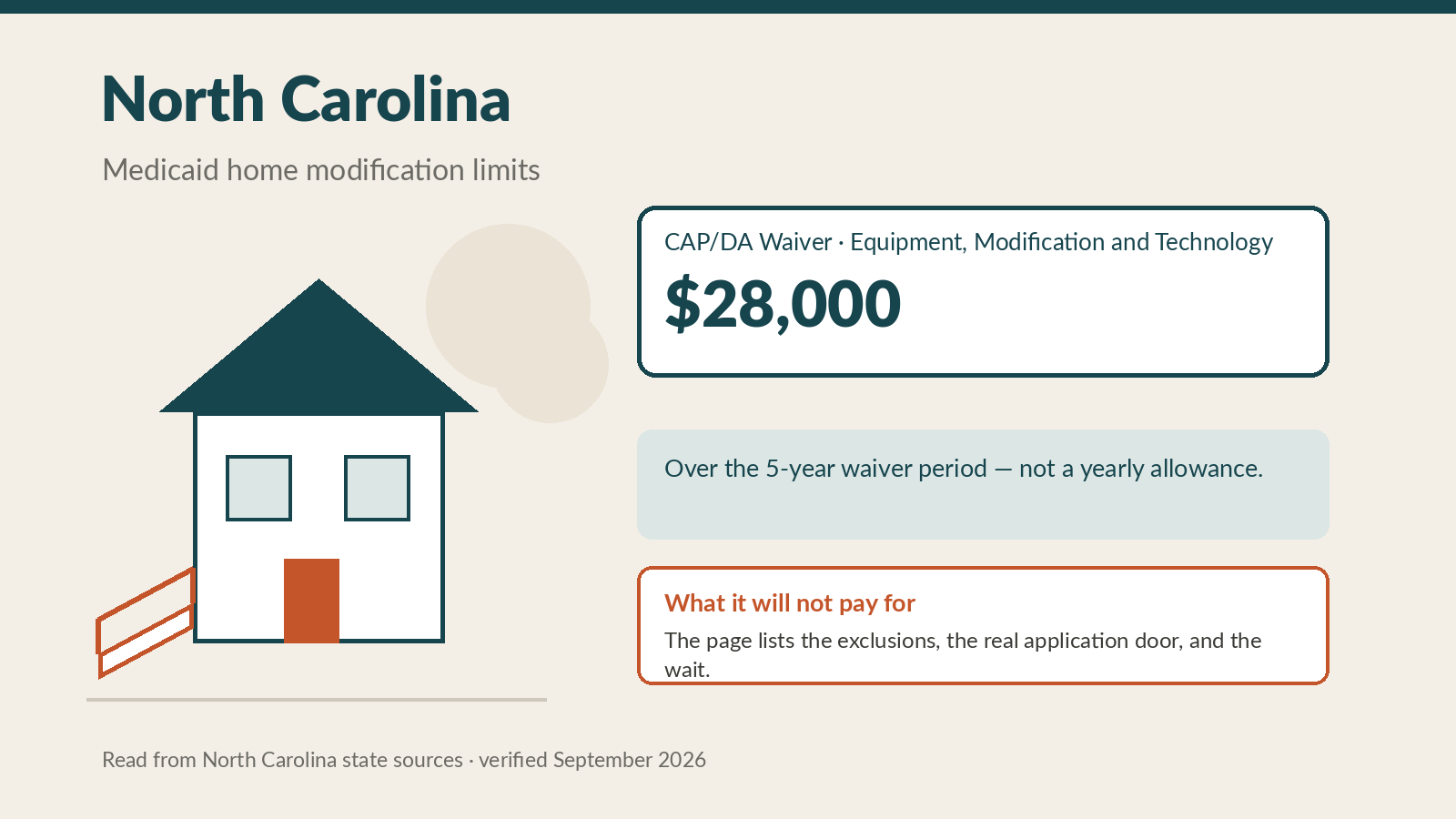
The number is 28,000 dollars, and it is not what most people think it is. It is not annual. It does not reset. It is not just for ramps and grab bars. And since February 2024 it has come with something North Carolina did not have before: a statewide waiting list.
This page covers what North Carolina Medicaid will actually pay to modify a home, taken word for word from the state’s own clinical coverage policies and its CMS-approved waiver application. Every figure below has a citation and a document date. Where the state does not publish something — and there is one important thing it does not — we say so and list the pages we checked.
Last verified 2026-09-02.
The amount, and the period it applies to
North Carolina runs two home and community based waivers that pay for home modifications. Which one you use depends on age, not on the type of work.
| CAP/DA (adults) | CAP/C (children) | |
|---|---|---|
| Full name | Community Alternatives Program for Disabled Adults | Community Alternatives Program for Children |
| Service name | Equipment, Modification and Technology | Home Accessibility and Adaptation |
| Limit | 28,000 dollars | 28,000 dollars |
| Period | Over the 5-year cycle of the waiver | Over the 5-year cycle of the waiver |
| Governing policy | Clinical Coverage Policy 3K-2 | Clinical Coverage Policy 3K-1 |
| Policy amended | September 1, 2025 | November 15, 2024 |
| Waiver period | Nov 1, 2024 – Oct 31, 2029 | Mar 1, 2023 – Feb 29, 2028 |
Policy 3K-2, section 5.8.2, states it plainly: “Equipment, modification and technology services are limited to 28,000 over the waiver approval cycle. The Case Management Entity (CME) shall track the cost of procured Equipment, modification and technology during each waiver participation year, to avoid exceeding the 28,000 limit.”
Appendix B of the same policy is more explicit about the period: “over the 5-year cycle of the waiver. The case management entity shall track the cost of equipment, modification and technology billed and paid during the plan year, to avoid exceeding the 28,000 limit over the lifetime of the waiver (five years).” The identical phrase appears in Appendix C of the CMS-approved waiver application, NC.0132.R08.00.
Read that last clause again, because it is the most misunderstood thing about this program. This is a lifetime pool for the waiver period, not a yearly allowance. Spend 26,000 dollars on a bathroom and a ramp in year one and you have 2,000 dollars left until the waiver renews in 2029. The children’s policy says outright what happens when it runs out: “When the maximum utilization limit is reached, requests for home modification are denied.”
It went up recently, and older figures are still circulating
The previous ceiling was 13,000 dollars. NC Medicaid announced the change on January 8, 2025: “Modification, equipment, and technology: Increased budget limit from 13,000 to 28,000 over the approved waiver period,” with the renewal “effective Nov. 1, 2024, through Oct. 31, 2029.” Plans of Care created on or after November 1, 2024 get the new limit. If you find a page quoting 13,000 dollars for North Carolina, it is describing the pre-2024 rule.
Per person, but shared inside a household
The money is planned per beneficiary, with a caveat most summaries drop. Policy 3K-2 Appendix B: “The total funding budget for equipment, modification and technology services is planned per CAP/DA beneficiary and the total budget shall be shared between the two primary caregivers when shared responsibilities are established,” and “Equipment, technology and modification are shared when the disabilities of the multiple CAP/DA beneficiaries in same household are similar.”
So two people with similar disabilities under one roof do not get 56,000 dollars. They share.
There is no general exception process for adults
We looked for one. For adults, the answer is Not published — 3K-2 contains no provision to exceed the 28,000 dollar ceiling. The only override in the policy is the EPSDT special provision, which by federal law applies to beneficiaries under 21 (section 2.2.1: “EPSDT Special Provision: Exception to Policy Limitations for a Medicaid Beneficiary under 21 Years of Age”). For an adult on CAP/DA, 28,000 dollars over five years is the wall.
There is also a clock on each approved job: “the installation of equipment or modification must be completed within three calendar months of service plan approval.”
A correction we are making in public
Our own 50-state Medicaid home modification limits table has described North Carolina’s 28,000 dollars as a “combined” pool covering assistive technology, equipment and vehicle modifications. Re-reading the source documents for this page, that wording is correct for the children’s programme and not literally supportable for the adult one.
Policy 3K-1 (CAP/C) uses the word: “Home accessibility and adaptation provides a combined vehicle modification and assistive technology budget of 28,000 per beneficiary per the cycle of the CAP/C waiver.”
Policy 3K-2 (CAP/DA) never says “combined.” The reason is structural rather than substantive: CAP/DA has a single service called Equipment, Modification and Technology whose own definition already spans equipment, assistive technology, home modification and vehicle modification. The practical effect is the same — a wheelchair lift for your van and a roll-in shower draw on one 28,000 dollar pool — but the state does not describe it as a merger of separate budgets, and we should not put a word in its mouth. We have corrected the state table accordingly.
One more thing worth flagging: the policy numbers are easy to transpose. 3K-1 is the children’s programme and 3K-2 is the adult one, which is the reverse of what the alphabetical instinct suggests.
What North Carolina covers
Policy 3K-2’s covered list is unusually detailed for a state waiver, which makes it useful. Quoting Appendix B directly, the service “may cover: a. Installation, maintenance, and repairs of ramps; grab bars; safety rails and handrails; b. Widening of doorways or passages for wheelchair or walker accessibility; c. An emergency egress when determined to be medically necessary due to physical limitations of the responsible party.”
It continues: “d. Modification of bathroom facilities to improve accessibility for a disabled individual, including toilet; shower and tub (including hand-held showers), and sink fixtures or modifications; water faucet controls; floor urinal adaptations; plumbing modifications; and modification for turnaround space e. Bedroom modifications to accommodate hospital beds and wheelchairs; f. Kitchen Modifications to improve accessibility for an individual with a disability including cabinets, sink fixtures or modifications, water faucet controls, related plumbing modifications, and modification for turnaround; g. Floor coverings for ease of ambulation for the home.”
Beyond construction work, the same 28,000 dollars also reaches portable lift and hoist equipment, door handle replacement, non-slip surfaces, seat lifts where a physician orders one and a therapist confirms the need, smart home devices for people who live alone, air filtration, a backup generator where a ventilator is in use, environmental control units, and vehicle modifications including ramps, wheelchair tie-downs, raised roofs and lowered floors.
Where the work can be done
This trips up renters constantly. The policy allows modifications “only in the following settings: a. A primary private residence where the CAP/DA beneficiary resides that is owned by the beneficiary, or their family; b. A rented residence when the modifications are portable; or c. A rented residence, when portal modifications are allowed by the owner.”
If you rent and the landlord will not agree, the programme will not pay — regardless of medical need.
What it will not pay for
Thirteen exclusions, again verbatim from 3K-2: “a. Addition of square footage to the home; b. Home renovations; c. A dwelling where the owner refuses portal modification; d. The modification in a rented residence that is not portable; e. Purchase of locks; f. Modification during new construction; g. Roof repair or replacement; h. Central air conditioning; i. Swimming pools, hot tubs, spas, saunas; j. Items that meet the definition exclusions for general utility to a non-disabled beneficiary; k. Replacement of equipment that has not been properly used, has been lost or purposely damaged as verified by written documentation or through observation; l. Computer desks or other furniture; and m. Items that meet the definition exclusions for recreational in nature.”
The children’s list under 3K-1 is close but not identical. It additionally excludes “service agreements, maintenance contracts, insurance, and extended warranties,” bars a relative from being the contractor — “approved vendor shall not be the spouse, parent, primary caregiver or legal guardian of the CAP/C beneficiary” — and excludes plumbing beyond the specific bathroom plumbing listed as covered. On the other hand CAP/C explicitly reaches driving surfaces and allows a modification to move with the family.
Nobody is putting your house back
Worth knowing before a ramp is bolted to the front of the property: “Medicaid assumes no liability related to use or maintenance of the equipment, modification or technology and assumes no responsibility for returning the private residence to its pre-modified condition.”
Other payers come first
Do not expect the waiver to be the first door. Policy 3K-2: “Items that are covered through DME, orthotics and prosthetics, home health supplies, and EPSDT are obtained through the respective programs prior to requesting CAP/DA services. CAP/DA shall not cover items that are covered by one of these programs but were denied for a particular beneficiary for lack of evidence of declaration of need.” And separately: “Medicaid is the payer of last resort; if the beneficiary has private insurance that covers the item, this insurance is billed.”
In practice, if a stair lift or a piece of equipment might qualify as durable medical equipment, that route gets exhausted first. Our guides to whether Medicare covers stair lifts and whether Medicare covers walk-in tubs explain how those determinations usually go, and our stair lift cost breakdown gives you the published prices to weigh against the 28,000 dollar pool.
How to apply: the actual door, by name
North Carolina does not run applications through a single statewide portal. The entry point is a local case management entity in your county.
- NC Medicaid, Division of Health Benefits (NC DHHS) administers both waivers. Programme information sits at medicaid.ncdhhs.gov, and the Contact Center is 888-245-0179.
- The CAP/DA case management entity in your county is who you actually call. NC Medicaid publishes a county-by-county directory of these agencies with names and phone numbers, linked from the CAP/DA programme page.
- NC LIFTSS is the state’s independent assessment entity and handles referrals: 833-522-5429, fax 833-470-0597.
- Your county Department of Social Services handles Medicaid eligibility itself; NC DHHS publishes a directory of all 100 county offices.
The state’s own instruction reads: “Contact a local CAP/DA case management entity in the county of residence of the applicant to request a CAP/DA referral. If you are a CAP/DA case management entity or a qualified home-and community-based provider, a referral can be completed in the e-CAP system or by calling NC LIFTSS at 833-522-5429 or faxing the completed referral form to 833-470-0597.” The CAP/C page gives the same referral number.
One gap worth naming. Many states run a single Aging and Disability Resource Connection entry page on a .gov domain. North Carolina’s no-wrong-door function is carried by NC 2-1-1 and NCCARE360, neither of which is a .gov site. We could not locate a state-operated ADRC portal, so we are recording that as Not published rather than pointing you at a third-party referral service and calling it official.
The waiting list, honestly
This is the part that changes the answer to “can I get 28,000 dollars,” and it is missing from almost every national page about North Carolina.
CAP/DA has had a statewide waiting list since February 16, 2024. NC Medicaid’s announcement: “Effective Feb. 16, 2024, individuals requesting to receive services may be placed on a waitlist.” The stated cause was success, not failure: “assessments for CAP/DA significantly increased over the past year, resulting in maximum utilization of the waiver slots.”
The state also tells you how to find out where you stand: “NCLIFTSS, the organization that manages CAP/DA referrals and assessments, can tell individuals on the waitlist, their number on the list. The contact number for NCLIFTSS is 833-522-5429.” Call and ask. Most states will not give you a position number.
How the list actually works
From the CMS-approved waiver application: “This HCBS waiver program has a maximum number of participants approved to access services at any given time. Access to waiver services are limited to each county. Each county is assigned a maximum number of participants to serve based on the average number of Aged, Blind and Disabled individuals in that county. Once the maximum waiver allotment, referred to as slots, are reached in a county, a waitlist is created. Individuals are placed on the waitlist based on the date of the initial application for consideration for waiver participation. Due to the demand, entry to this program is on a first-come, first-serve basis.”
Two consequences follow, and both matter. First, the queue is county-level, so your wait depends on where you live, not on how sick you are. Second, position is set by application date — which means the single most useful thing you can do today is get the referral logged, even if you are not sure you qualify.
Who jumps the queue
The waiver lists priority categories that bypass the ordinary queue: adults transferring from another HCBS waiver; people with AIDS and a T-count of 200; existing participants changing county or case management entity; people returning to the community after up to 90 days of short-term rehabilitation; Money Follows the Person and vocational rehabilitation referrals; people using community transition services; people determined by Adult Protective Services to have been abused, neglected or exploited; those whose spouse or guardian is deployed on military duty; hospice patients facing placement in a non-hospice facility; and the Transitions to Community Living population.
There is also a dedicated pool: “A reserve capacity of 434 is used to target individuals with Alzheimer’s Disease and Related Disorders.”
The capacity numbers
| Figure | Value | Source |
|---|---|---|
| Unduplicated participants, each of years 1–5 | 14,078 | Waiver NC.0132.R08.00, Appendix B-3-a |
| Point-in-time maximum, each of years 1–5 | 11,648 | Appendix B-3-b |
| Statewide allotment set by the General Assembly | 11,214 | Appendix B-3-e |
| Alzheimer’s reserve within that | 434 | Appendix B-3-e |
| Transition and waitlist-prioritisation reserve | 75 / 125 / 150 / 175 / 200 by year | Appendix B-3-c |
Note who sets the ceiling: “The statewide allotment capacity for this HCBS waiver is 11,214 which the North Carolina General Assembly sets.” The constraint is legislative appropriation, not federal rules. If you want the waitlist shorter, the address is Raleigh.
How long is the wait? Not published.
North Carolina does not publish an average or median wait time for CAP/DA. We read the full 270-page waiver application, both clinical coverage policies, the CAP/DA programme page, the 2024 waitlist announcement, the 2025 renewal announcement and the medicaid.gov waiver factsheet. No figure exists in any of them.
The waiver acknowledges the concept without quantifying it, in a rule about reallocating unused slots: counties running below 74% utilisation with no waitlist may have slots reassigned “to other counties with a large waitlist and extended wait times.” No number attached.
The state’s one direct statement on timing came in response to a public comment, and it is about post-referral enrolment rather than waitlist duration: “No changes will be made to the renewed waiver application. The state has a new vendor and enrollment in the CAP/DA waiver is achieved within 30 days of the referral.” Read that carefully — it describes how fast you are processed once a slot exists, not how long you wait for the slot.
A caution about one number you will see quoted. The figure of 1,816 people waiting appears inside the waiver document, but it is not the state’s count. It comes from a public comment submitted by AARP North Carolina during the 2024 comment period: “Obtaining the maximum participant benefits from the CAP/DA waiver requires eliminating current and future program waiting lists (currently 1,816 individuals).” Several sites repeat it as an official statistic. It is an advocacy organisation’s figure from 2024, and it should be attributed that way.
The one movement figure the state does publish is from the 2024 announcement: the new assessment arrangement “allowed nearly 1,000 individuals to move off a county-wide wait list and link them to CAP/DA or other community services.”
Primary sources and last verification date
| Document | Date |
|---|---|
| Clinical Coverage Policy 3K-2 (CAP/DA), doc 25H18 | Amended September 1, 2025 |
| Clinical Coverage Policy 3K-1 (CAP/C), doc 24J11 | Amended November 15, 2024 |
| CMS-approved 1915(c) application NC.0132.R08.00 | Effective November 1, 2024; printed December 18, 2024 |
| NC Medicaid bulletin, CAP/DA renewal approved | January 8, 2025 |
| NC Medicaid bulletin, CAP/DA waitlist | March 5, 2024 |
| CAP/DA programme page and county CME directory | Page last modified April 16, 2026 |
| CAP/C waiver renewal bulletin | April 12, 2023 |
All of the above are published by NC DHHS at medicaid.ncdhhs.gov or by CMS at medicaid.gov. We did not use commercial senior-care sites, law firm pages or aggregators for any figure on this page. Last verified 2026-09-02.
Where North Carolina sits nationally
28,000 dollars is generous by national standards — most states sit between 5,000 and 15,000 dollars, and West Virginia publishes 1,000 dollars a year. But North Carolina’s figure covers five years and a wider set of items than most, and it now comes with a queue. A smaller annual allowance with no waiting list can be worth more in practice.
Compare for yourself in our state-by-state limits table, or use the funding checker. Our other state pages cover Ohio, Texas, New York and California.
If CAP/DA is not available to you, or the wait is too long to be useful, the alternatives are worth working through: how Medicaid pays for home modifications generally, the VA HISA grant if there is military service in the family, and the non-Medicaid routes collected in our home modification grants hub. For sequencing the work itself, see aging in place home modifications.
Four things to do this week
1. Get the referral date on the record. Position on the waitlist is set by application date. Calling NC LIFTSS at 833-522-5429 today is worth more than a perfect application next month.
2. Ask for your number on the list. North Carolina will tell you. Most states will not.
3. Check whether a priority category applies. Hospital or rehab discharge within 90 days, an APS finding, a spouse deployed, a move from another waiver — any of these changes your position entirely.
4. Plan the whole five years before spending any of it. This is one pool until 2029, and there is no exception process for adults. The order in which you do the bathroom, the ramp and the vehicle determines what is still available in 2028.
Also in this series: Washington COPES, the 700 dollar limit and why Community First Choice will not pay for modifications.
Leave a Reply