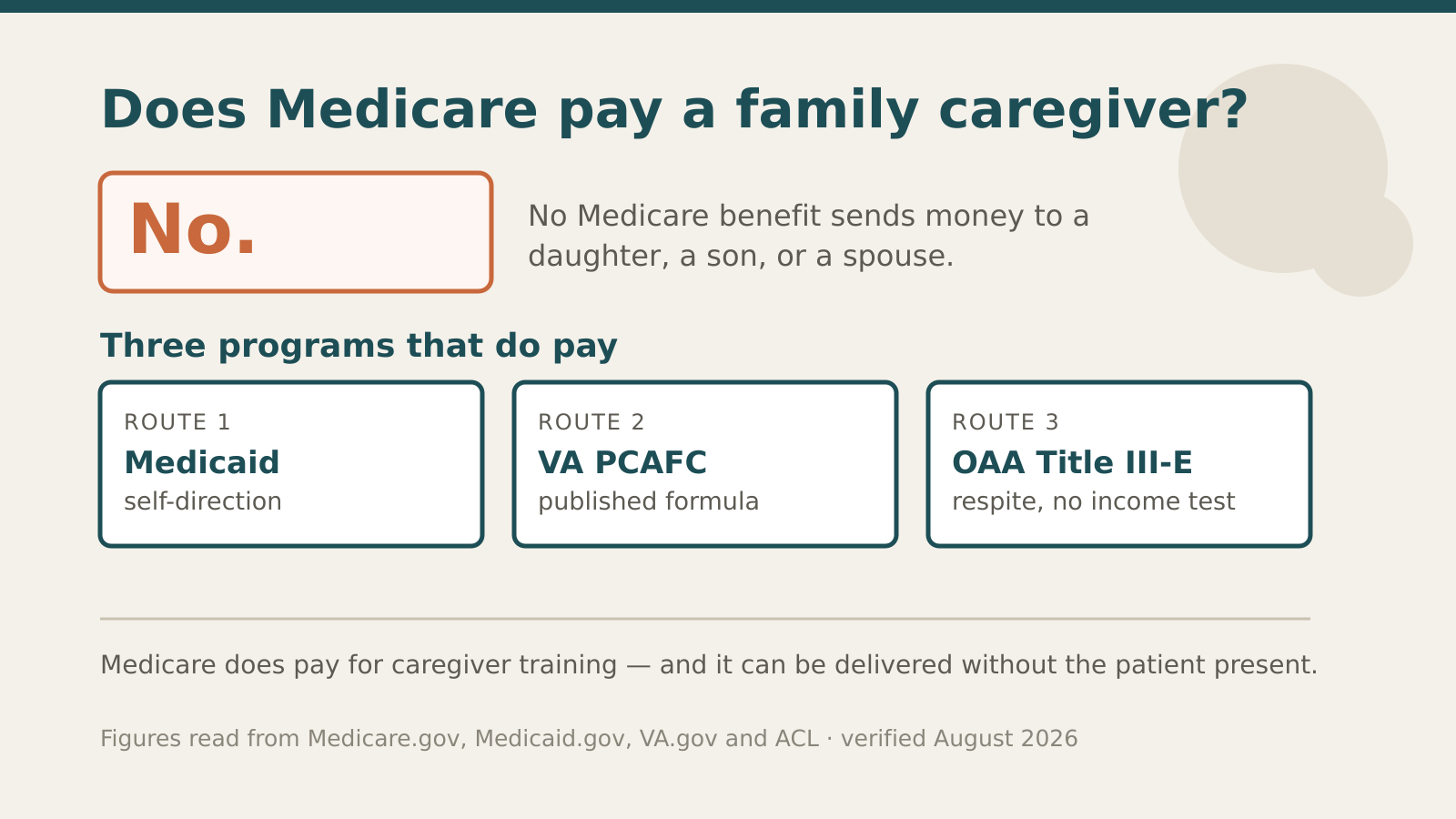
No. Medicare does not pay a family member to provide care. There is no Medicare benefit that sends money to a daughter, a son, or a spouse for the hours they put in. If you came here hoping otherwise, that is the answer, and everything below is about the programs that do pay — because at least three of them exist, and one publishes the exact arithmetic it uses to calculate your check.
The confusion is understandable. Medicare pays for services delivered to the person you care for, and it pays for training delivered to you. What it does not do is treat you as a paid worker. Medicaid can. The VA can. Your Area Agency on Aging can fund respite so you get a break. Here is how each one works in 2026, with the numbers as published.
What Medicare actually pays for when a family member is doing the care
Four Part B services and one nationwide payment model. None of them puts money in your pocket, but all five reduce what the household spends or what you carry alone.
1. Caregiver training services — Part B
This is the one most families have never heard of. If a health care provider determines that caregiver training is appropriate for the patient’s treatment plan, the caregiver can get individual or group training sessions from the provider without the patient present. The training covers giving medications, helping with daily tasks, moving the patient safely, communicating effectively, preventing bedsores and infections, and caring for wounds.
Providers who can deliver it include doctors, nurse practitioners, clinical nurse specialists, certified nurse-midwives, physician assistants, clinical psychologists, and therapists — physical, occupational, and speech-language.
Cost: after the Part B deductible, you pay 20% of the Medicare-approved amount. In 2026 the Part B deductible is $283, and the standard Part B premium is $202.90 per month.
2. Chronic care management — Part B, monthly
Requires two or more serious chronic conditions expected to last at least a year. You get a comprehensive care plan listing health problems, goals, other providers, medications, and community services; 24/7 access for urgent care needs; support during transitions between care settings; and a medication review. Same cost structure: 20% after the $283 deductible.
3. Principal illness navigation — Part B, monthly
Requires one serious condition expected to last at least 3 months that puts the person at high risk of hospitalization, nursing home placement, sudden worsening of symptoms, physical or mental decline, or death. You need an initial visit with the provider first; after that, navigation runs monthly for the rest of the year, and you need another initial visit after a year to keep going. If there is more than one serious condition, navigation can run for each one separately.
4. Advance care planning — Part B, sometimes free
Covered as a voluntary service. The detail worth acting on: you pay nothing if the provider accepts assignment and the planning happens as part of the “Welcome to Medicare” visit or a yearly “Wellness” visit. Do it during other medical treatment and the deductible and coinsurance apply. Same conversation, two different prices, decided entirely by which appointment it happens in.
5. The GUIDE Model — up to $2,500 a year in respite, if dementia is the diagnosis
This is the closest Medicare currently comes to putting real money behind an unpaid caregiver. The Guiding an Improved Dementia Experience (GUIDE) Model is a voluntary, nationwide model that began July 1, 2024 and runs for 8 years, authorized under Section 1115A of the Social Security Act. As published, it has 292 participants.
Two payment components matter here:
- Respite services payment. CMS reimburses participants up to $2,500 annually per eligible patient for services that temporarily relieve qualifying caregivers — in-home care, adult day center programs, and facility-based respite.
- Monthly dementia care management payment. Tiered per-patient payments based on patient complexity and caregiver burden, adjusted by the participant’s performance on quality measures.
Participants must offer caregiver training and support services, run a 24/7 support line, assign a Care Navigator, and screen both patient and caregiver for psychosocial and health-related social needs.
The catch is geographic. GUIDE only exists where a participating dementia care program exists. Organizations in the Established Program Track began delivering services July 1, 2024; the New Program Track completed a pre-implementation year from July 1, 2024 to June 30, 2025 and began delivering July 1, 2025. CMS publishes a participant list. If there is no participant near you, this benefit is not available to you — there is no fallback.
Medicaid self-direction: the route that can actually pay a family member
This is the answer most people are looking for, and it lives under Medicaid, not Medicare.
Self-directed Medicaid services mean participants, or their representatives, hold decision-making authority over certain services. CMS splits that authority in two, and the names matter because they determine whether you can be paid:
- Employer authority — the participant is afforded the decision-making authority to recruit, hire, train and supervise the individuals who furnish their services. That is the mechanism by which a family member becomes the paid worker.
- Budget authority — the participant has decision-making authority over how the Medicaid funds in an individualized budget are spent.
The four authorities your state can use
States have four options for offering self-direction. Which one your state uses changes the eligibility rules, so this is the first question to ask:
| Authority | What it is |
|---|---|
| 1915(i) | Home and Community-Based Services State Plan Option |
| 1915(j) | Self-Directed Personal Assistance Services State Plan Option |
| 1915(k) | Community First Choice |
| 1915(c) | Home and Community-Based Services Waiver Programs |
These arrived at different times, which is why state programs look so uneven. Consumer-directed personal care began in the 1990s under section 1905(a)(24). The Deficit Reduction Act of 2005 authorized 1915(i) and 1915(j). The Affordable Care Act, signed March 23, 2010, authorized 1915(k). The “Cash and Counseling” demonstrations that started this whole approach ran in three states under section 1115 authority.
What a self-directed program must give you
Federal rules require every self-direction authority to include four things. Knowing they are mandatory is useful, because if a caseworker tells you one is unavailable, that is worth pushing on:
- A person-centered planning process, directed by the individual, that must also include a contingency or “back-up” plan for when a worker is out sick — and that back-up plan must become part of the person-centered plan.
- A service plan — the written document specifying what will be furnished.
- An individualized budget — the amount of funds under the individual’s control. States must describe the method for calculating the dollar value based on reliable costs and service utilization.
- Information and assistance in support of self-direction — including a supports broker or consultant, who must be available to each individual who elects self-direction and who acts as an agent of the individual, taking direction from them.
The part nobody warns families about: you become an employer
If a family member is paid through self-direction, someone has to run payroll. Federal rules require that Financial Management Services (FMS) must be available to help. FMS handles payroll and employer-related duties: withholding and filing federal, state, local and unemployment taxes; purchasing workers’ compensation or other insurance; collecting and processing timesheets; calculating and processing employee benefits; and issuing payroll checks. It also tracks budget expenditures and flags spending that is over or under budget.
You can perform some or all of those functions yourself. Most people do not. Ask who the FMS entity is before you agree to anything — the difference between a smooth arrangement and a tax mess is usually right there.
What varies by state, and why we are not going to guess
The hourly rate a family caregiver is paid, whether a legally responsible relative such as a spouse or a parent of a minor child may be paid at all, and the size of the individualized budget are all set at state level and published in state documents rather than in a single federal table. Status: Not published federally. We looked at Medicaid.gov’s Self-Directed Services page and its four linked authority pages — 1915(i), 1915(j), 1915(k), and 1915(c) — and none of them publishes a state-by-state rate or spouse-eligibility matrix. The answer for your state is with your state Medicaid agency. This is the same pattern we documented in our state-by-state Medicaid home modification limits: real federal structure, entirely state-level numbers.
The VA program with a published formula: PCAFC
If the person you care for is a veteran, the Program of Comprehensive Assistance for Family Caregivers is the only one of these programs that publishes the exact arithmetic behind the payment.
The stipend formula, as published
VA defines the “monthly stipend rate” as the Office of Personnel Management General Schedule Annual Rate for grade 4, step 1, based on the locality pay area in which the eligible veteran resides, divided by 12. Then:
| Level | Monthly stipend |
|---|---|
| Level One | Monthly stipend rate × 0.625 |
| Level Two (VA determines the veteran is “unable to self-sustain in the community”) | Monthly stipend rate × 1.00 |
Two consequences follow from that formula. First, the stipend is a locality-adjusted number, so two caregivers doing identical work in different metro areas are paid differently. Second, when OPM updates the GS grade 4 step 1 rate, the stipend moves with it — you do not need to reapply for the increase.
Only the Primary Family Caregiver receives the stipend. A veteran can appoint 1 Primary Family Caregiver and up to 2 Secondary Family Caregivers at any one time.
Who qualifies
For the caregiver: at least 18 years old, and either a spouse, son, daughter, parent, stepfamily member or extended family member of the veteran, or someone who lives full time with the veteran or is willing to.
For the veteran, all of the following:
- A VA disability rating, individual or combined, of 70% or higher
- Discharged from the U.S. military, or has a date of medical discharge
- Needs at least 6 months of continuous, in-person personal care services
- Enrolled in VA health care
The published criteria expand on that six-month requirement: the need must rest on an inability to perform an activity of daily living; a need for supervision or protection based on symptoms or residuals of neurological or other impairment or injury; or a need for regular or extensive instruction or supervision without which the veteran’s ability to function in daily life would be seriously impaired. The rules also require that it be in the individual’s best interest to participate, that the same personal care services not be simultaneously and regularly provided by another individual or entity, that the veteran receive care at home, and that the veteran receive ongoing care from a Primary Care Team.
What else comes with it
Primary and Secondary caregivers get caregiver education and training, mental health counseling, and certain travel benefits when traveling with the veteran to receive care. Primary caregivers additionally get:
- The monthly stipend (direct deposit enrollment through the VA customer engagement portal is required)
- CHAMPVA health care access, if not already covered under another plan
- Free legal and financial planning assistance related to the injured veteran’s needs
- At least 30 days of respite care per year
- Telehealth therapy through the virtual psychotherapy program for caregivers
- Access to military commissaries, exchanges, and recreation retail facilities
The timeline and the three deadlines that matter
Apply jointly using VA Form 10-10CG — online, in person at a VA medical center, or by mail to the 10-10CG Evidence Intake Center, PO Box 5154, Janesville, WI 53547-5154. Do not send medical records with the application.
- 90 days: VA assigns the caregiver no later than 90 days after receiving the application. Before assignment you must complete caregiver education and training and a home care assessment.
- 120 days: once in the program, wellness contacts occur at least once every 120 days, with one annual visit to the veteran’s home.
- 30 days: notify the caregiver support team within 30 days if you or the veteran moves, if the veteran is admitted to a hospital, rehabilitation center, correctional facility, assisted living facility, medical foster home or nursing home, or if the veteran or another family caregiver dies. This is how overpayments — which VA will claw back — are avoided.
If the veteran does not meet PCAFC criteria, the Program of General Caregiver Support Services (PGCSS) is the separate, lower-threshold program. For stipend-specific questions VA publishes a Caregiver Stipend Team line at 1-833-930-0816, Monday to Friday, 8:00 a.m. to 7:00 p.m. ET.
Older Americans Act Title III-E: respite and training, no income test
The National Family Caregiver Support Program is the quiet one. Established in 2000 under Section 371 of the Older Americans Act, Title III-E, it distributes grants to states and territories based on their share of the population age 70 and over. Grantees provide five service types: information about available services; assistance gaining access to services; individual counseling, support groups and caregiver training; respite care; and supplemental services on a limited basis.
Who is eligible
As of the 2020 Older Americans Act reauthorization:
- Adult family members or other informal caregivers providing care to individuals 60 and older
- Adult family members or other informal caregivers providing care to individuals of any age with Alzheimer’s disease and related disorders
- Older relatives, not parents, age 55 and older providing care to children under 18
- Older relatives including parents, age 55 and older, providing care to adults ages 18–59 with disabilities
The 2024 Older Americans Act final rule adds a wrinkle worth knowing: entities implementing these services have discretion to define “adults” or “other informal caregivers” to include people under 18 — a 17-year-old caregiver may be defined as an adult if state law or the service provider allows.
What the program has actually delivered
The most recent service data published on the program page is FY 2014, in which more than 700,000 caregivers received services. Access assistance provided more than 1.3 million contacts; counseling and training reached more than 100,000 caregivers; and respite care went to more than 604,000 caregivers through nearly 6 million hours of relief.
The outcome survey is the part to quote to a reluctant relative: 74% of caregivers of program clients reported services enabled them to provide care longer than would otherwise have been possible, 88% said services helped them be a better caregiver, and nearly 62% indicated that without the services the care recipient would be living in a nursing home. Roughly 42% had been caregiving for 2–5 years and about 27% for 5–10 years.
A note on the funding figures. The program page publishes an appropriation table covering FY 2013 through FY 2016 — $145,586,000 in each of FY 2013, 2014 and 2015, rising to $150,586,000 in FY 2016. Later fiscal years are not published on that page. We are reporting what is there rather than extrapolating a current number.
The entry point is the Eldercare Locator, the public service that connects you to your state and local Area Agency on Aging.
What this costs you either way
Here is the honest summary in one table.
| Program | Pays the family caregiver? | Your cost |
|---|---|---|
| Medicare Part B caregiver training, chronic care management, principal illness navigation | No | $283 deductible, then 20% coinsurance |
| Medicare advance care planning | No | $0 inside a Welcome to Medicare or yearly Wellness visit; otherwise deductible + 20% |
| Medicare GUIDE Model respite | No — pays for your relief | Up to $2,500 per year per eligible patient, dementia only, participant sites only |
| Medicaid self-direction | Yes, in states that allow it | Rate and eligibility set by state |
| VA PCAFC | Yes, Primary caregiver only | GS-4 step 1 locality rate ÷ 12, × 0.625 or × 1.00 |
| OAA Title III-E | No — funds respite and training | Varies by Area Agency on Aging |
And here is what none of them cover: the physical changes to the house that make caregiving at home possible in the first place. Ramps, grab bars, a walk-in shower, a widened doorway, a stair lift. Those are a separate funding problem with separate programs — start with whether Medicaid pays for home modifications, then the home modification grant landscape, and if the person you care for is a veteran, the VA HISA grant.
Where to start this week
- Call your Area Agency on Aging through the Eldercare Locator. No income test, and they know which of the Medicaid authorities your state actually operates.
- If the veteran box applies, file VA Form 10-10CG. The 90-day clock only starts when the form arrives.
- Ask the treating provider about caregiver training services and, if the diagnosis is dementia, whether there is a GUIDE participant nearby. Both are Part B or Medicare-model services that a provider has to initiate — they will not be offered unprompted.
- Ask your state Medicaid agency one specific question: “Does this state offer self-direction with employer authority, and can a family member be the paid worker?” The words “employer authority” will get you to the right person faster than “can I get paid.”
Frequently asked questions
Can I get paid by Medicare to care for my parent? No. Medicare has no benefit that pays a family member for caregiving hours. It pays providers for services delivered to the patient, and it pays providers to train you.
Can a spouse be paid as a caregiver? Under Medicaid self-direction it depends on the state — some states exclude legally responsible relatives, some do not, and the rule lives in the state Medicaid plan rather than in federal law. Under VA PCAFC a spouse is explicitly listed among eligible family caregivers.
How much is the VA caregiver stipend? It is not a single national number. It equals the OPM GS grade 4, step 1 annual rate for the veteran’s locality pay area divided by 12, multiplied by 0.625 for Level One or 1.00 for Level Two. Two caregivers in different localities receive different amounts for the same level.
Does Medicare pay for respite so I can take a break? Two ways only. Inside the hospice benefit, inpatient respite is covered with a 5% coinsurance. Under the GUIDE Model, up to $2,500 a year for dementia patients at participating sites. Outside those two, respite is funded through Medicaid waivers or the Older Americans Act, not Medicare. We cover the hospice route in detail in does Medicare cover palliative care.
Do I have to pay taxes on caregiver payments? Payments through Medicaid self-direction run through a Financial Management Services entity that handles withholding and filing of federal, state, local and unemployment taxes. The tax treatment of any specific payment is a question for a tax professional, not for this page.
Sources
- Medicare.gov — Caregiver training services
- Medicare.gov — Chronic care management services
- Medicare.gov — Principal illness navigation services
- Medicare.gov — Advance care planning
- Medicare.gov — Medicare costs (2026 figures)
- CMS — GUIDE (Guiding an Improved Dementia Experience) Model
- Medicaid.gov — Self-Directed Services
- VA.gov — Program of Comprehensive Assistance for Family Caregivers
- VA Caregiver Support Program — PCAFC Monthly Stipend for Primary Family Caregivers
- ACL — National Family Caregiver Support Program
All figures on this page were read directly from the federal sources listed above and last verified on August 26, 2026. Medicare cost-sharing changes each January; the VA stipend changes when OPM updates the GS pay schedule; Medicaid self-direction rules are set by each state and change on state timelines.
Leave a Reply