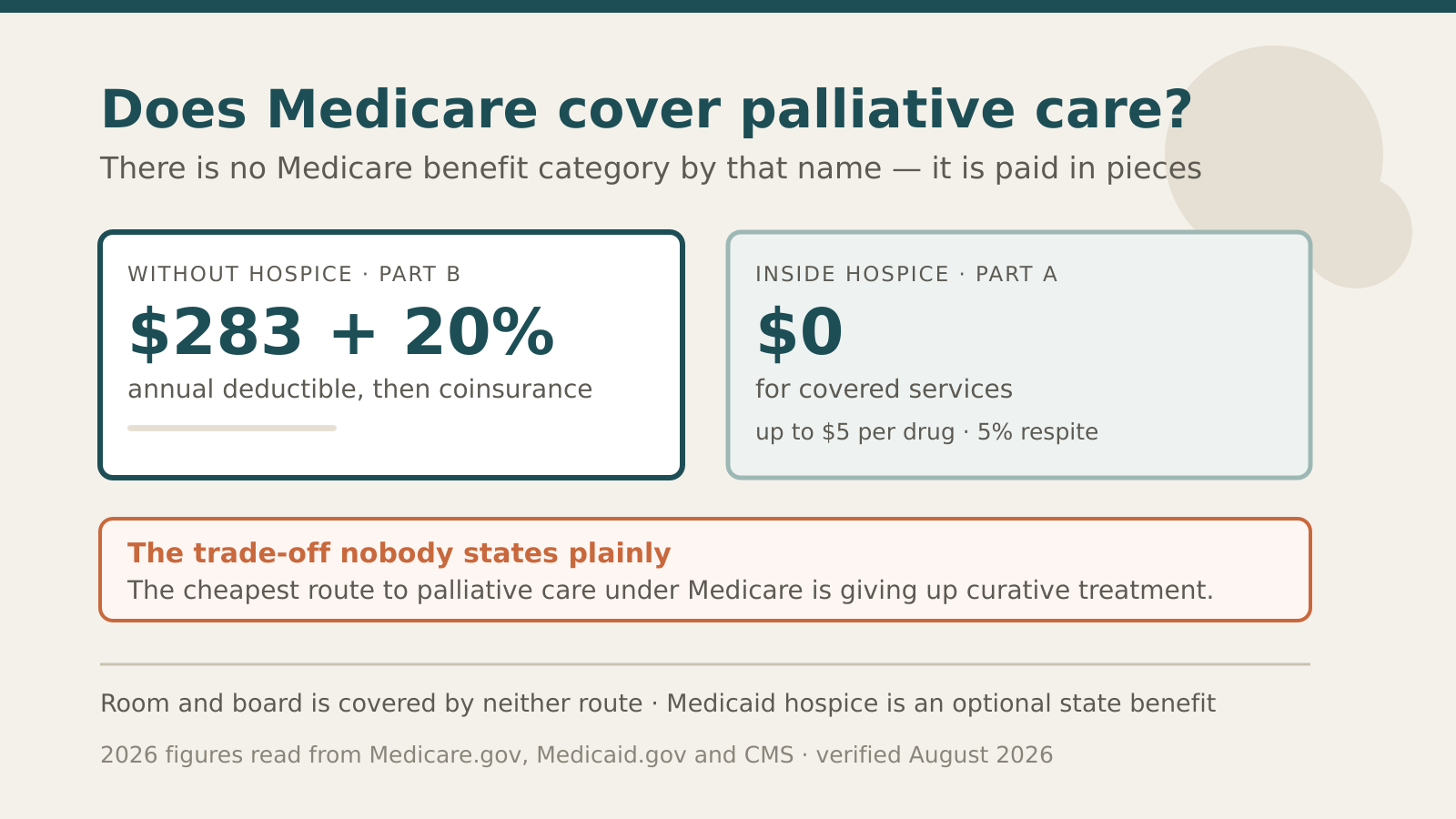
Medicare has no benefit category called “palliative care.” That single fact explains most of the confusion on this question, and it is why two different people can both be right when one says “Medicare covers it” and the other says “Medicare doesn’t.” Palliative care is paid for in pieces — some under Part B at 20% coinsurance, some bundled at $0 inside the hospice benefit, and some not at all. Which bucket you land in depends on one thing: whether you have elected hospice.
This page walks the line between those buckets with the actual 2026 dollar figures, then goes where the official pages stop — what your state Medicaid program adds, and what it is allowed to leave out.
Does Medicare pay for palliative care? The short answer
Yes, but not as a single service with a single price. Medicare pays for palliative care two ways, and they cost you very different amounts.
Route 1 — outside hospice, under Part B. If you are seriously ill but still pursuing treatment, the palliative visits, symptom-management consultations, and care-planning services you receive are billed as ordinary Part B physician services. In 2026 that means you pay the $283 annual Part B deductible first, then 20% of the Medicare-approved amount for each covered service, as long as your provider accepts assignment. The Part B premium itself is $202.90 per month for most people in 2026, higher if your income is above the threshold.
Route 2 — inside the hospice benefit, under Part A. Once you elect hospice, palliative care stops being a line item and becomes the entire plan of care. Medicare.gov states it plainly in its hospice eligibility conditions: you must accept “comfort care (palliative care) instead of care to cure your illness and related conditions.” At that point you pay nothing for covered hospice services.
The practical consequence is uncomfortable but worth saying out loud: the cheapest way to get palliative care under Medicare is to give up curative treatment. That is a real trade-off, not a technicality, and it is the single most important thing to understand before you make the election.
Who pays for palliative care: the four payers, ranked by what they actually cover
When people ask who pays for palliative care, they usually have one of four payers in front of them. Here is how they rank in 2026, from most complete coverage to least.
| Payer | What it covers | What you pay |
|---|---|---|
| Medicare Part A hospice benefit | The full plan of care: nursing, physician services, drugs for symptom control, medical equipment and supplies, aide and homemaker services, counseling, short-term inpatient and respite care | $0 for covered services; up to $5 per prescription for outpatient pain and symptom drugs; 5% of the Medicare-approved amount for inpatient respite |
| Medicare Part B | Palliative and care-management services delivered outside hospice — advance care planning, chronic care management, principal illness navigation, caregiver training | $283 deductible, then 20% coinsurance |
| Medicaid | Hospice as an optional state plan benefit; varies state to state (see below) | Varies by state |
| You | Room and board, personal care hours beyond what the plan authorizes, home modifications | Full cost |
Notice what sits in the bottom row. Room and board is the largest predictable out-of-pocket item in end-of-life care, and neither Medicare route covers it. Medicare.gov is explicit: Medicare does not cover room and board if you get hospice care in your home, or if you live in a nursing home or a hospice inpatient facility. The only exception is when the hospice team itself determines you need short-term inpatient or respite care and arranges it.
The four Part B services most people miss
Because Medicare has no palliative benefit category, the Part B services that function as palliative support are scattered across the coverage index under other names. All four below are Part B, and all four cost you 20% of the Medicare-approved amount after the $283 deductible:
- Advance care planning. Covered as a voluntary service. Important exception: you pay nothing if your provider accepts assignment and the planning happens as part of your “Welcome to Medicare” visit or a yearly “Wellness” visit. Get it done inside a wellness visit and it is free; get it done during other medical treatment and the deductible and coinsurance apply.
- Chronic care management. A monthly service requiring two or more serious chronic conditions expected to last at least a year. Includes a comprehensive care plan, 24/7 access for urgent needs, and medication review.
- Principal illness navigation. Requires one serious condition expected to last at least three months that puts you at high risk of hospitalization, nursing home placement, sudden worsening, decline, or death. You need an initial visit first; after that you can receive navigation monthly for the rest of the year, and you need another initial visit after a year to continue.
- Caregiver training services. Training for the family member doing the care — giving medications, safe transfers, wound care, preventing bedsores. It can be delivered without the patient present, which is the detail almost nobody knows.
If you are managing serious illness at home and none of these four have been offered to you, ask. They are the closest thing Original Medicare has to a palliative program.
Does Medicare pay for hospice care, and where exactly is the line?
Yes. Hospice is covered by Part A, and the cost-sharing is unusually light. To qualify you must have Part A and meet all three conditions:
- Your hospice doctor and your regular doctor (if you have one) certify that you are terminally ill, with a life expectancy of 6 months or less.
- You accept comfort care instead of care to cure your illness and related conditions.
- You sign a Hospice Election Statement identifying the hospice and your attending doctor. This must be completed before you get any hospice services.
The benefit runs in two 90-day benefit periods, followed by an unlimited number of 60-day periods. The six-month prognosis is a certification standard, not a countdown clock — after six months you can continue as long as the hospice medical director or hospice doctor recertifies you following a face-to-face meeting. You may change hospice providers once during each benefit period.
What hospice will not pay for
Five exclusions, straight from the coverage rules, and each one is a bill someone ends up paying:
- Treatment intended to cure your terminal illness or related conditions.
- Prescription drugs meant to cure the illness, as opposed to controlling symptoms or relieving pain.
- Care from any hospice provider not arranged by your hospice medical team.
- Room and board, at home or in a facility.
- Emergency room care, inpatient hospital care, and ambulance transportation — unless arranged by your hospice team, or unrelated to the terminal illness.
There is a protection here that is worth using. You can ask your hospice for a written list of the items, services, and drugs they have determined are not related to your terminal illness, along with the reason for that determination. They must give it to you within 3 to 5 days of your request, depending on when you asked, and they must supply it to your non-hospice providers or to Medicare on request. Ask for that addendum in writing on day one. It is the document that prevents the surprise bill.
The three hospice costs that are not $0
“You pay nothing” is the headline, and it is broadly true. But three exceptions have dollar figures attached in 2026:
| Item | 2026 cost to you |
|---|---|
| Covered hospice services | $0 |
| Outpatient prescription drugs for pain relief and symptom control | Copayment of up to $5 per prescription |
| Inpatient respite care | 5% of the Medicare-approved amount, capped at the inpatient deductible amount |
| Care for conditions unrelated to your terminal illness | Original Medicare deductibles and coinsurance still apply |
For scale on that last row, here are the 2026 Original Medicare figures that would apply to unrelated care: the Part A deductible is $1,736 per benefit period, inpatient days 61–90 cost $434 per day, days 91–150 cost $868 per day against lifetime reserve days, and a skilled nursing facility stay costs $217 per day for days 21–100. If you do not qualify for premium-free Part A, buying it costs either $311 or $565 per month depending on your work history.
Is palliative care covered by insurance other than Medicare?
If you are in a Medicare Advantage plan rather than Original Medicare, the hospice benefit still runs through Original Medicare — that structure has not changed. What differs is everything around hospice: the supplemental benefits, the network rules, and the cost-sharing on the Part B services listed above. Plan documents, not this page, are the authority on your specific plan. We cover the mechanics of how Advantage plans handle in-home services in our guide to whether Medicare Advantage covers home health care.
Medigap policies help with the Part A and Part B cost-sharing described above — the $283 deductible, the 20% coinsurance, the per-day inpatient amounts. They do not create coverage where none exists, so they will not pay room and board either.
Where the official pages go quiet: there is no published federal list of which private insurers cover standalone, non-hospice palliative consultations, and we are not going to invent one. If you have employer or retiree coverage alongside Medicare, the question to ask your plan is narrow and answerable: “Do you cover palliative care consultations billed under Part B codes when the member has not elected hospice, and what is my cost share?”
Does Medicaid cover palliative care? This is where the answer stops being national
This is the part the federal coverage pages do not do, and it is the part that changes what you actually pay.
Medicaid hospice is an optional state plan service. Medicaid.gov says so in the first sentence of its hospice benefits page. Optional means exactly what it sounds like — a state chooses whether to offer it, and the terms it offers are set in that state’s Medicaid state plan, not in federal law. Changing hospice coverage or reimbursement requires the state to file a state plan amendment.
Where a state does offer it, the benefit covers nursing, medical social services, physician services, counseling for the individual and the family members caring for them at home, short-term inpatient care, medical appliances and supplies, home health aide and homemaker services, and physical, occupational and speech-language therapy. As with Medicare, electing it means acknowledging that other Medicaid services for curing the terminal condition are waived — but you may revoke the election at any time and resume those benefits.
The FY 2026 Medicaid hospice payment floor, by level of care
Here is the table that no consumer-facing page publishes. These are the CMS minimum Medicaid hospice rates for federal fiscal year 2026, effective October 1, 2025 through September 30, 2026, reflecting the final Medicare hospice rule published August 1, 2025. They apply to providers that submitted the required quality data. States retain the flexibility to pay providers more than these minimums — these are floors, not ceilings.
| Level of care | FY 2026 daily rate (quality data submitted) | Rate with 4-point non-reporting reduction |
|---|---|---|
| Routine Home Care, days 1–60 | $231.13 | $222.12 |
| Routine Home Care, days 61+ | $182.18 | $175.07 |
| Continuous Home Care (full 24 hours) | $1,674.94 — hourly rate $69.79 | $1,609.65 — hourly rate $67.07 |
| Inpatient Respite Care | $560.51 | $538.65 |
| General Inpatient Care | $1,199.86 | $1,153.08 |
| Service Intensity Add-On (per hour) | $69.79 | $67.07 |
Four rules govern how those rates get applied, and each one is a limit you can run into:
- Continuous Home Care requires a minimum of eight hours per day before the state pays at that level, and pays for every hour or part hour up to 24.
- Inpatient respite is capped at five days per respite admission, counting the admission day but not the discharge day. Day six and after drop to the Routine Home Care rate.
- The Service Intensity Add-On is paid only for registered nurse or social worker visits during Routine Home Care in the last seven days of life, for at least fifteen minutes and up to four hours, and not by telephone for the social worker.
- Aggregate inpatient days — general inpatient plus inpatient respite — may not exceed 20% of a hospice’s total Medicaid hospice days in the year running October 1 to September 30.
Two more figures worth having. If you are in a nursing facility on Medicaid hospice, the hospice is reimbursed for room and board at 95% of the skilled nursing facility rate, less any Post Eligibility Treatment of Income amount, and the hospice must pass that payment through to the facility. And the Medicare hospice cap for the cap year ending September 30, 2026 is $35,361.44 — a per-patient aggregate limit that is optional for states to adopt under Medicaid, and only applies if the state wrote it into its state plan.
The under-21 rule that changes everything for families
One federal requirement overrides the trade-off described at the top of this page. Since the Affordable Care Act took effect on March 23, 2010, Medicaid- and CHIP-eligible individuals under age 21 who elect hospice no longer have to waive curative treatment. They can receive both curative care and hospice care for the same terminal condition, concurrently.
There is no equivalent provision for adults. If you are 21 or over, electing hospice still means giving up curative treatment for the terminal illness. That asymmetry is not widely explained, and it is the single most consequential difference between the pediatric and adult rules.
What we could not verify, and where we looked
We could not find a published federal table listing, state by state, which Medicaid programs cover non-hospice palliative care as a distinct service, or the dollar limits attached to it. Medicaid.gov’s hospice benefits and hospice payments pages publish the federal structure and the national minimum rates, not a state-level coverage matrix. Status: Not published. The authoritative answer for your state lives in that state’s Medicaid state plan and its 3.1-A / 3.1-B and 4.19-B pages. Our state-by-state Medicaid funding limits table shows the same pattern in the home modification benefit — wide variation, published in state documents rather than a single federal list.
How much does palliative care cost out of pocket?
Work it in the order the bills arrive.
If you have not elected hospice. Your palliative care runs through Part B. You pay the $283 deductible once for the year, then 20% of the Medicare-approved amount for each covered visit or service. There is no annual out-of-pocket limit in Original Medicare unless you have Medigap or are in a Medicare Advantage plan. That means the 20% has no ceiling of its own — a long year of frequent visits compounds.
If you have elected hospice. Your exposure collapses to three items: $0 for covered services, up to $5 per outpatient prescription for pain and symptom drugs, and 5% of the Medicare-approved amount for inpatient respite, which cannot exceed the inpatient deductible amount. Everything else in the plan of care is bundled.
What is not in either number. Room and board. Personal care hours beyond what is authorized. And the physical changes to the house — grab bars, a ramp, a walk-in shower, a widened doorway — that make staying at home possible in the first place. None of that is in the hospice bundle or the Part B coinsurance. Those costs sit with the family, and they are often the reason a home-based plan fails. If that is the wall you are hitting, start with whether Medicaid pays for home modifications and our overview of aging in place home modifications, then check what home modification grants exist in your situation.
One more comparison worth making before you decide: the arithmetic of care at home versus a facility does not always favor home, and the crossover point is a specific number of paid hours per week. We work that number in home care vs memory care.
Frequently asked questions
Is palliative care the same as hospice? No. Hospice is one delivery model for palliative care, restricted to people certified with a life expectancy of 6 months or less who have accepted comfort care instead of curative treatment. Palliative care outside hospice has no prognosis requirement and does not require giving up treatment — but it is billed under Part B at 20% coinsurance rather than bundled at $0.
Does Medicare cover palliative care at home? Yes, through both routes. Under hospice, home is the default setting and the plan of care follows you there. Outside hospice, the Part B services — chronic care management, principal illness navigation, caregiver training — are not tied to a facility. What Medicare does not pay for at home is room and board or custodial personal care hours.
Can I leave hospice if I change my mind? Yes. You can revoke the hospice election and return to standard Medicare or Medicaid benefits, including curative treatment. Under Medicaid the revocation right is stated explicitly: you may revoke at any time and resume the benefits that were waived.
Does Medicaid cover palliative care in every state? No. Medicaid hospice is an optional state plan service. A state may choose not to offer it, and the states that do set their own terms through the state plan.
Who certifies that I qualify for hospice? Only your hospice doctor and your regular doctor, if you have one, can certify terminal illness with a life expectancy of 6 months or less. After the first six months, recertification requires a face-to-face meeting with a hospice doctor or hospice nurse practitioner.
Sources
- Medicare.gov — Hospice care coverage
- Medicare.gov — Medicare costs (2026 figures)
- Medicare.gov — Advance care planning
- Medicare.gov — Chronic care management services
- Medicare.gov — Principal illness navigation services
- Medicare.gov — Caregiver training services
- Medicaid.gov — Hospice benefits
- Medicaid.gov — Hospice payments
- CMS — Annual Change in Medicaid Hospice Payment Rates, FY 2026 (memorandum dated September 5, 2025)
All figures on this page were read directly from the federal sources listed above and last verified on August 26, 2026. Medicare cost-sharing amounts change each January; Medicaid hospice rates change each October 1.
Related: if the person doing the day-to-day care is a family member, see does Medicare pay for a family caregiver for the Medicaid, VA and Older Americans Act routes that do pay.
Leave a Reply