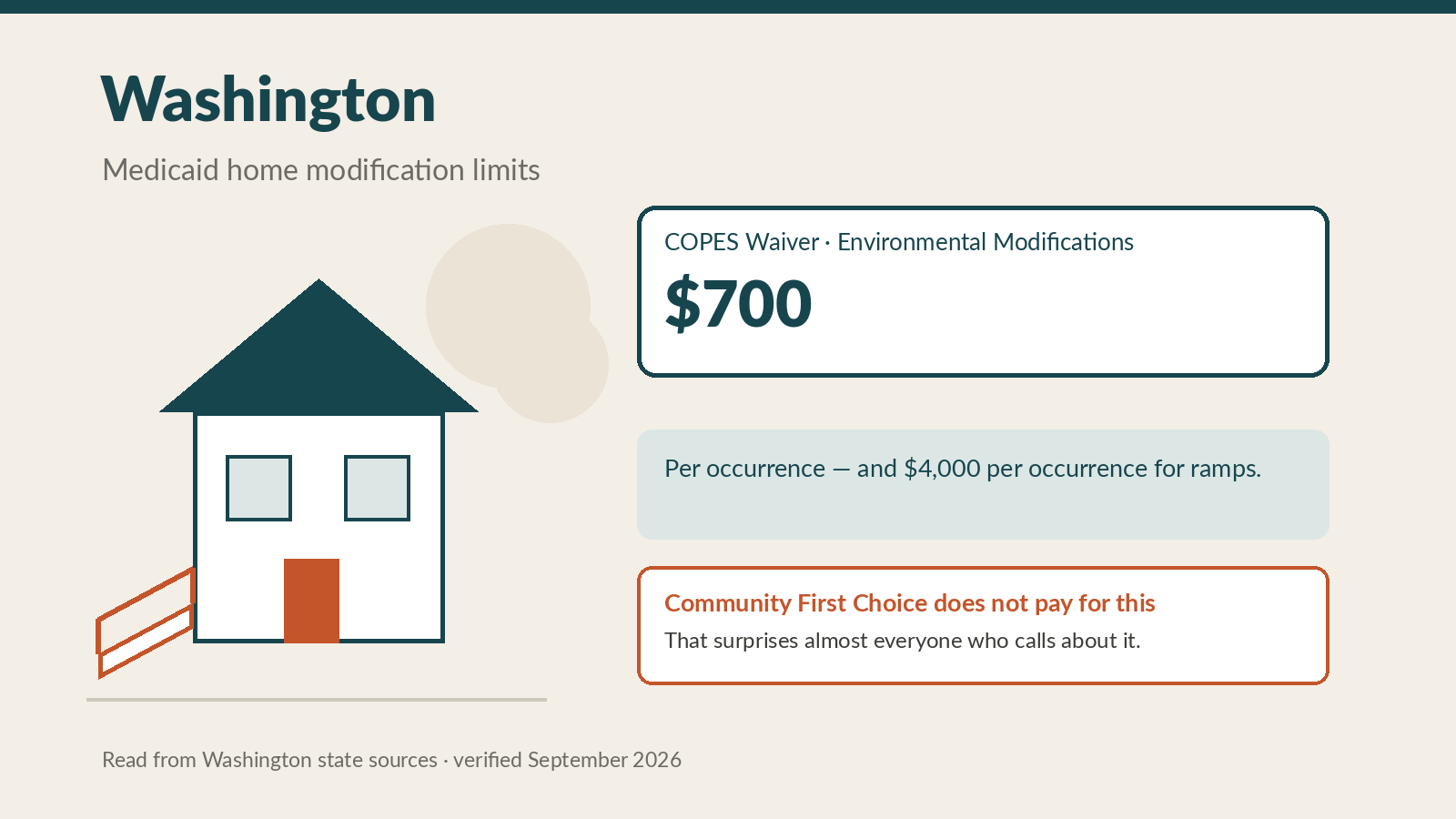
Washington’s Medicaid home modification limit is 700 dollars per occurrence, and 4,000 dollars for a ramp. Neither number appears anywhere in Washington law.
We went looking for them in the Washington Administrative Code, because that is where a state normally puts a service limit. WAC 388-106-0300, the rule that defines what the COPES waiver pays for at home, describes environmental modifications in five qualitative conditions and does not contain a single dollar sign. The figures live in a staff operations manual instead.
That is not a scandal, but it does change how you should use the numbers, and it explains why they are so hard to verify against anything official. This page walks through what Washington actually pays, which programme you have to be on to get it — the answer is probably not the one you expect — and where the real ceilings and exceptions sit. Every figure is quoted from a state source with its revision date attached.
Last verified 2026-09-02.
The amounts, and where they actually come from
The operative text is in the DSHS Long-Term Care Manual, Chapter 7d (COPES), last revised 05/2026:
Environmental Modification Service Code: S5165 UA. Limit without ETR 700.00 per occurrence. Limit of 4000 without ETR for construction of ramps.
Three things in that quotation are usually reported wrong.
It is “per occurrence,” not “per instance” and not “per year.” Each approved modification event draws against the limit separately. There is no annual reset because there is no annual allowance.
It says “without ETR.” These are not absolute ceilings — they are the amounts a case manager can authorise without going through the exception process. That is a meaningfully different thing, and it is the single most useful fact on this page.
It is not a rule, it is a manual. The WAC that governs COPES in-home services, WAC 388-106-0300 (effective August 10, 2019), sets only conditions: modifications qualify if they “(a) Are necessary to ensure your health, welfare, and safety; (b) Enable you to function with greater independence in the home; (c) Directly benefit you medically or remedially; (d) Meet applicable state or local codes; and (e) Are not adaptations or improvements, which are of general utility or add to the total square footage.” The dollar figures are administrative guidance layered on top.
The exception process, and its one nasty catch
Exceeding 700 or 4,000 dollars means an Exception to Rule request under WAC 388-440-0001 (effective May 5, 2014). The department may grant one when “(a) The exception would not contradict a specific provision of federal law or state statute; and (b) The client’s situation differs from the majority; and (c) It is in the interest of overall economy and the client’s welfare; and either (d) It increases opportunities for the client to function effectively; or (e) A client has an impairment or limitation that significantly interferes with the usual procedures required to determine eligibility and payment and/or the client is at serious risk of institutionalization.”
Then this: “Clients have no fair hearing rights as defined under chapter 388-02 WAC regarding exception to rule decisions by department staff.”
You cannot appeal a denied ETR to an administrative law judge. The only route is the complaint process in chapter 388-426 WAC. That makes the quality of the initial request unusually important — there is no second bite.
The good news is where it gets decided. Chapter 3 of the Long-Term Care Manual (revised 4/2026) lists environmental modification overruns among the requests that “the local, regional/AAA level must review and render decisions for,” meaning your ETR does not have to climb to headquarters. Chapter 7d tells you what it must contain: “cost-effective alternatives explored to address the barrier must be documented in the ETR (this should include specific alternatives such as Specialized Medical Equipment, not simply that the client’s wants to remain in the community setting).”
Translated: an ETR that says “she wants to stay home” fails. An ETR that says “we priced a ceiling lift and a portable ramp, here is why neither works, here is the cost comparison” is the one that succeeds.
Community First Choice does not pay for this, and that surprises everyone
This is the correction most Washington residents need, and it is the opposite of what almost every national summary implies.
Community First Choice is Washington’s big, statewide, entitlement-based long-term services programme. Far more people are on CFC than on COPES. It is natural to assume CFC covers home modifications. It does not, and the exclusion is explicit.
WAC 388-106-0270, the rule listing CFC services (effective July 7, 2023), contains nine service categories and environmental modifications is not among them. WAC 388-106-0274 then closes the door from the other side: “There are limits to the assistive technology you may receive. Assistive technology excludes: … (h) Home/environmental modifications.” That rule was last made effective November 13, 2025 — it is current law, not a historical artefact. Chapter 7b of the Long-Term Care Manual (revised 04/2026) repeats it in plain language: “Examples of items not covered under CFC AT: … Environmental Modification.”
CFC’s assistive technology benefit does exist but its ceiling is not public either: “In combination with skills acquisition training, assistive technology purchases are limited to a yearly amount determined by the department per fiscal year.” The department does not publish that amount in the WAC. Not published.
The practical consequence: in Washington, being on Medicaid long-term care is not enough to get your bathroom modified. You need to be on a waiver that covers it. The manual describes the usual route, dual enrolment: “If the client is enrolled in CFC+COPES, they are enrolled in both the CFC state plan and the COPES waiver.” If you are on CFC alone and a case manager tells you modifications are not available, they are correct — but the answer is to ask about adding COPES, not to give up.
The other waivers, briefly
Residential Support Waiver. WAC 388-106-0336 (effective August 16, 2025) lists eleven services. Environmental modifications is not one of them.
New Freedom. This one does cover the work, under a completely different money model. WAC 388-106-1400(4)(d) (effective September 30, 2022) includes “Environmental or vehicle modifications, defined as alterations to your residence or vehicle that are necessary to accommodate your disability and promote your functional independence, health, safety, and welfare,” with the standard caveat that they “cannot be adaptations or improvements that are of general utility or merely add to the total square footage of the home.”
New Freedom runs on a participant-directed budget rather than a service limit. Chapter 7e (revised 4/2026): “A participant is allowed to accumulate up to 3,500 in their account to pay for such a purchase without getting additional approval,” and “may request approval to exceed the 3,500 cap for exceptional, planned purchases with preapproval from the New Freedom Program Manager.” New Freedom is only available in some counties, which the manual states in its own title.
| Programme | Covers home modifications? | Limit |
|---|---|---|
| COPES waiver | Yes | 700 per occurrence; 4,000 for ramps; both “without ETR” |
| Community First Choice | No — explicitly excluded | n/a |
| Residential Support Waiver | No — not in the service list | n/a |
| New Freedom | Yes, via participant budget | 3,500 accumulated without extra approval; more with preapproval. Limited counties |
What Washington covers
Chapter 7d defines the service as “those minor physical modifications to the private residence of the client (owned or rented) that are: justified by the client’s service plan, necessary to ensure the health, welfare and safety of the client or enable the client to function with greater independence in the home, and is the most cost-effective option to meet the client’s identified need.”
That third condition does more work in Washington than in most states. It is why the manual explicitly discourages tile, and why the ETR standard is built around documented alternatives.
The listed modifications: “All authorized modifications must meet ADA specifications, including the slope of a ramp. Modifications may include: the installation of ramps and grab-bars, widening of doorway(s), modification of existing bathroom facilities, the installation of specialized electric and plumbing systems that are to accommodate the medical equipment and supplies that are necessary for the health and welfare of the client, lift systems not covered by insurance (such as EWC-type lifts).”
What it will not pay for
Verbatim from Chapter 7d. “Excluded are: modifications or improvements to the home that are of general utility and are not of direct medical or remedial benefit to the client. Repairs or general maintenance needed prior to a modification being completed (or determined during the modification), including testing and removal or abatement of asbestos or mold or repairs required due to water or pest damage. Repair and general maintenance of a dwelling are the responsibility of the owner. Tile showers, walls, or floors as there are typically other, less costly options. If a contractor can demonstrate that a basic tile is the most cost-effective option, tile may be considered. Modifications that add to the total square footage of the home except when necessary to complete an adaptation (e.g., to improve entrance/egress to a residence or to configure a bathroom to accommodate a wheelchair). Modifications to licensed settings such as adult family homes or assisted living facilities. Modifications to more than one entrance/exit.”
Two of those deserve highlighting because they end projects that were already underway.
The mold and rot clause. If a contractor opens a bathroom wall and finds water damage, the programme will not pay to fix it — that becomes the owner’s bill, and the modification stalls until it is resolved. If the house is old, budget for this before you start.
One entrance only. “Social services may not be used if there is a safe, accessible entrance/exit or for more than one entrance/exit.” A ramp at the front means no second ramp at the back, and a house with an existing accessible entrance gets nothing.
Rules for renters and contractors
If you rent, get the landlord’s signature before anything else happens: “Approval for a modification must be given in writing from the landlord/homeowner prior to an authorization being created. Use DSHS form 27-147, Housing Modification Property Release Agreement, to obtain written approval. This form is a legally binding form and cannot be altered in any way.”
Contractor requirements are specific enough to be worth knowing before you pick one. Providers must “meet the standards of Chapter 18.27 RCW Registration of Contractors” and “have a current contract with the Department.” Then: “If a stair lift is being authorized, the contracted environmental modification provider must hold an elevator license.” And on size: “Ramps larger than eight (8) feet must be installed by a vendor with an Environmental Modification contract.” Volunteer labour is allowed only where costs are “less than 500 per Chapter 18.27.090(9) RCW.”
If a stair lift is what you are pricing, our stair lift cost guide lists the published US prices, and whether Medicare covers stair lifts covers the other payer you should exhaust first.
Coming home from a nursing facility
One provision is genuinely generous and routinely missed: “Modifications may be authorized up to 180 days in advance of the community transition of a resident of a nursing facility.” If a discharge is being planned, the ramp can be built before the move rather than after — which is often the difference between a discharge that works and one that fails.
How to apply: the actual door, by name
One naming note first, because it will confuse you otherwise. The agency has been renamed. What was the Aging and Long-Term Support Administration (ALTSA) is now the Home and Community Living Administration (HCLA) — the 5/2026 manual states “HCS programs are funded by Medicaid and/or state funds and administered by the Home and Community Living Administration (HCLA).” The web addresses still say altsa and many page titles still say ALTSA. Both names refer to the same office.
- DSHS Home and Community Living Administration (formerly ALTSA) — the consumer starting point is the Getting Started page under dshs.wa.gov/altsa, and the Find a Local Office page lists Home and Community Services offices, Area Agencies on Aging and Residential Care Services by region.
- Home and Community Services regional intake — Region 1, eastern Washington: (509) 568-3767 or (866) 323-9409. Region 2 North, covering Snohomish, Whatcom, Skagit and Island: 1 (800) 780-7094. Region 2 South, King County: (206) 341-7750. Region 3, including Pierce, Kitsap and Thurston: 1 (800) 786-3799.
- Washington Connection is the official online application. DSHS’s own instruction sheet confirms it: “An online application can be completed and submitted by going to the Washington Connections website and clicking ‘Apply Now’ (this is not a real time process).” The site runs on the department’s own domain behind the scenes.
- Community Living Connections is the statewide referral network, reachable at waclc.org.
One discrepancy we are flagging rather than resolving. Two DSHS pages give different phone numbers for Community Living Connections — the Find a Local Office page prints 1-855-587-0252 and the Who to Contact page prints 1-855-567-0252. Both are on dshs.wa.gov. We are not going to guess which is right; use the website, or call the regional intake number for your area instead.
The waiting list, honestly
Washington’s answer here is unusually two-sided, and getting it right changes what you should do.
COPES can have a waiting list, by rule. WAC 388-106-0335 (effective June 17, 2005): “The department will create a waiting list in accordance with caseload limits determined by legislative funding. Wait listed clients will gain access in the following manner: (1) Nursing home residents wanting COPES waiver services will be ranked first on the waitlist by date of application for services; (2) Then clients living in the community with a higher level of need, as determined by the CARE assessment, will be ranked higher on the waitlist over clients with a lower level of need; and (3) When two or more clients in the community have equal need levels, the client with the earlier application for services will have priority.”
Note the ordering: assessed need outranks application date for people living in the community. That is different from North Carolina, where the queue is strictly first-come. In Washington, a thorough CARE assessment is worth more than an early filing. The Residential Support Waiver and New Freedom carry equivalent waitlist rules at WAC 388-106-0348 and WAC 388-106-1470.
CFC cannot have one. Chapter 7 of the manual (revised 5/2026) explains the mechanism: “State Plan services must be offered statewide, and the state cannot set limits on the number of people who will be served or the dollar amount that will be spent. Federal rules require that state plan services should be used before using 1915(c) waiver funds. This is why state plan programs are considered priority programs.” DSHS describes CFC as “a Medicaid entitlement state plan option, established by the Affordable Care Act under 1915(k) of the Social Security Act.” The structural confirmation is that COPES, the Residential Support Waiver and New Freedom each have a “Are there waiting lists” rule in chapter 388-106 WAC, and the CFC sections at 388-106-0270 through 0295 have none.
So Washington hands you a real trade-off: the entitlement programme with no queue is the one that will not modify your house, and the programme that will modify your house is the one that can make you wait.
How long, and how many slots? Not published.
Washington publishes no average or median wait time for COPES. We checked the whole of chapter 388-106 WAC and Long-Term Care Manual chapters 3, 7, 7b, 7d and 7e, plus the DSHS application pages. No figure exists.
The current participant cap is also not published in any readable form. The current COPES waiver, WA.0049.R09.00, is approved and effective January 1, 2024 through December 31, 2028, but medicaid.gov distributes the approved application only as a ZIP archive and renders its factsheet page empty. The only figure we could read verbatim is from the superseded 2017 version, WA.0049.R07.06, whose Appendix B-3-a table lists 42,328 unduplicated participants in each of years one through five. That number is from a replaced document and should not be quoted as current.
Primary sources and last verification date
| Source | Effective or revision date |
|---|---|
| WAC 388-106-0300 — COPES in-home services | Effective August 10, 2019 |
| WAC 388-106-0335 — COPES waiting list | Effective June 17, 2005 |
| WAC 388-106-0270 — CFC service list | Effective July 7, 2023 |
| WAC 388-106-0274 — CFC assistive technology limits | Effective November 13, 2025 |
| WAC 388-106-0336 — Residential Support Waiver services | Effective August 16, 2025 |
| WAC 388-106-1400 / 1405 — New Freedom services and exclusions | Effective September 30, 2022 |
| WAC 388-440-0001 — Exceptions to rule | Effective May 5, 2014 |
| LTC Manual Chapter 7d, COPES (source of the 700 and 4,000 figures) | Last revised 05/2026 |
| LTC Manual Chapter 7b, Community First Choice | Last revised 04/2026 |
| LTC Manual Chapter 7e, New Freedom | Last revised 4/2026 |
| LTC Manual Chapter 7, state plan versus waivers | Last revised 5/2026 |
| LTC Manual Chapter 3, ETR approval levels | Last revised 4/2026 |
| medicaid.gov, COPES waiver WA.0049.R09.00 | Effective 01/01/2024 – 12/31/2028 |
All WAC text was read at the Washington State Legislature’s own site; all manual text at dshs.wa.gov. We used no commercial senior-care sites, blogs or aggregators for any figure on this page. Last verified 2026-09-02.
Where Washington sits nationally
On a headline comparison Washington looks like one of the least generous states in the country — 700 dollars against North Carolina’s 28,000 and Alaska’s 40,000. That comparison is misleading in both directions.
It understates Washington because 700 dollars is a per-occurrence figure that a case manager can authorise without paperwork, ramps get their own 4,000 dollar line, and an ETR can exceed both. It overstates Washington because the exception has no appeal rights, so an unsympathetic first decision is close to final.
See how the states compare in our Medicaid home modification limits by state table, or run the state funding checker. Our other state pages cover North Carolina, Ohio, Texas, New York and California.
Because the Washington ceilings are low relative to real construction costs, stacking matters here more than in most states. Start with how Medicaid pays for home modifications, then check the VA HISA grant if there is military service in the family, and the non-Medicaid routes in our home modification grants hub. For sequencing the work itself, see aging in place home modifications, and if the bathroom is the problem, whether Medicare covers walk-in tubs.
Five things to do this week
1. Find out which programme you are actually on. CFC and COPES sound interchangeable and are not. If you are on CFC only, ask specifically about CFC+COPES dual enrolment — that is the sentence that unlocks modifications.
2. Treat 700 dollars as the no-paperwork ceiling, not the answer. The words “without ETR” are in the manual for a reason.
3. Build the ETR around alternatives, not need. Price the equipment option, document why it fails, show the cost comparison. There is no appeal, so the first submission is the only one that counts.
4. If you rent, get DSHS form 27-147 signed first. Nothing is authorised until the landlord has signed it, and the form cannot be modified.
5. If a nursing facility discharge is being planned, start now. The 180-day advance authorisation exists precisely so the house is ready on the day of the move.
Leave a Reply