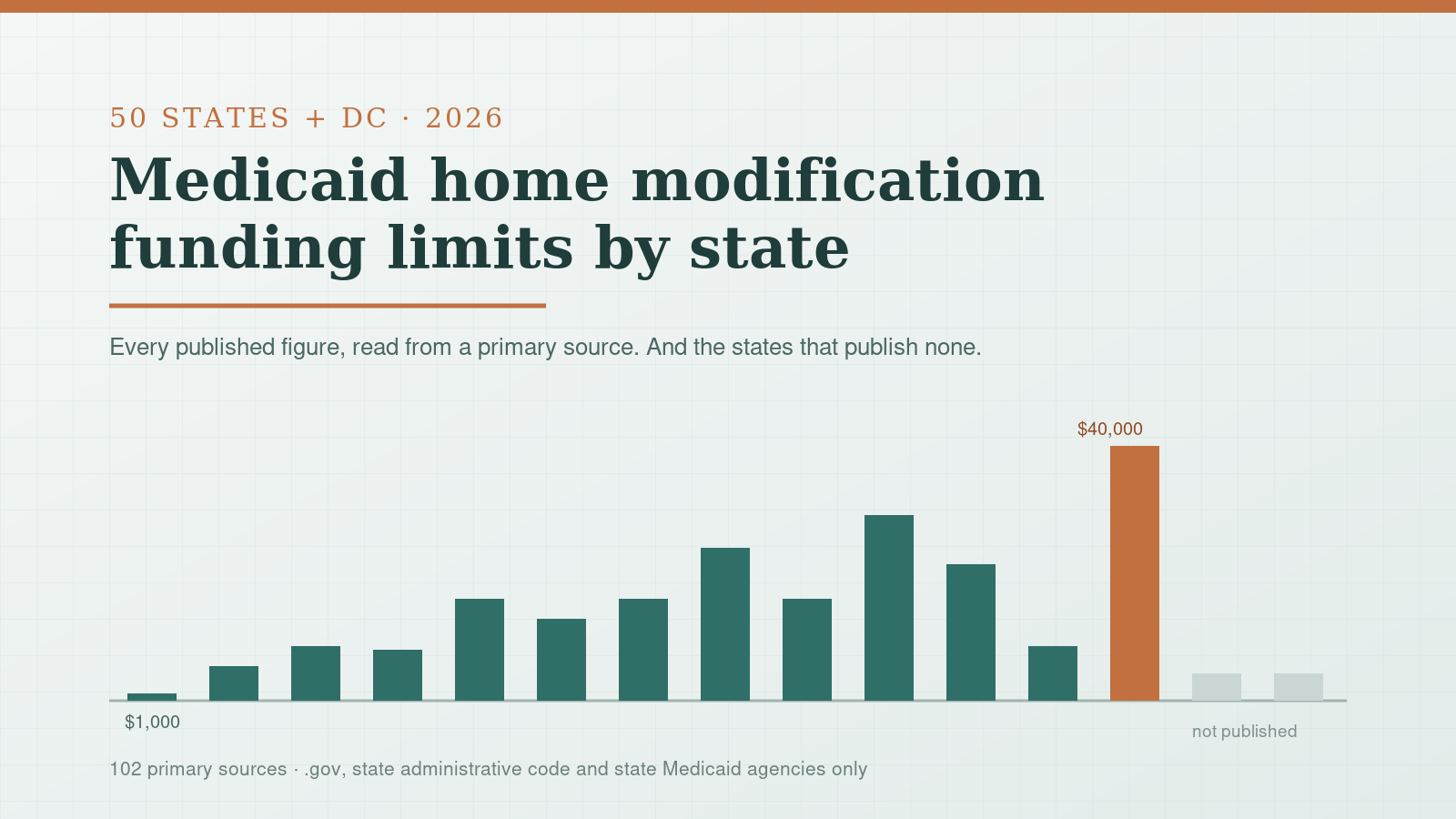
Every U.S. state pays for some home modifications through Medicaid, but almost none of them advertise how much. This page collects the published dollar limit for each state and the District of Columbia, with a link to the government document the figure came from.
What we found: 29 of the 51 jurisdictions publish a dollar figure. 22 do not publish one at all — and that is not the same as having no limit. Where a state publishes nothing, we say so and list the official pages we checked, rather than printing an estimate.
State detail pages: Texas
Among the states that do publish a figure, the range is wide: West Virginia caps environmental accessibility adaptations at $1,000 per service year, while Alaska covers up to $40,000 every three years. That is a 40-fold difference in the same federal program.
Last verified: August 10, 2026. Every figure below was read directly from a state government website, a state administrative code, or a CMS waiver document on the date shown. No figure on this page comes from a commercial website, a blog, or a summary of a summary.
How we verified this
We used one rule: a dollar figure appears on this page only if we read it, word for word, on an official government source.
- Sources we accepted: state .gov websites, state Medicaid agency publications, state administrative codes and regulations, and waiver applications and technical guides published on medicaid.gov.
- Sources we rejected: commercial senior-care sites, lead-generation sites, law-firm marketing pages, blogs, and AI-generated summaries — including the ones that currently rank for these searches.
- When a document was unreachable — blocked by robots.txt, distributed only as a ZIP archive, published only as a Word file, or too large to render — we recorded that fact instead of substituting a number from a weaker source.
This matters more than it sounds. Several states control home-modification spending with something other than a dollar cap: a cost-effectiveness test, an individual budget, or a formula. Printing a plausible-looking number for those states would be wrong, not merely imprecise. You can read more about our approach on our data sourcing page.
Published home modification limits, by state
Figures are for the waiver or program most commonly used by older adults and adults with physical disabilities. Many states run additional waivers — especially for people with intellectual and developmental disabilities — that carry different limits. Where we know of a materially different figure under another waiver, it is noted in the state-by-state notes below.
| State | Program | Published limit | Period | Official source |
|---|---|---|---|---|
| Alabama | Elderly & Disabled (E&D) Waiver — Home Modification Services | $5,000 | lifetime | Source |
| Alaska | Environmental Modification (E-Mod) Home Accessibility Program | $40,000 | every 3 years | Source |
| Arizona | ALTCS — Home Modifications (AMPM Policy 1240-I) | Not published | — | Source |
| Arkansas | ARChoices in Homecare — Environmental Accessibility Adaptations | Not published | — | Source |
| California | Medi-Cal Community Supports (CalAIM) — Environmental Accessibility Adaptations | $7,500 | lifetime | Source |
| Colorado | Elderly, Blind and Disabled (EBD) Waiver — Home Modification Benefit | $14,000 | lifetime | Source |
| Connecticut | CT Home Care Program for Elders — Environmental Accessibility Adaptations | Not published | — | Source |
| Delaware | Diamond State Health Plan-Plus (DSHP Plus) — Home modifications | $6,000 / $10,000 / $20,000 | per project / per benefit year / lifetime | Source |
| District of Columbia | EPD Waiver — Environmental Accessibility Adaptation | $10,000.00 | per waiver period | Source |
| Florida | SMMC Long-Term Care — Home Accessibility Adaptation Services | Not published | — | Source |
| Georgia | Independent Care Waiver Program (ICWP) — Environmental Modification | Not published | — | Source |
| Hawaii | QUEST Integration — Environmental accessibility adaptations | Not published | — | Source |
| Idaho | Aged and Disabled Waiver (ID.1076) — Environmental Accessibility Adaptations | Not published | — | Source |
| Illinois | Home Services Program (HSP) — Environmental Modifications | $25,000 | over 5 years | Source |
| Indiana | PathWays for Aging Waiver — Home Modifications | $20,000 | lifetime | Source |
| Iowa | Health & Disability / Physical Disability / Brain Injury Waivers — Home and Vehicle Modification | $7,154.64 | per year | Source |
| Kansas | HCBS waivers — Home and Environmental Modification Services (HEMS) | $10,000 | per waiver, per lifetime | Source |
| Kentucky | Home and Community Based (HCB) Waiver — Environmental and Minor Home Adaptations | $3,025 | per year | Source |
| Louisiana | Community Choices Waiver — Environmental Accessibility Adaptations | Not published | — | Source |
| Maine | MaineCare Section 19 — Home and Community Benefits (ME.0276) | Not published | — | Source |
| Maryland | Community First Choice — Environmental Assessments and Adaptations | $15,000 | over 3 years | Source |
| Massachusetts | Frail Elder Waiver — Environmental Accessibility Adaptation | Not published | — | Source |
| Michigan | MI Choice Waiver — Environmental Accessibility Adaptations | Not published | — | Source |
| Minnesota | Elderly Waiver — Environmental Accessibility Adaptations | $21,199 | per year | Source |
| Mississippi | Independent Living Waiver — Environmental Accessibility Adaptations | Not published | — | Source |
| Missouri | Independent Living Waiver — Environmental Accessibility Adaptations | $5,000 | in a five-year period | Source |
| Montana | Big Sky Waiver — Environmental Accessibility Adaptations | Not published | — | Source |
| Nebraska | Aged and Disabled (AD) Waiver — Home Modifications | Not published | — | Source |
| Nevada | HCBS Waiver for Persons with Physical Disabilities — Environmental Accessibility Adaptations | Not published | — | Source |
| New Hampshire | Choices for Independence (CFI) Waiver — Environmental Accessibility Services | $15,000 | lifetime | Source |
| New Jersey | Managed Long Term Services and Supports (MLTSS) — Residential Modifications | $5,000 / $10,000 | per calendar year / lifetime | Source |
| New Mexico | Turquoise Care Community Benefit — Environmental Modifications | $5,000 | every 5 years | Source |
| New York | Community First Choice Option (CFCO) — Environmental Modifications | $15,000 | per year (soft cap) | Source |
| North Carolina | CAP/DA — Equipment, Modification and Technology | $28,000 | over the 5-year waiver period | Source |
| North Dakota | Medicaid HCBS Waiver (ND.0273) — Environmental Modification | Not published | set by formula | Source |
| Ohio | PASSPORT Waiver — Home Modification Services (OAC 5160-44-13) | $15,000 | per calendar year | Source |
| Oklahoma | ADvantage Program — Environmental Modifications | Not published | — | Source |
| Oregon | Community First Choice (K Plan) — Consumer Environmental Modifications | $5,000 | per modification | Source |
| Pennsylvania | Community HealthChoices (CHC) Waiver — Home Adaptations | Not published | — | Source |
| Rhode Island | Medicaid LTSS (1115 demonstration) — Environmental modifications | Not published | — | Source |
| South Carolina | Community Choices Waiver — Environmental Modifications | $7,500 | lifetime | Source |
| South Dakota | HOPE Waiver — Environmental Accessibility Adaptations | Not published | — | Source |
| Tennessee | TennCare CHOICES — Minor home modifications | $6,000 / $10,000 / $20,000 | per project / calendar year / lifetime | Source |
| Texas | STAR+PLUS HCBS — Minor Home Modifications | $7,500 | lifetime | Source |
| Utah | Aging Waiver (65+) — Environmental Accessibility Adaptations | $5,000.00 | per service | Source |
| Vermont | Choices for Care — Home Modifications | Not published | — | Source |
| Virginia | CCC Plus Waiver — Environmental Modifications | $5,000 | per calendar year | Source |
| Washington | COPES Waiver — Environmental Modifications | $700 per occurrence; $4,000 for ramps | per occurrence | Source |
| West Virginia | Aged and Disabled Waiver — Environmental Accessibility Adaptations | $1,000 | per service year | Source |
| Wisconsin | IRIS — Environmental Accessibility Adaptations (Home Modifications) | Not published | — | Source |
| Wyoming | Community Choices Waiver — Environmental Modifications | $20,000 | lifetime, per family | Source |
Read this before you use any figure above
Four things trip people up when they compare these numbers.
- Some limits are shared with other services. Illinois’ $25,000, Maryland’s $15,000, Kansas’ $10,000 and North Carolina’s $28,000 is a single service budget that also covers assistive technology, equipment and vehicle modifications, so the amount available for construction work is less. The word combined appears in the CAP/C children policy 3K-1; the adult CAP/DA policy 3K-2 does not use it. Full detail on our North Carolina page.
- Some limits are not annual or lifetime at all. Oregon’s $5,000 is per modification. Utah’s $5,000 is a maximum payment per service. Washington’s $700 is per occurrence. Reading any of those as a yearly budget will give you the wrong answer. Note too that the 700 and 4,000 figures are the limits without an Exception to Rule, and that Community First Choice does not cover modifications at all: see our Washington page.
- Some limits can be exceeded. New York’s $15,000 is a soft cap that the state health department can approve past. Oregon and Washington both have formal exception processes. Wyoming allows requests above $20,000 for critical health or safety needs.
- Wyoming’s cap is per family, not per person. Two waiver participants in the same household share one $20,000 lifetime allowance.
Two states where the official sources disagree
We found two jurisdictions where more than one government document is in play and the figures do not match. We are publishing both readings rather than picking one, because we cannot verify which is currently operative.
New Mexico: $5,000 or $65,000?
The New Mexico Administrative Code, at 8.308.12.13(G)(5), states that environmental modification services are “limited to five-thousand dollars ($5,000) every five years.” The same figure appears in the Health Care Authority’s own PDF of that rule.
However, HCA’s Managed Care Policy Manual for Self-Directed Community Benefit, effective July 1, 2024, states that environmental modification services are “limited to $65,000.00 every five years, beginning from the first date of service.”
That is a thirteen-fold difference between two official New Mexico sources. The newer manual may reflect an increase that has not yet been carried into the administrative code, but we could not confirm that. If you are in New Mexico, confirm the current figure with the Health Care Authority before relying on either number.
South Carolina: a 2017 figure that the current manual does not repeat
An SCDHHS guidance document states a “$7,500 lifetime cap for all environmental modifications, ramps, heaters, fans, A/C” and attributes it to the CLTC Community Choices Policy and Procedure Manual last updated July 1, 2017.
The newer CLTC Provider Manual dated December 8, 2023 states no dollar cap for home environmental modifications. The only $7,500 in that manual applies to vehicle modifications. The current HCBS provider manual on the SCDHHS provider portal could not be opened, so we could not confirm whether the 2017 home-modification cap is still in force. South Carolina’s separate HASCI waiver publishes a different limit of $20,000 per modification.
The 22 jurisdictions that publish no dollar figure
These states cover home modifications but do not put a number on it in any document we could reach. They fall into three groups, and the difference matters.
Group A: the state uses a mechanism other than a dollar cap
For these states we can say with confidence that no fixed dollar amount exists, because the official document says what governs instead.
- North Dakota sets the ceiling by formula: “the dollar limit is the lesser of the highest monthly rate for the highest cost skilled nursing facility or 20% of the tax evaluation of the home.” The limit therefore depends on your own home’s tax valuation.
- Arkansas explicitly exempts the service from its budget cap: “The Individual Services Budget shall not apply to environmental accessibility adaptations/adaptive equipment.”
- Louisiana, Wisconsin and Michigan fund modifications out of the participant’s individual budget or a cost-effectiveness review rather than a service ceiling.
- Arizona, Florida and Pennsylvania deliver long-term care through managed care plans that authorize case by case. Their governing policy documents contain no dollar amounts at all.
Group B: we checked and found no published figure
Connecticut, Georgia, Mississippi, Montana, Nebraska, Rhode Island, South Dakota and Vermont all cover the service and all describe it in detail, but none of the official sources we reached states an amount.
Group C: the governing document could not be opened
For these states we are reporting a gap in what is publicly readable, not an absence of a limit. If you live in one of them, call the agency listed in the notes below.
- Maine — the MaineCare Benefits Manual Section 19 is published by the Secretary of State only as Microsoft Word files, and the current waiver amendment PDF sits under a path that maine.gov’s robots.txt disallows.
- Nevada — every URL for Medicaid Services Manual Chapter 2200 on dhcfp.nv.gov is blocked by robots.txt.
- Idaho — IDAPA 16.03.26 section 542 is the governing rule, but the chapter PDF is large enough that it would not render past its table of contents.
- Oklahoma, Massachusetts and Hawaii — the relevant waiver application appendix is distributed only as a ZIP archive on medicaid.gov, or the document truncated before the service definitions.
State-by-state notes
The exact wording of each limit, the caveats attached to it, and what we checked.
Alabama
Program: Elderly & Disabled (E&D) Waiver — Home Modification Services
Published limit: $5,000 (lifetime)
Verified: August 10, 2026
Ala. Admin. Code 560-X-36: “Limits on Home Modification Services are $5,000 per waiver participant per lifetime.” ID waiver (560-X-35) uses $5,000 per waiver year. medicaid.alabama.gov unreachable (SSL) — verified in the Administrative Code instead.
Alaska
Program: Environmental Modification (E-Mod) Home Accessibility Program
Published limit: $40,000 (every 3 years)
Verified: August 10, 2026
“The program covers up to $40,000 every three years.” Available across Alaska’s five HCBS waivers; initiated through your care coordinator.
Arizona
Program: ALTCS — Home Modifications (AMPM Policy 1240-I)
Published limit: No published figure
Verified: August 10, 2026
AMPM 1240-I contains no dollar figure. Controls are procedural — two competitive bids recommended, costs must be “within reasonable limits”, 90-day completion. ALTCS is managed care; the plan authorizes case by case.
Arkansas
Program: ARChoices in Homecare — Environmental Accessibility Adaptations
Published limit: No published figure
Verified: August 10, 2026
Manual sec. 212.200.B.6 excludes the service from the budget cap: “The Individual Services Budget shall not apply to environmental accessibility adaptations/adaptive equipment.” The $30,000/$20,000/$5,000 ISB tiers are NOT home-modification caps.
California
Program: Medi-Cal Community Supports (CalAIM) — Environmental Accessibility Adaptations
Published limit: $7,500 (lifetime)
Verified: August 10, 2026
“EAAs are payable up to a total lifetime maximum of $7,500.” Exceptions if the member moves or their condition changes significantly. Community Supports are optional for managed care plans — availability varies by county.
Colorado
Program: Elderly, Blind and Disabled (EBD) Waiver — Home Modification Benefit
Published limit: $14,000 (lifetime)
Verified: August 10, 2026
“There is a $14,000 lifetime maximum … for the Brain Injury waiver, the Community Mental Health Supports waiver, the Elderly, Blind and Disabled waiver and the Complementary and Integrative Health waiver.” CES and SLS waivers use $10,000 over five years instead.
Connecticut
Program: CT Home Care Program for Elders — Environmental Accessibility Adaptations
Published limit: No published figure
Verified: August 10, 2026
No cap on any reachable CT source. R.C.S.A. 17b-342-3 sets limits only as percentages of nursing-facility cost. CMS Appendix C is distributed only as a ZIP.
Delaware
Program: Diamond State Health Plan-Plus (DSHP Plus) — Home modifications
Published limit: $6,000 / $10,000 / $20,000 (per project / per benefit year / lifetime)
Verified: August 10, 2026
“Limit: $6,000 per project; $10,000 per benefit year; $20,000 per lifetime.” Three limits apply at once. LTSS is managed care — the MCO authorizes.
District of Columbia
Program: EPD Waiver — Environmental Accessibility Adaptation
Published limit: $10,000.00 (per waiver period)
Verified: August 10, 2026
29 DCMR 4217.2: “The maximum reimbursable cost per beneficiary over the duration of each waiver period is ten thousand dollars ($10,000.00) for EAA services”, including a $500 inspection reimbursement. Homeowners must first apply to DHCD’s HAIP program.
Florida
Program: SMMC Long-Term Care — Home Accessibility Adaptation Services
Published limit: No published figure
Verified: August 10, 2026
The coverage policy incorporated by Rule 59G-4.192 F.A.C. contains no dollar amounts. Florida delivers LTC through capitated plans; amounts are set in the enrollee’s care plan.
Georgia
Program: Independent Care Waiver Program (ICWP) — Environmental Modification
Published limit: No published figure
Verified: August 10, 2026
Sec. 601.6.7 defines the service with no cap. “Medicaid does not reimburse for modification to rental property.” ICWP serves adults who apply between 21 and 64. Georgia’s CCSP/SOURCE waiver does not list home modification at all.
Hawaii
Program: QUEST Integration — Environmental accessibility adaptations
Published limit: No published figure
Verified: August 10, 2026
Listed as covered, no cap stated. The DOH I/DD waiver manual references “the $10,000 and $45,000 limit” in a change-log table, but the section body would not render, so what those apply to is unverified and deliberately not carried into this row.
Idaho
Program: Aged and Disabled Waiver (ID.1076) — Environmental Accessibility Adaptations
Published limit: No published figure
Verified: August 10, 2026
Coverage confirmed by the CMS factsheet and Idaho DHW; no reachable source states a figure. IDAPA 16.03.26 sec. 542 is the governing rule but its PDF is too large to render past the table of contents.
Illinois
Program: Home Services Program (HSP) — Environmental Modifications
Published limit: $25,000 (over 5 years)
Verified: August 10, 2026
89 Ill. Adm. Code 686.605: total cost of all environmental modifications AND assistive equipment purchases, rentals and repairs “does not exceed $25,000 over 5 years.” Shared pool, not modifications alone. HSP serves people under 60.
Indiana
Program: PathWays for Aging Waiver — Home Modifications
Published limit: $20,000 (lifetime)
Verified: August 10, 2026
“A lifetime cap of $20,000 applies to home modifications installations.” Separately “a per-year cap of $1,000 applies to home modifications maintenance”, plus a $628.00 per-project assessment. PathWays covers age 60+; under 60 uses the Health & Wellness waiver (cap not verified).
Iowa
Program: Health & Disability / Physical Disability / Brain Injury Waivers — Home and Vehicle Modification
Published limit: $7,154.64 (per year)
Verified: August 10, 2026
From the upper rate limits effective 2026-01-01. Combined with vehicle modification. Elderly Waiver is $1,192.44 lifetime; ID Waiver $5,962.19 lifetime. Indexed annually — re-check before relying on it.
Kansas
Program: HCBS waivers — Home and Environmental Modification Services (HEMS)
Published limit: $10,000 (per waiver, per lifetime)
Verified: August 10, 2026
KDADS policy E2025-041: “Payment for HEMS combined with VMS and SMES shall not exceed $10,000 per participant, per waiver, per lifetime, except for I/DD waiver participants with no cap.” Combined with vehicle mods and specialized equipment.
Kentucky
Program: Home and Community Based (HCB) Waiver — Environmental and Minor Home Adaptations
Published limit: $3,025 (per year)
Verified: August 10, 2026
907 KAR 7:015 reimbursement table: “Environmental and Minor Home Modifications | Per Year | Up to $3,025”. The version served rendered as 907 KAR 7:015E (emergency, eff. 2025-01-01). Kentucky’s HCB waiver has a waiting list.
Louisiana
Program: Community Choices Waiver — Environmental Accessibility Adaptations
Published limit: No published figure
Verified: August 10, 2026
No standalone cap. EAA costs are “subject to the participant’s annual budget allotment” — the individual budget is the binding limit. The $1,000 assessment threshold in the manual is NOT a funding cap.
Maine
Program: MaineCare Section 19 — Home and Community Benefits (ME.0276)
Published limit: No published figure
Verified: August 10, 2026
UNVERIFIABLE, not confirmed absent. The governing rule (MaineCare Benefits Manual Ch. II & III, Section 19) is published only as .docx by the Secretary of State and could not be opened; the current waiver amendment PDF sits under a robots.txt-disallowed path. Call OADS at (207) 287-3707.
Maryland
Program: Community First Choice — Environmental Assessments and Adaptations
Published limit: $15,000 (over 3 years)
Verified: August 10, 2026
COMAR 10.09.84.23E: “limited to a combined reimbursement of up to $15,000 over a 3-year period per participant.” Combined with technology that substitutes for human assistance. Community Options Waiver participants get this through CFC, not the waiver itself.
Massachusetts
Program: Frail Elder Waiver — Environmental Accessibility Adaptation
Published limit: No published figure
Verified: August 10, 2026
Covered, no cap on any reachable page. Appendix C of the FEW application could not be read (mass.gov downloads returned truncated/binary; CMS copy is a ZIP). 101 CMR 359.00’s “I.C.” rate for Home Accessibility Adaptations applies to ABI/MFP waivers, NOT FEW.
Michigan
Program: MI Choice Waiver — Environmental Accessibility Adaptations
Published limit: No published figure
Verified: August 10, 2026
Bulletin MSA 19-17 sets out EAA policy in detail with no maximum. Cost is controlled by a cost-effectiveness test: “the case record must contain documented evidence that the adaptation is the most cost-effective and reasonable alternative.” MI Choice is a funding source of last resort.
Minnesota
Program: Elderly Waiver — Environmental Accessibility Adaptations
Published limit: $21,199 (per year)
Verified: August 10, 2026
TIME-SENSITIVE. $21,199 was effective 2025-01-01. DHS announced a 2.7% increase effective 2026-01-01 but did not publish the resulting figure, and DHS-3945 (the rate-limit document) is robots-blocked. The limit rises each January with CPI. BI/CAC/CADI/DD waivers use $40,000 per year instead.
Mississippi
Program: Independent Living Waiver — Environmental Accessibility Adaptations
Published limit: No published figure
Verified: August 10, 2026
Title 23 Part 208 Ch. 2 Rule 2.6(5) sets no dollar maximum. Mississippi’s larger Elderly & Disabled Waiver does NOT cover standing home modifications — only as Community Transition Services within 90 days of leaving an institution.
Missouri
Program: Independent Living Waiver — Environmental Accessibility Adaptations
Published limit: $5,000 (in a five-year period)
Verified: August 10, 2026
HCBS Policy Manual 3.55: “Authorization of EAA is limited to $5,000 in a five-year period.” Specialized Medical Equipment has its own separate $5,000/5-year limit. Confirmed for the Independent Living Waiver only.
Montana
Program: Big Sky Waiver — Environmental Accessibility Adaptations
Published limit: No published figure
Verified: August 10, 2026
No cap. The only dollar figure is an approval trigger: “Environmental Accessibility Adaptations in excess of $5,000 must be prior authorized by the Regional Program Officer.” Service is limited to a one-time purchase, with departmental exceptions possible.
Nebraska
Program: Aged and Disabled (AD) Waiver — Home Modifications
Published limit: No published figure
Verified: August 10, 2026
Title 480 NAC: home modifications are “separately capitated” and “This separate cap may change annually” — no amount given. Nebraska’s DD waivers do publish $10,000 per five-year period; that figure does NOT apply to the AD Waiver.
Nevada
Program: HCBS Waiver for Persons with Physical Disabilities — Environmental Accessibility Adaptations
Published limit: No published figure
Verified: August 10, 2026
INCOMPLETE, not a confirmed absence. The billing guide confirms the service (S5165) with no limit. The authoritative Medicaid Services Manual Ch. 2200 on dhcfp.nv.gov is robots-blocked on every URL tried; the CMS application is a ZIP.
New Hampshire
Program: Choices for Independence (CFI) Waiver — Environmental Accessibility Services
Published limit: $15,000 (lifetime)
Verified: August 10, 2026
“limited to separate lifetime maximums of $15,000 per member per lifetime” — EAS and Specialized Medical Equipment each get their own $15,000. CAVEAT: manual dated 2018-01-18; current rule He-E 801.17(i) defers to the CMS-approved waiver, which is a ZIP. Re-verify.
New Jersey
Program: Managed Long Term Services and Supports (MLTSS) — Residential Modifications
Published limit: $5,000 / $10,000 (per calendar year / lifetime)
Verified: August 10, 2026
“Residential Modifications are limited to $5,000 per calendar year, $10,000 lifetime.” Both limits apply. Authorization runs through the member’s MCO care manager.
New Mexico
Program: Turquoise Care Community Benefit — Environmental Modifications
Published limit: $5,000 (every 5 years)
Verified: August 10, 2026
⚠ SOURCE CONFLICT. 8.308.12.13(G)(5) NMAC: “limited to five-thousand dollars ($5,000) every five years” — confirmed in two official documents. But HCA’s Managed Care Policy Manual Section 9 (eff. 2024-07-01) says “$65,000.00 every five years.” A 13x divergence that could not be broken. Confirm with HCA before relying on either.
New York
Program: Community First Choice Option (CFCO) — Environmental Modifications
Published limit: $15,000 (per year (soft cap))
Verified: August 10, 2026
“Agreements for E-Mods may not exceed $15,000 per year without prior approval from the New York State Department of Health.” A review threshold, not an absolute ceiling. The NHTD and TBI waivers cover e-mods with NO published cap — do not apply this figure to them.
North Carolina
Program: CAP/DA — Equipment, Modification and Technology
Published limit: $28,000 (over the 5-year waiver period)
Verified: August 10, 2026
“Increased budget limit from $13,000 to $28,000 over the approved waiver period” (2024-11-01 to 2029-10-31). Combined pool covering modifications, equipment AND assistive technology. Clinical coverage policy 3K-2 itself states no figure.
North Dakota
Program: Medicaid HCBS Waiver (ND.0273) — Environmental Modification
Published limit: No published figure (set by formula)
Verified: August 10, 2026
No fixed dollar cap — set by formula: “the dollar limit is the lesser of the highest monthly rate for the highest cost skilled nursing facility or 20% of the tax evaluation of the home.” The $500 (assessment trigger) and $4,000 (unlicensed contractor ceiling) figures are NOT the cap.
Ohio
Program: PASSPORT Waiver — Home Modification Services (OAC 5160-44-13)
Published limit: $15,000 (per calendar year)
Verified: August 10, 2026
“Home modifications shall not exceed a total of fifteen thousand dollars in a calendar year per individual.” Applies to Ohio’s nursing-facility level-of-care HCBS programs generally. The DD side (OAC 5123-9-23) uses $15,000 per project as of the rule version effective July 1, 2026 (previously $10,000), with a county board exception process above that amount. See our Ohio page for the full rule.
Oklahoma
Program: ADvantage Program — Environmental Modifications
Published limit: No published figure
Verified: August 10, 2026
OAC 317:30-5-763(4) defines the service and states only “All services require prior authorization.” The reimbursement rule contains no limit. Appendix C of the waiver application could not be read — treat as unverified rather than confirmed-uncapped.
Oregon
Program: Community First Choice (K Plan) — Consumer Environmental Modifications
Published limit: $5,000 (per modification)
Verified: August 10, 2026
OAR 411-035-0055(4)(a): “limited to $5000 per environmental modification unless an exception is required.” A per-project limit, not annual or lifetime. Exceptions granted where no alternative meets the need. Modifications over $500 need a licensed contractor.
Pennsylvania
Program: Community HealthChoices (CHC) Waiver — Home Adaptations
Published limit: No published figure
Verified: August 10, 2026
Appendix C-3 limits are qualitative only — last-resort funding, “least expensive, most cost-effective manner”, excluded if the home is in foreclosure or not structurally sound. The $4,000 in that document is Community Transition Services, not home adaptations.
Rhode Island
Program: Medicaid LTSS (1115 demonstration) — Environmental modifications
Published limit: No published figure
Verified: August 10, 2026
No 1915(c) waiver, so no CMS Appendix C. 210-RICR-50-10-2 imposes conditions but no amount: EOHHS Office of DME prior approval, code compliance, home assessment by a certified rehab professional. The separate RI Livable Home Modification Grant is not Medicaid.
South Carolina
Program: Community Choices Waiver — Environmental Modifications
Published limit: $7,500 (lifetime)
Verified: August 10, 2026
⚠ VERIFY. “Service Cap – $7,500 lifetime cap for all environmental modifications, ramps, heaters, fans, A/C” — but the source attributes it to a 2017 manual, and the newer CLTC Provider Manual (2023-12-08) states no home-mod cap (its $7,500 is for VEHICLE modifications). The current provider manual could not be opened. HASCI waiver uses $20,000 per modification.
South Dakota
Program: HOPE Waiver — Environmental Accessibility Adaptations
Published limit: No published figure
Verified: August 10, 2026
No hard cap. The $5,000 in the manual is a documentation threshold: “When EAA authorized exceeds $5,000.00, the provider must attach the Therap Service Authorization.” Amounts above are permitted with review — do NOT read $5,000 as a cap.
Tennessee
Program: TennCare CHOICES — Minor home modifications
Published limit: $6,000 / $10,000 / $20,000 (per project / calendar year / lifetime)
Verified: August 10, 2026
“Minor home modifications (up to $6,000 per project; $10,000 per calendar year; and $20,000 per lifetime).” Available to CHOICES Groups 2 and 3. Home mods are EXCLUDED from the CHOICES Group 3 $15,000 annual expenditure cap.
Texas
Program: STAR+PLUS HCBS — Minor Home Modifications
Published limit: $7,500 (lifetime)
Verified: August 10, 2026
“There is a lifetime limit of $7,500 per member for this service and $300 yearly for repairs.” The $300/year applies only after the $7,500 is exhausted. CLASS, HCS and STAR Kids/MDCP have their own separate limits, not verified here.
Utah
Program: Aging Waiver (65+) — Environmental Accessibility Adaptations
Published limit: $5,000.00 (per service)
Verified: August 10, 2026
From the rate table’s “Maximum Allowable Rate” column, unit “Per service” — a payment ceiling per episode, not a stated annual or lifetime cap. Identical on the 2022 and 2023 sheets; the 2026 sheet had a corrupted text layer. New Choices Waiver uses $2,000.00 per episode.
Vermont
Program: Choices for Care — Home Modifications
Published limit: No published figure
Verified: August 10, 2026
The regulations set the limit as “Up to the current rate on file per calendar year” — an annual limit exists but the amount lives in a separate rate file that is not published. The DAIL guidance memo that would carry it is robots-blocked.
Virginia
Program: CCC Plus Waiver — Environmental Modifications
Published limit: $5,000 (per calendar year)
Verified: August 10, 2026
12VAC30-120-945: “up to a per member annual maximum of $5,000 per calendar year.” Assistive technology has its own separate $5,000. The limit persists across a change of waiver within the same calendar year. DD waivers carry a parallel $5,000 under 12VAC30-122-370.
Washington
Program: COPES Waiver — Environmental Modifications
Published limit: $700 per occurrence; $4,000 for ramps (per occurrence)
Verified: August 10, 2026
“Limit without ETR $700.00 per occurrence” and “Limit of $4000 without ETR for construction of ramps.” Both are ceilings only absent an Exception to Rule; cost-effective alternatives must be documented in the ETR. LTC Manual Ch. 7d, revised 05/2026.
West Virginia
Program: Aged and Disabled Waiver — Environmental Accessibility Adaptations
Published limit: $1,000 (per service year)
Verified: August 10, 2026
“EAA cannot exceed $1,000 per service year.” Used only after all other funding sources are exhausted; the member must find another source for any balance. The I/DD waiver uses the same $1,000.
Wisconsin
Program: IRIS — Environmental Accessibility Adaptations (Home Modifications)
Published limit: No published figure
Verified: August 10, 2026
Funded from the participant’s individual budget, not a fixed ceiling. One-time items need an IRIS consultant to submit a budget request to DHS, ideally with three written cost estimates. Treat as unverified-absent: the IRIS Service Definition Manual section could not be rendered.
Wyoming
Program: Community Choices Waiver — Environmental Modifications
Published limit: $20,000 (lifetime, per family)
Verified: August 10, 2026
“A lifetime cap of $20,000 per family applies to this service.” PER FAMILY, not per individual — two participants in one household share it. Chapter 44 confirms it applies “regardless of waiver.” Exceeding it needs Extraordinary Care Committee approval.
What this page is not
It is not an application, and it is not advice about your case. Eligibility for any of these programs depends on a functional assessment and on financial eligibility rules that vary by state, and most of these waivers have waiting lists. A published cap tells you the ceiling; it does not tell you that the money is available to you.
It also does not cover the non-Medicaid routes. If you are a veteran, the VA HISA grant is a separate program with its own limits. If you are trying to understand what the work itself costs before you look at who pays, start with our guide to aging in place home modifications. For the Medicaid basics, see does Medicaid pay for home modifications and our overview of home modification grants.
Corrections
If you work for a state agency and a figure here is out of date, or if you can point us to the document that resolves the New Mexico or South Carolina conflict, please tell us and we will update the row and the verification date. We keep the source link on every row precisely so that this page can be checked rather than trusted.
State detail pages: we are building out a full page for each state, with the application route, the exclusion list quoted verbatim and an honest account of the waiting list. Published so far: Texas and New York. Not sure which applies to you? Check what your own state publishes in our 51-state tool.
Related: Medicaid hospice coverage varies by state the same way these modification limits do. See does Medicare cover palliative care for the FY 2026 Medicaid hospice rate table.